Schefflera Bonsai Yellow Leaves: Causes and How to Fix Them

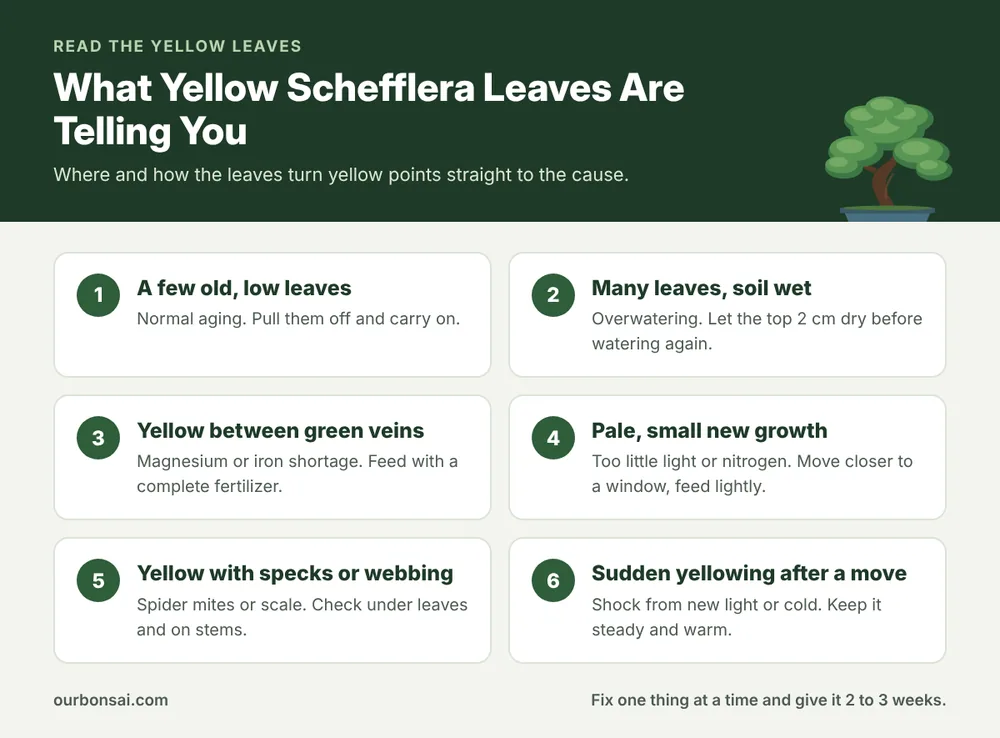
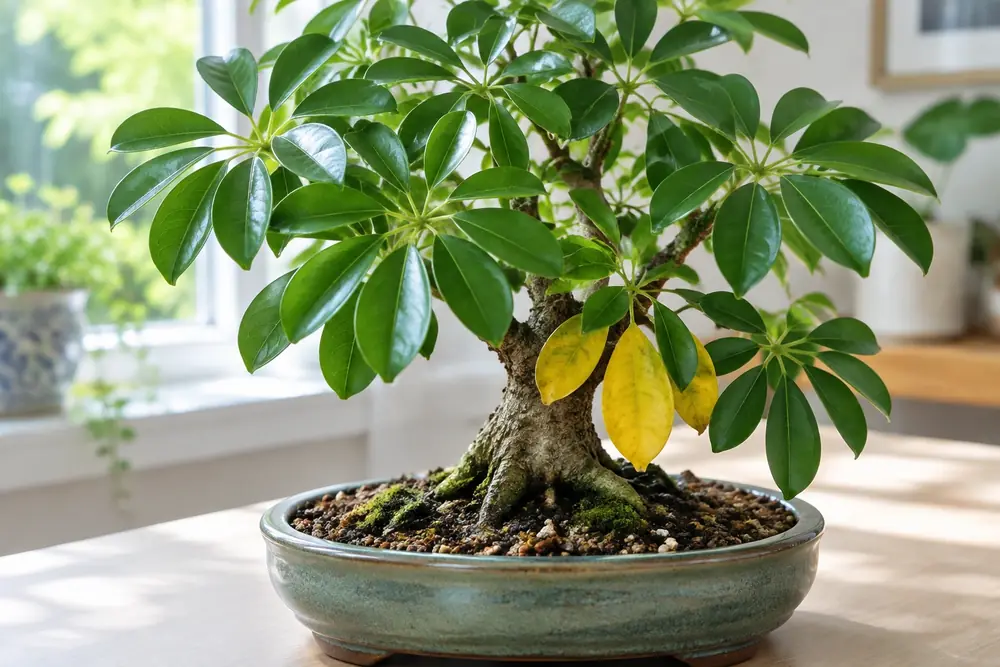
Seeing schefflera bonsai yellow leaves is common, and in most cases it is fixable. A single yellow leaf at the bottom of the tree is just an old leaf being replaced. When many leaves turn yellow at once, the dwarf schefflera is telling you something changed: usually too much water, too little light, a lack of nutrients or a cold draft. The trick is to look at the pattern of the yellowing, because each cause leaves a different signature.
In this guide
This guide walks you through the seven most common reasons, how to tell them apart, and the fix for each one.
Is some yellowing normal?
Yes. The dwarf umbrella tree (Schefflera arboricola) keeps each leaf for a long time, but not forever. Older leaves low on the stems turn yellow and drop as the tree puts its energy into new growth at the tips. If you see one or two yellow leaves every few weeks and the rest of the tree looks glossy and green, there is nothing to fix.
It becomes a problem when yellowing spreads quickly, hits new leaves, or comes with drooping, spots or leaf drop.
The 7 most common causes of yellow leaves on schefflera bonsai
| Cause | What the yellowing looks like | Quick fix |
|---|---|---|
| Overwatering | Many leaves yellow at once, soil stays wet, may droop | Water only when the top 2 cm is dry |
| Underwatering | Yellow then crispy, soil pulls from pot edge | Soak the pot, then water consistently |
| Low light | Pale, thin new leaves, long gaps between them | Brighter window or grow light |
| Nutrient shortage | Yellow between green veins, or overall pale tree | Feed every 2 weeks in growth season |
| Cold or drafts | Sudden yellowing and drop, often near a window | Keep above 15 °C (60 °F) |
| Pests | Yellow speckles, sticky leaves, webbing | Identify and treat the pest |
| Root problems | Yellowing plus slow growth, roots circling or rotting | Repot in spring, trim roots |
1. Overwatering
This is the most common cause indoors. Schefflera likes even moisture but hates soggy soil. When roots sit in water, they lose oxygen, stop absorbing nutrients and the leaves turn yellow, often starting low on the tree. If the soil smells sour, check for root rot in bonsai.
2. Underwatering
Leaves go limp, yellow and then crisp. The soil feels dry and light, and may pull away from the pot sides. Soak the pot in a basin of water for 10 minutes, then water whenever the top 2 cm of soil is dry.
3. Not enough light
Schefflera copes with lower light than most bonsai, but in a dim room it slowly yellows and drops its inner leaves and grows long, floppy stems. Our guide on how much light a bonsai tree needs helps you judge your spot. A grow light for bonsai solves dark winters.
4. Nutrient deficiency
Bonsai soil holds few nutrients, so a tree that is never fed eventually turns pale. Yellowing between green veins is typical of a magnesium or iron shortage. Overall pale, small leaves suggest nitrogen. Chlorosis is the technical name for this kind of yellowing. A balanced liquid feed every two weeks in spring and summer, monthly in winter, prevents it.
5. Cold and drafts
Leaves near a cold window or an outside door can turn yellow within days in winter. Air conditioning in summer can do the same. Move the tree to a stable spot between 15 and 27 °C (60 to 80 °F).
6. Pests
Spider mites leave tiny yellow speckles and fine webbing. Scale insects show up as small brown bumps on stems and leaves, often with sticky honeydew. See our guides to spider mites on bonsai trees and scale on bonsai trees.
7. Root-bound or compacted soil
After two or three years in the same pot, roots fill the space, the soil breaks down and water no longer drains properly. Growth slows and leaves yellow. Repot in spring into fresh, gritty bonsai soil.
How to fix yellow leaves step by step
- Check the soil moisture first. Push a finger 2 cm into the soil. Wet means stop watering. Bone dry means soak it.
- Check the light. If the tree is more than a meter or so from a window, move it closer.
- Look for pests. Turn over several leaves and check the stems with a magnifier.
- Check the temperature. Feel for drafts near the tree, especially at night.
- Feed if needed. If the tree has not been fed for months and everything else is fine, start a regular feeding routine. Our best liquid fertilizer for bonsai picks work well.
- Remove the yellow leaves. Yellow leaves will not turn green again. Pull them off gently so the tree looks tidy and you can see whether new yellowing appears.
- Wait two to three weeks. Change one thing at a time so you know what worked.
Yellow leaves in special situations
After repotting
It is normal for a schefflera to drop a few yellow leaves in the two or three weeks after repotting, because some fine roots were lost. Keep it out of direct sun, water carefully and do not feed for about a month. If yellowing continues after that, check that the new soil drains well.
In winter
Shorter days and dry heating air make winter the main season for yellow schefflera leaves. Water a little less often, since the tree uses less, move it to the brightest window you have and add a humidity tray. Feeding can drop to once a month.
After moving outdoors for summer
Schefflera enjoys a summer outside in warm climates, but direct midday sun after months indoors bleaches and yellows leaves within days. Start in shade and move it into brighter light gradually over two weeks.
On variegated varieties
Some schefflera, such as ‘Gold Capella’ or ‘Trinette’, naturally have yellow or cream patches on their leaves. That is the variety, not a problem. Watch instead for leaves that lose their green parts and go fully yellow, which means the same causes as above.
Preventing yellow leaves on schefflera
- Use free-draining bonsai soil, not dense potting compost.
- Water when the top of the soil is dry, not on a fixed day.
- Give the brightest indirect light you can, with some gentle morning sun.
- Feed regularly while the tree grows.
- Keep it away from heaters, AC units and cold glass.
- Raise humidity with a humidity tray in heated rooms.
For full care details, see our dwarf schefflera bonsai care guide. If the tree is losing leaves fast rather than just yellowing, read why a bonsai loses leaves suddenly.
FAQ: schefflera bonsai yellow leaves
Will yellow schefflera leaves turn green again?
No. Once a leaf has turned yellow, it will not recover. Remove it and focus on keeping the new leaves healthy.
Should I cut off yellow leaves on my schefflera bonsai?
Yes. Pull or snip them off at the leaf stalk. It does not hurt the tree and makes it easier to see if the problem is still active.
Is overwatering or underwatering more likely?
Indoors, overwatering is far more common. Always check the soil before adding more water.
How often should I fertilize a schefflera bonsai?
Every two weeks in spring and summer with a balanced liquid fertilizer, and about once a month in autumn and winter.
Final thoughts
Schefflera bonsai yellow leaves are a message, not a mystery. A few old leaves are normal. Many at once usually means too much water, too little light or a hungry tree. Read the pattern, fix one cause at a time, and your dwarf schefflera will be back to glossy green within a few weeks.