How Often to Water Bald Cypress Bonsai (Indoor & Outdoor)


This post contains affiliate links. As an Amazon Associate, OurBonsai earns from qualifying purchases at no extra cost to you. Read our disclosure.
In this guide
- Why bald cypress bonsai need so much water
- How often to water bald cypress bonsai by season
- The water tray method
- How to tell when your bald cypress needs water
- How to water a bald cypress bonsai properly
- Indoors or outdoors?
- Watering in winter
- Signs of underwatering and overwatering
- Common watering mistakes with bald cypress
- FAQ: how often to water bald cypress bonsai
- Final thoughts
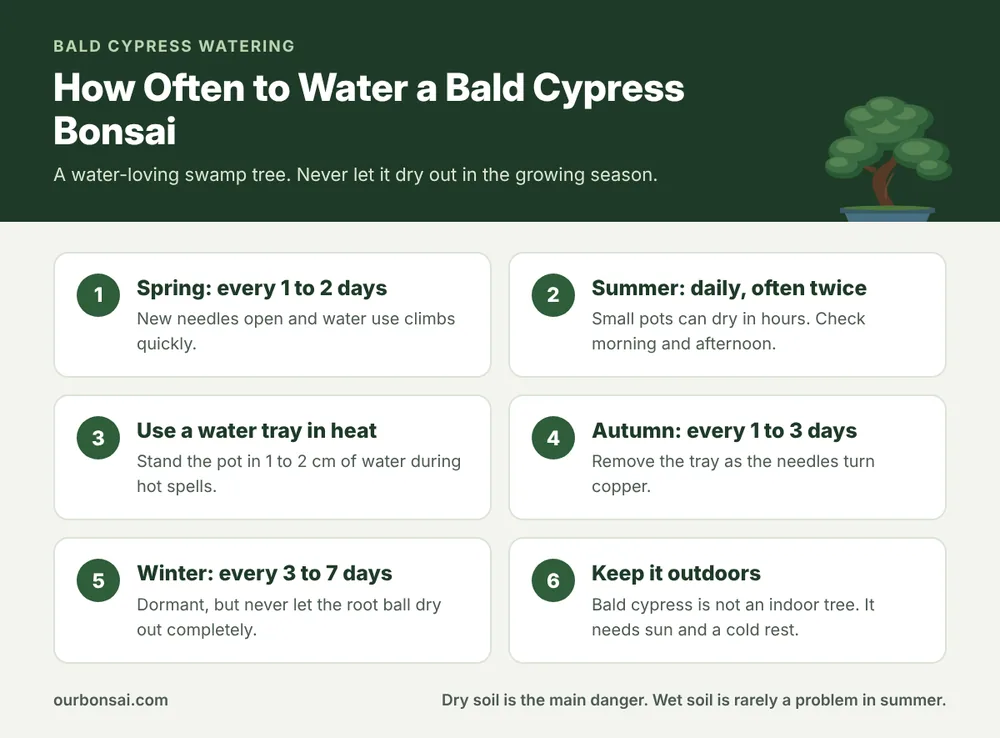
If you are wondering how often to water bald cypress bonsai, the answer is: more often than almost any other bonsai. In the growing season, check it at least once a day and water whenever the top of the soil starts to dry, which in summer usually means daily and often twice a day. Many growers even stand the pot in a shallow tray of water during hot weather. In winter, when the tree is dormant and bare, it needs water much less often, every few days, but the soil should never dry out completely.
Bald cypress (Taxodium distichum) grows naturally in swamps and along rivers in the southeastern United States, often standing in water for months. The Wikipedia article on Taxodium distichum describes how it thrives in flooded ground. As a bonsai, it keeps that love of water. This guide explains how to water it in each season, how to use a water tray safely, and how to recognize the signs of too little or too much water.
Why bald cypress bonsai need so much water
Bald cypress grows fast and carries thousands of soft, needle-like leaves arranged on small deciduous shoots. In summer sun, this foliage loses a lot of water. In a shallow bonsai pot, the small root ball can be emptied in a few hours on a hot day.
Unlike most bonsai, bald cypress roots are adapted to low oxygen. In nature, the tree can live with its roots under water. That means it tolerates wet soil much better than species such as junipers or pines. For most growers, the real risk is not overwatering but letting the tree dry out on a hot afternoon.
How often to water bald cypress bonsai by season
The schedule below is for a tree outdoors in a typical bonsai pot. Always check the soil first, because pot size, soil and weather change everything.
| Season | How often to water | Notes |
|---|---|---|
| Early spring | Every 2 to 3 days | Buds swelling, water use still low |
| Late spring | Every 1 to 2 days | New foliage opens, demand rises fast |
| Summer | Daily, often twice | Consider a water tray during heat |
| Autumn | Every 1 to 3 days | Remove tray as foliage turns copper |
| Winter (dormant) | Every 3 to 7 days | Keep moist, protect roots from hard frost |
The water tray method
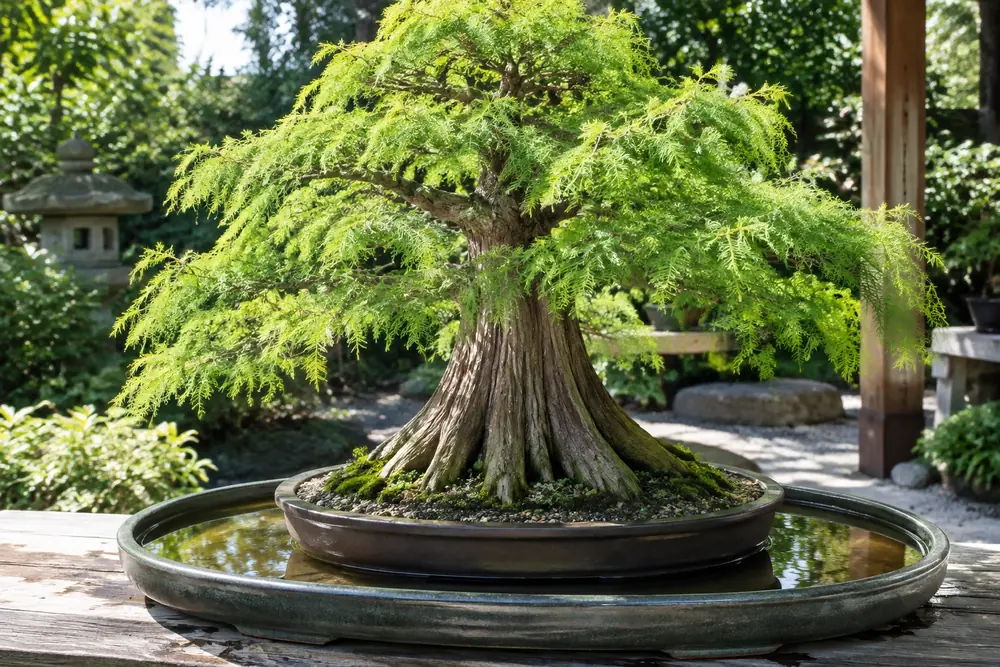
A shallow water tray is the easiest way to keep a bald cypress bonsai happy in summer.
- Choose a tray wider than the pot, at least a few centimeters deep.
- Fill it with about 1 to 2 cm (half an inch) of water.
- Stand the pot in the tray so the bottom of the soil sits in water while the upper soil can still breathe.
- Keep watering from the top as usual. This flushes the soil and adds fresh oxygen.
- Change the water every few days so it stays fresh and mosquitoes cannot breed.
- Remove the tray in autumn, when growth slows and the foliage starts to change color.
Do not use a water tray for a freshly repotted tree until new roots are clearly growing, and never leave the tray in place over winter. Cold, waterlogged soil during dormancy can rot roots even in this species. A simple plant saucer without holes or a shallow plastic tray works well. For other summer techniques, see our guide to watering bonsai in summer.
How to tell when your bald cypress needs water
- Finger test: push a finger about 1 cm into the soil. If it feels just dry, water. If it feels damp, wait.
- Color of the soil: akadama and many bonsai soils turn lighter as they dry. Learn what your soil looks like when wet and dry.
- Pot weight: lift the pot after watering and again later. A light pot needs water.
- Foliage: soft new shoots that droop in the afternoon are a sign of thirst. Water immediately.
A soil moisture meter can help while you learn the rhythm, but with bald cypress in summer, it is safest to simply water every day.
How to water a bald cypress bonsai properly
- Use a watering can with a fine rose, such as a Japanese watering can for bonsai, so you do not wash soil out of the pot.
- Water the whole soil surface until water runs from the drainage holes.
- Wait a minute or two and water again so the soil soaks it up fully.
- In very hot weather, water early in the morning and again in the late afternoon.
- Rain water is ideal, because bald cypress prefers slightly acidic soil. Hard tap water over many years can raise the soil pH and cause yellow foliage.
Indoors or outdoors?
Bald cypress is an outdoor tree. It needs full sun to grow well and a cold winter dormancy to stay healthy. Kept indoors, it weakens quickly, grows long and pale and usually dies within a year or two. So the watering advice in this guide assumes the tree lives outside. Our guide to types of outdoor bonsai trees explains why species like this one need the seasons.
Watering in winter
In autumn, the foliage turns a rusty copper color and the small shoots drop off with their leaves. This is normal. Bald cypress is one of the few deciduous conifers, much like its relative the dawn redwood (see our Brussel’s dawn redwood bonsai review).
During dormancy:
- Keep the tree outside in a sheltered spot, protected from strong wind.
- Protect the roots from hard frost by placing the pot on the ground, mulching around it, or moving it into an unheated shed or garage.
- Water when the soil starts to dry, on mild days, so the water does not freeze immediately.
- Never let the root ball dry out completely, even when the tree is bare.
Signs of underwatering and overwatering
| Sign | Likely cause | What to do |
|---|---|---|
| Soft shoots wilting in the afternoon | Underwatering | Water now, check twice daily in summer |
| Brown, crispy foliage in summer | Root ball dried out | Water thoroughly, use a water tray |
| Yellow foliage in summer, soil fine | Alkaline soil or hard water | Use rain water, repot into akadama |
| Sour smell, black roots in winter | Waterlogged dormant roots | Remove tray, improve drainage |
| Early copper color in midsummer | Drought stress | Increase watering frequency |
For yellowing problems in general, see our guide to bonsai leaves turning yellow or brown.
Common watering mistakes with bald cypress
- Treating it like a juniper. Junipers want to dry slightly between waterings. Bald cypress does not.
- Using a very fast-draining soil. A pumice and lava mix dries too fast. Use an akadama-heavy mix.
- Forgetting the afternoon check. In heat waves, one watering a day is often not enough.
- Leaving the water tray in winter. Cold, wet, dormant roots can rot.
- Bringing it indoors. Low light and warmth in winter weaken the tree.
FAQ: how often to water bald cypress bonsai
Can you overwater a bald cypress bonsai?
In the growing season it is very hard to overwater, because the species tolerates wet roots. In winter dormancy, constantly soggy soil can cause problems.
Should my bald cypress bonsai sit in water?
In summer, a shallow water tray is helpful. Remove it in autumn and winter.
How often should I water a bald cypress bonsai in winter?
Every three to seven days, depending on weather. Keep the soil slightly moist and protect the roots from hard frost.
Why is my bald cypress turning brown in summer?
Usually the soil dried out on a hot day. Water more often and consider a water tray.
Final thoughts
So, how often to water bald cypress bonsai? Every day in the growing season, often twice in summer, with a shallow water tray in hot spells, and every few days in winter. It is one of the few bonsai where too much water is rarely the problem. Keep it outdoors, keep the soil slightly acidic and never let the roots dry out, and it will grow vigorously for decades. For more on soil, see our bonsai soil mix ratio guide.