How to Prune Serissa Bonsai: Step-by-Step Guide

If you want to know how to prune serissa bonsai, the key is timing. Serissa grows quickly and buds back easily, even from older wood, so it handles pruning well. But it flowers on new growth, and pruning at the wrong moment removes the flower buds. The basic method: let new shoots grow four to six pairs of leaves, then cut them back to one or two pairs, ideally right after a flush of flowers. Do structural pruning in early spring, remove crossing and inward branches, and keep the tree warm and steady afterwards.
In this guide
This guide covers timing, tools, the step-by-step method and the aftercare that keeps serissa from sulking.
How serissa grows
Serissa (Serissa japonica), also called snow rose or tree of a thousand stars, is a small evergreen shrub with tiny leaves and small white or pale pink flowers. The Wikipedia page on Serissa notes it is the only species in its genus, native to Southeast Asia. It branches densely and, once established, pushes new shoots constantly through the growing season. That makes it ideal for bonsai, because frequent trimming quickly creates a fine, twiggy canopy.
The catch is that serissa can be touchy. It drops leaves when moved, chilled or dried out, and heavy pruning combined with other stress can set it back. Prune a healthy, stable tree and it responds beautifully.
When to prune serissa bonsai
| Type of pruning | Best time | Notes |
|---|---|---|
| Structural pruning (thick branches) | Early spring | Before the main growth flush, when the tree is strong |
| Maintenance trimming | After each flush of flowers | Keeps shape without losing many buds |
| Light shaping | Spring to early autumn | Whenever shoots have 4 to 6 leaf pairs |
| Avoid | Midwinter indoors, or right after repotting | The tree is weak or recovering |
Serissa can bloom on and off much of the year, with the biggest show usually in late spring and early summer. If you trim constantly, you will have a neat tree but few flowers. Many growers let it bloom, then prune hard right after.
Tools you need
- Small, sharp bonsai scissors. Serissa twigs are thin. Fine-tipped scissors give clean cuts. See our guide to the best bonsai pruning shears for beginners.
- A concave cutter for removing thicker branches flush with the trunk.
- Wound sealant for cuts larger than a few millimeters. Our guide to the best bonsai cut paste alternative has options.
- Tweezers for cleaning out dead leaves and flowers inside the canopy.
You may notice an unpleasant smell when you cut serissa wood or roots. That is normal for this species and not a sign of rot.
How to prune serissa bonsai step by step
Step 1: Check the tree is healthy
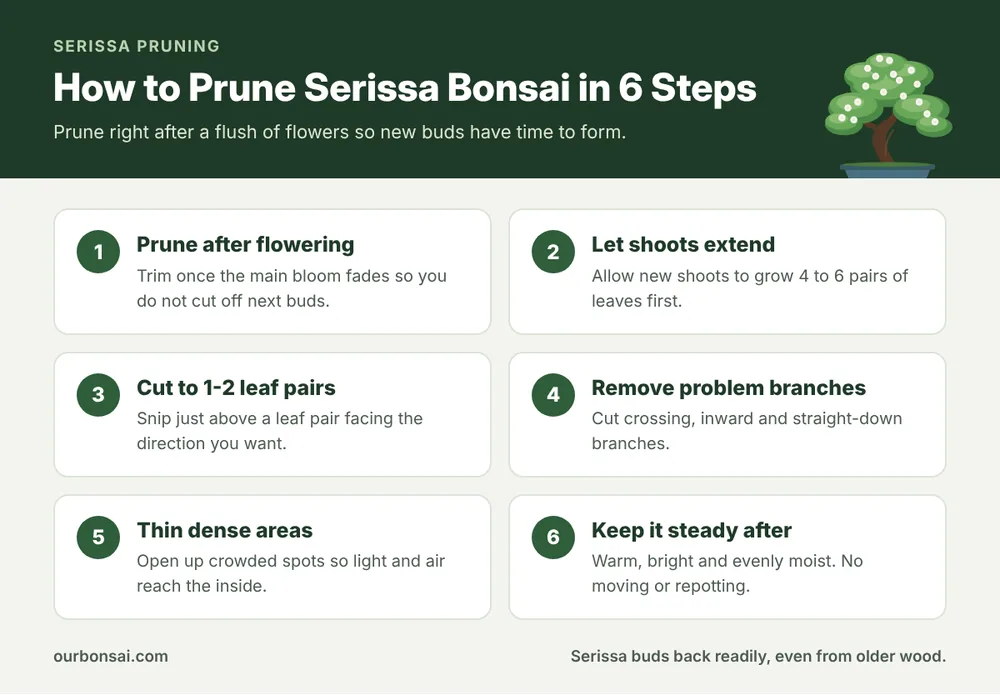
Only prune a serissa that has full, green foliage and is actively growing. If it has recently dropped leaves, been moved or repotted, wait until it has settled for a few weeks.
Step 2: Remove dead and unwanted branches
Start by cutting out dead twigs, then any branches that cross others, grow straight toward the trunk or hang straight down. Remove one of any two branches that grow from the same point.
Step 3: Do structural cuts in early spring
If a branch is far too long or too thick for its position, cut it back in early spring. Serissa buds readily from older wood, so you can cut back to a short stub and expect new shoots. Seal large cuts.
Step 4: Trim new shoots
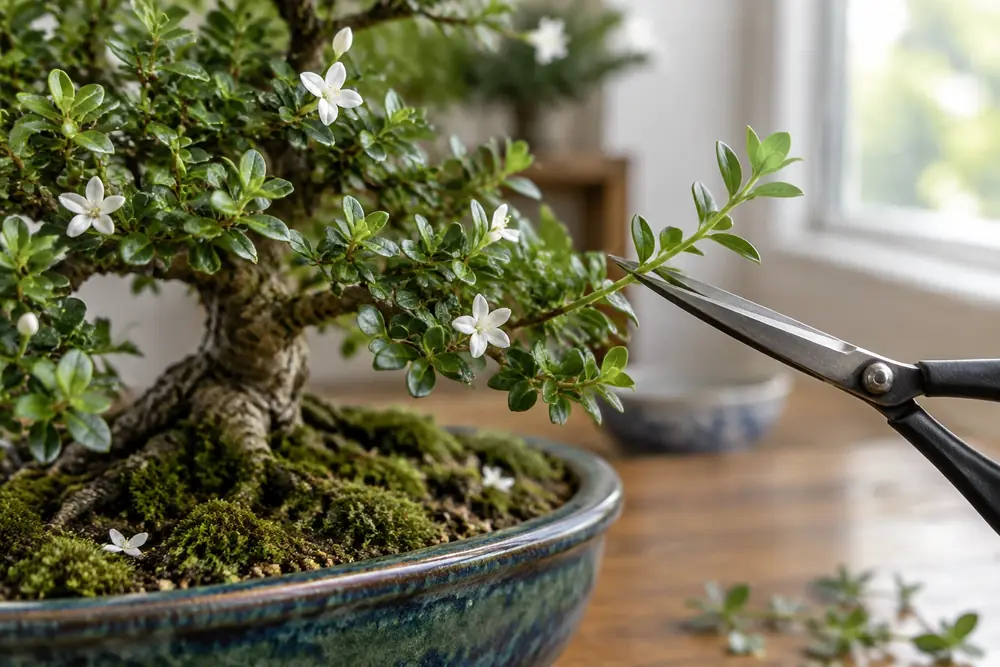
During the growing season, let each new shoot grow four to six pairs of leaves. Then cut it back to one or two pairs. Cut just above a leaf pair whose buds point in the direction you want the next branch to grow. Repeating this builds dense, fine ramification.
Step 5: Thin crowded areas
The outer parts of serissa tend to grow thick and shade the inside. Thin out clusters of shoots so that light and air reach the interior. This keeps inner leaves alive and lowers the risk of pests.
Step 6: Clean up
Pick off spent flowers and dead leaves from the canopy and the soil surface. They can trap moisture and invite fungus.
Aftercare: keeping serissa stable after pruning
- Keep the tree in its usual bright spot. Do not move it.
- Water carefully. A pruned tree with fewer leaves uses less water, so check the soil before watering.
- Keep it warm, above about 15 °C (60 °F), and away from drafts.
- Resume feeding about one to two weeks after a light trim, or once new shoots appear after a hard prune.
For watering basics, our guide to watering indoor bonsai in winter is useful in cooler months. If leaves start to yellow after pruning, see our guide to serissa bonsai yellow leaves.
Pruning to encourage more flowers
Serissa flowers at the tips of new growth. To get more flowers:
- Let the tree grow freely for a few weeks in spring before the main bloom.
- Prune right after flowering rather than just before.
- Feed regularly with a balanced or slightly phosphorus-rich fertilizer in spring and summer.
- Give it as much bright light as possible. Our guide on how much light a bonsai tree needs helps.
Wiring and pruning together
Serissa branches are thin and can be wired easily, but the bark marks quickly. Wire lightly and check every two weeks. Many growers prefer the “clip and grow” method on serissa, shaping the tree mostly with scissors, because it responds so well to pruning.
Common mistakes when pruning serissa
- Pruning right before flowering. You lose the flower buds.
- Pruning a stressed tree. Wait until a leaf-dropping serissa recovers.
- Pruning and repotting at the same time. Too much stress for a sensitive species.
- Leaving long shoots too long. Shoots that grow unchecked thicken and create long, bare sections.
- Moving the tree to a new spot for pruning and leaving it there. Serissa dislikes changes in position.
For other flowering indoor trees and their pruning needs, see our list of the best flowering indoor bonsai trees and our guide on when to start pruning bonsai.
FAQ: how to prune serissa bonsai
How often should I prune my serissa bonsai?
Trim new shoots whenever they reach four to six leaf pairs during the growing season, usually every few weeks. Do structural pruning once a year in early spring.
Can I cut serissa back hard?
Yes, a healthy serissa buds back from older wood. Do hard pruning in early spring and avoid it on a weak or recently moved tree.
Will pruning stop my serissa from flowering?
Constant trimming reduces flowers because blooms form on new growth. Prune right after a flush of flowers to get both shape and blooms.
Why does my serissa smell when I cut it?
Serissa wood and roots release an unpleasant smell when cut. It is normal and harmless.
Should I prune the roots when I prune the branches?
Not at the same time. Root pruning belongs to spring repotting, every two to three years. Give the tree several weeks between a repot and any heavy branch pruning.
Final thoughts
Learning how to prune serissa bonsai is mostly about timing and restraint. Let shoots grow, then cut them back to one or two leaf pairs, ideally after flowering. Do the big cuts in spring, thin the canopy to let light in, and keep the tree warm and steady afterwards. Do that, and your serissa will grow dense, fine branches and cover itself in tiny white stars.