Tap Water vs Rain Water Bonsai Guide: Which Is Better?

This post contains affiliate links. As an Amazon Associate, OurBonsai earns from qualifying purchases at no extra cost to you. Read our disclosure.
In this guide
- Tap water vs rain water for bonsai at a glance
- What hard water does to bonsai
- Which bonsai benefit most from rainwater?
- What about chlorine in tap water?
- Advantages of rainwater
- Disadvantages of rainwater
- How to collect and store rainwater for bonsai
- Mixing tap water and rainwater
- How to reduce the effects of hard tap water
- Is distilled or bottled water better?
- How to find out how hard your tap water is
- Water temperature matters too
- FAQ: tap water vs rain water bonsai
- Final thoughts
The question of tap water vs rain water bonsai growers argue about comes up as soon as you start keeping trees in small pots. The short answer: most bonsai grow perfectly well on ordinary tap water. Rainwater is softer and slightly acidic, which makes it better for a few lime-hating species and for areas with very hard water. Knowing what is in your tap water helps you decide whether switching is worth it.
This guide compares the two, explains what hardness, chlorine and pH mean for your trees, and shows simple ways to collect and use rainwater.
Tap water vs rain water for bonsai at a glance
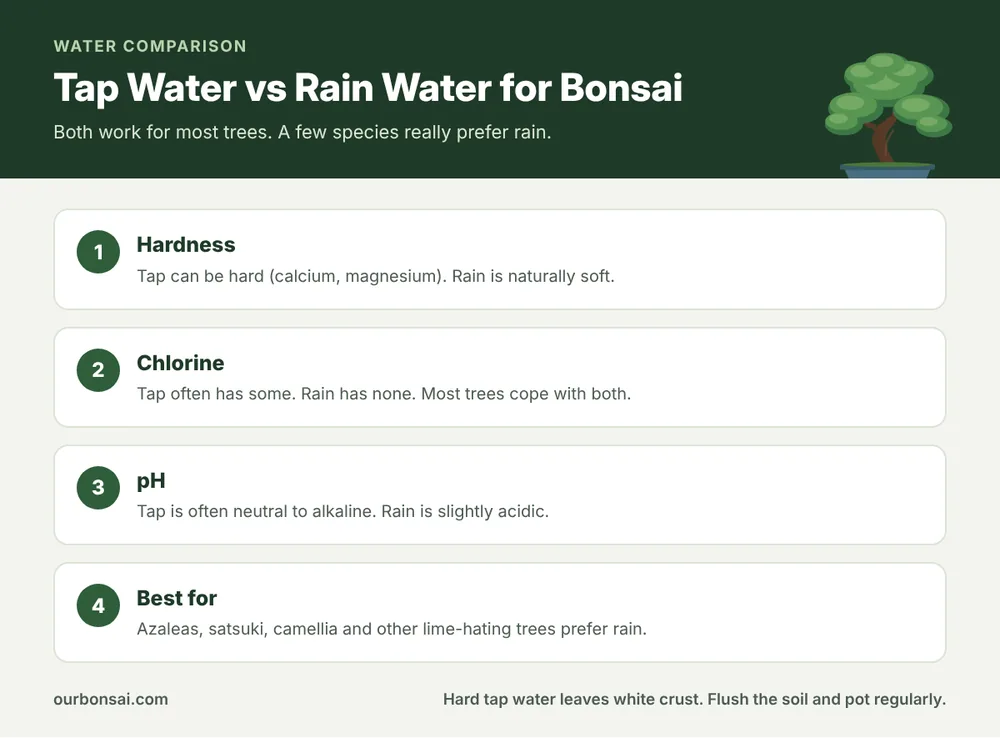
| Factor | Tap water | Rain water |
|---|---|---|
| Hardness (calcium, magnesium) | Soft to very hard, depends on area | Very soft |
| Chlorine / chloramine | Usually present in small amounts | None |
| pH | Often neutral to slightly alkaline | Slightly acidic |
| Dissolved nutrients | Some minerals | A little nitrogen |
| Availability | Always | Depends on weather and storage |
| Cost | Low | Free after setup |
What hard water does to bonsai
Hard water contains dissolved calcium and magnesium. In a garden bed, that is rarely a problem. In a small bonsai pot that is watered every day, the minerals build up:
- White crust forms on the soil surface, the pot and sometimes the trunk.
- Soil pH slowly rises, becoming more alkaline over months.
- Nutrient uptake drops for some elements, especially iron, which can cause yellow leaves with green veins (chlorosis).
Most trees, including junipers, pines, ficus, elms and maples, tolerate moderately hard water without much trouble, especially if they are repotted every few years. Lime-hating trees, however, struggle.
Which bonsai benefit most from rainwater?
- Azaleas and Satsuki need acidic soil and are the classic rainwater trees. Hard water slowly ruins their kanuma soil. See our guide to the best soil for azalea bonsai.
- Camellias, gardenias and other acid-loving shrubs.
- Trident and Japanese maples in very hard water areas, which can develop chlorosis.
- Any tree in kanuma, which is chosen precisely for its acidity. Our kanuma soil review explains why.
What about chlorine in tap water?
Many water suppliers add a small amount of chlorine or chloramine to keep water safe to drink. At these levels, it rarely harms bonsai. Soil, organic matter and the root zone neutralize it quickly.
If you want to reduce it:
- Chlorine evaporates if you leave water standing in an open container for a day.
- Chloramine does not evaporate easily. A simple carbon filter removes most of it.
In practice, most growers water straight from the tap and never see a problem.
Advantages of rainwater
- Naturally soft, so no mineral buildup.
- Slightly acidic, which suits most bonsai soils.
- Free once you have a way to collect it.
- Often at outdoor temperature, so it does not shock roots.
Disadvantages of rainwater
- You need storage, and in dry spells it runs out.
- Water from dirty roofs or near busy roads can carry pollutants.
- Stored water can grow algae or breed mosquitoes if left uncovered.
- Carrying cans from a barrel takes more time than using a hose.
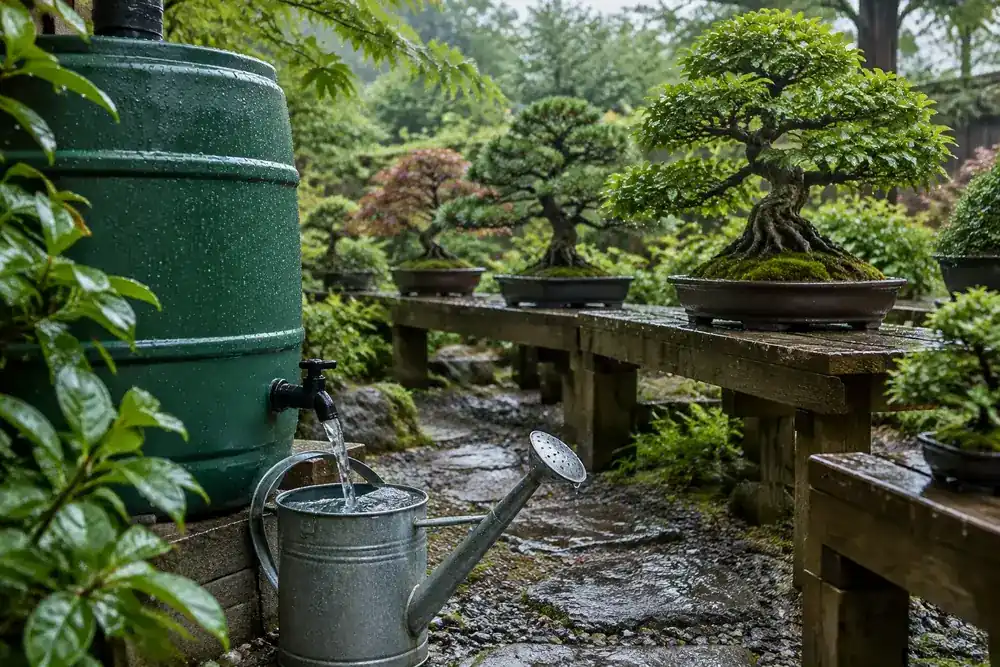
How to collect and store rainwater for bonsai
Rainwater harvesting can be very simple:
- Connect a barrel to a downpipe with a diverter. Many kits are available, such as a rain barrel on Amazon.
- Keep the lid closed to block light (which stops algae) and mosquitoes.
- Let the first rain after a dry spell run off if your roof is dusty.
- Use a fine-rose can to water from the barrel. Our guide to the best Japanese watering can for bonsai covers good choices.
- Clean the barrel once a year.
If you live in an apartment, even a large bucket on a balcony fills quickly in a heavy shower.
Mixing tap water and rainwater
You do not have to choose one or the other. Many growers:
- Use rainwater for azaleas and other acid lovers.
- Use tap water for everything else.
- Switch to tap water during dry spells when the barrel runs out.
Mixing the two also reduces hardness. Even one part rain to one part tap makes a difference.
How to reduce the effects of hard tap water
If rainwater is not practical:
- Flush the soil thoroughly with each watering, so salts do not build up. Water until it runs from the drainage holes.
- Repot regularly into fresh soil to reset the pH.
- Use a fertilizer with trace elements or occasional chelated iron for lime-sensitive trees.
- Wipe white crust off pots with diluted vinegar.
- Consider a filter. Filtered or reverse osmosis water removes most minerals.
Our bonsai care guide covers the basic watering routine, and our tips on watering bonsai in summer explain how to keep up during heat waves.
Is distilled or bottled water better?
Distilled water is pure, with no minerals at all. It works, but it is expensive and unnecessary for most trees, and it contains none of the trace minerals plants use. Bottled mineral water is often harder than tap water. For almost everyone, the real choice is between tap and rain.
How to find out how hard your tap water is
You do not need to guess. Your local water supplier usually publishes a water quality report with hardness and pH values, often on its website. Cheap test strips from aquarium or pool shops give a quick reading too. As a rough guide, water under about 60 mg/L of calcium carbonate is soft, 60 to 120 mg/L is moderately hard, and above 180 mg/L is very hard. If your water is in the very hard range and you grow azaleas or maples, collecting rainwater is well worth the effort. If it is soft, tap water is perfectly fine for every tree in your collection.
Water temperature matters too
Whatever the source, the temperature of the water affects your trees. Very cold water straight from a deep well or an outdoor tap in spring can chill the roots of tropical indoor trees and slow their growth. Water left in a hose in full summer sun can be hot enough to damage roots. Rainwater stored in a barrel is usually close to air temperature, which is one of its quiet advantages. For indoor trees, fill your watering can and let it stand for an hour or so before use, which also lets some chlorine escape. Outdoors, run the hose for a few seconds before pointing it at your trees in hot weather.
FAQ: tap water vs rain water bonsai
Is tap water bad for bonsai?
No. Most bonsai grow well on tap water. Only lime-hating species and very hard water areas really benefit from switching.
Should I let tap water sit before watering bonsai?
It helps if your water has chlorine, as it evaporates within a day. It makes little difference with chloramine. Most growers do not bother.
Is rainwater always better for bonsai?
It is softer and slightly acidic, which suits most trees. But clean tap water is far better than dirty or stagnant rainwater.
Can I use water from a dehumidifier or air conditioner?
It is similar to distilled water and can be used occasionally, but avoid it if the unit has metal parts that might add contaminants.
Final thoughts
In the tap water vs rain water bonsai debate, both sides win. Tap water is convenient and fine for most trees, especially if you flush the soil and repot regularly. Rainwater is softer and slightly acidic, ideal for azaleas, satsuki and other acid lovers, and a good fix for very hard water areas. Many growers simply use both: rain when they have it, tap when they do not.