Trident Maple Bonsai Dropping Leaves: What It Means by Season

This post contains affiliate links. As an Amazon Associate, OurBonsai earns from qualifying purchases at no extra cost to you. Read our disclosure.
In this guide
- Normal leaf drop: autumn dormancy
- Abnormal leaf drop: what is going on?
- Trident maple bonsai dropping leaves: causes by season
- Leaf drop after leaf pruning
- What to do when your trident drops leaves
- Preventing summer leaf drop on tridents
- Why some trident leaves drop and others do not
- Feeding and recovery after leaf drop
- FAQ: trident maple bonsai dropping leaves
- Final thoughts
Trident maple bonsai dropping leaves is one of those things that can be completely normal or a real warning sign, depending on when it happens. Acer buergerianum is deciduous, so it drops every leaf in autumn. But a trident shedding leaves in June is telling you something is wrong. The season, the color of the leaves and what is happening to the buds are your best clues.
This guide explains leaf drop season by season, the most common causes, and what to do to help your tree grow a fresh set of leaves.
Normal leaf drop: autumn dormancy
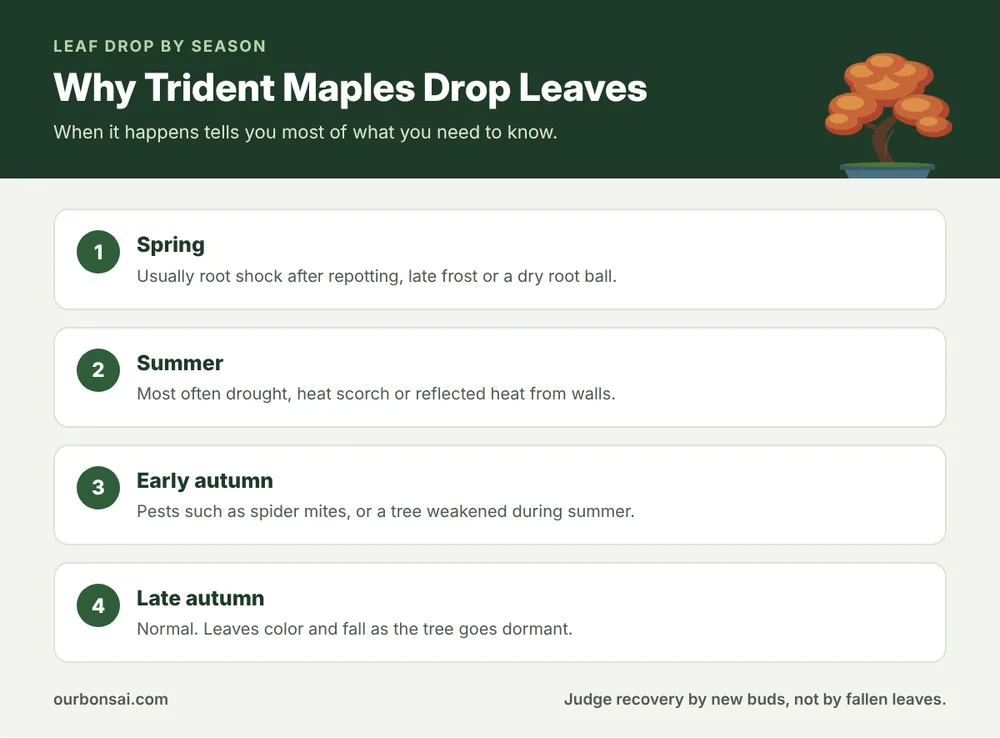
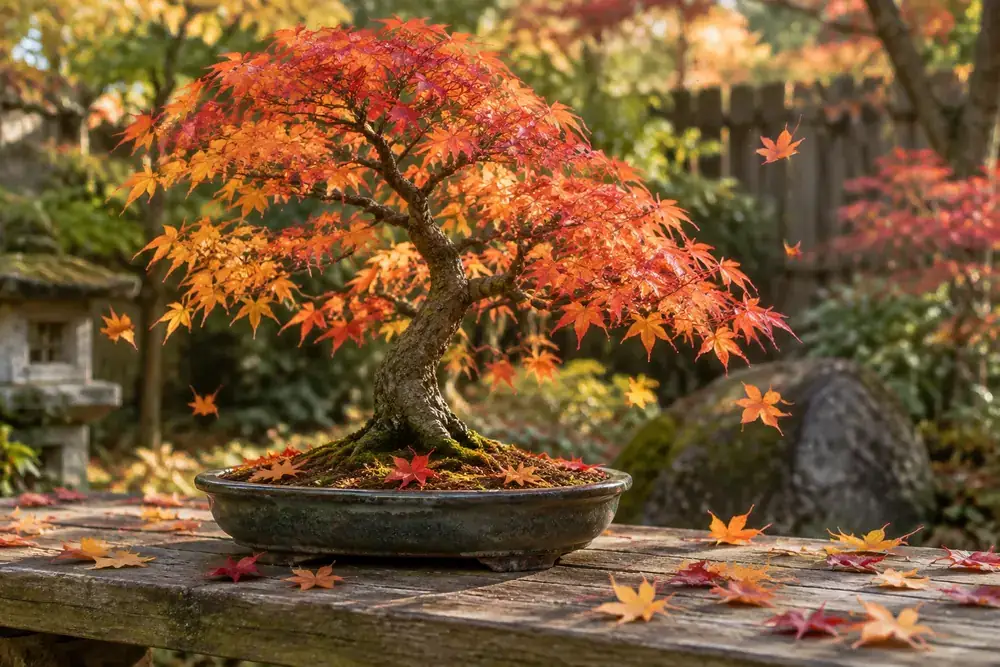
From mid to late autumn, after the first cool nights, trident maples turn yellow, orange and deep red. Over a few weeks the leaves fall, and the tree goes into dormancy for winter. This is healthy and necessary. The tree needs this cold rest to grow strongly in spring.
Signs that autumn leaf drop is normal:
- The whole tree colors fairly evenly.
- It happens after nights turn cool.
- Buds along the branches are firm and plump.
- Twigs are flexible and green under the bark.
Abnormal leaf drop: what is going on?
Outside autumn, leaf drop means the tree is shedding leaves it cannot support. Plants do this through a process called abscission: they seal off and drop leaves to save water and energy when under stress.
| When | What you see | Likely cause |
|---|---|---|
| Spring, after repotting | New leaves wilt and drop | Root loss, transplant shock |
| Spring, after cold night | Soft new leaves blacken and drop | Late frost |
| Summer | Brown crispy edges, then drop | Drought or heat scorch |
| Summer | Yellow leaves, wet soil | Overwatering or root rot |
| Late summer | Speckled, dull leaves fall | Spider mites |
| Any time | Sudden drop of green leaves | Root ball dried out completely |
Trident maple bonsai dropping leaves: causes by season
Spring
Root shock after repotting. Trident maples are often root pruned hard. If repotting happened late, after the leaves opened, or if a lot of roots were removed, the new leaves may wilt and drop. Keep the tree in bright shade, out of wind, and water carefully. New buds usually follow within a few weeks.
Late frost. Fresh trident leaves are soft. A frost after bud break can blacken them overnight. The tree usually pushes a second set of buds. Protect trees on frosty spring nights.
Summer
Drought. The most common cause by far. A root-bound trident in a small pot can dry out in hours on a hot day. Leaves scorch at the edges, then fall. Check twice a day in hot weather. Our guide to watering bonsai in summer helps.
Heat and reflected sun. Trees placed against hot walls or on paving get extra heat from below and behind. Move them to a spot with afternoon shade.
Overwatering. Less common with tridents, but old, compacted soil can stay soggy. Yellow leaves and a sour smell suggest root problems; see our guide to bonsai root rot.
Early autumn
Pests. Spider mites build up in hot, dry late summer and can strip a tree early. Look for fine speckling and webbing under the leaves. Our guide to spider mites on bonsai trees explains how to treat them.
A tree weakened in summer may simply color and drop earlier than usual.
Leaf drop after leaf pruning
Leaf pruning, where you cut off some or all leaves in early summer, is a common trident technique. After it, a few remaining leaves may yellow and drop. That is normal. If the tree does not push new buds within three to four weeks after full defoliation, it may have been too weak for the technique. Learn more about timing in our guide on when to prune deciduous bonsai.
What to do when your trident drops leaves
- Check the soil right away. Bone dry? Soak the pot for ten minutes in a bowl of water. Soggy? Tip out excess water and improve drainage.
- Scratch-test a few twigs. Green under the bark means the branches are alive.
- Move to bright shade for a couple of weeks if the cause was heat, drought or root work.
- Look for pests under the leaves and on shoot tips.
- Hold back on fertilizer and pruning until new buds appear.
- Be patient. Trident maples are strong. Most push new leaves within two to five weeks if the roots are alive.
For a wider view of leaf drop across all species, our guide on why bonsai lose leaves suddenly is a good next read.
Preventing summer leaf drop on tridents
- Repot before the tree becomes completely root-bound.
- Use free-draining soil that still holds water, such as an akadama mix.
- Water thoroughly every time, and check twice daily in heat waves.
- Give afternoon shade in hot climates.
- Consider an automatic watering system for bonsai if you are away during the day.
- Set the pot on a gravel tray or shade cloth bench to keep roots cooler.
A shade cloth for plants rated around 30 to 40 percent is a simple way to protect tridents during the hottest weeks.
Why some trident leaves drop and others do not
It is common for a trident to drop leaves only on one side or only on the inner branches. Leaves on the sunniest, most exposed side scorch first in drought and heat. Inner leaves that get very little light yellow and drop because the tree no longer finds them useful. Leaves on a single branch dropping in midsummer, while the rest of the tree is fine, can point to damage on that branch, such as old wire biting in, a split, or a disease such as verticillium wilt that affects maples. Follow that branch back to the trunk and look for wounds, dark streaks or dead bark. Patterns like these help you find the cause much faster than looking at the fallen leaves alone.
Feeding and recovery after leaf drop
Once new buds appear, the tree needs energy to rebuild its canopy. Start feeding at half strength when the first new leaves have opened, then return to your normal routine over a few weeks. Do not cut back the new shoots straight away; let them extend and harden so they can feed the roots. If the drop happened in late summer, the tree may not push a full new set before autumn. That is fine. Keep it healthy through autumn, protect the roots in winter, and it will leaf out normally next spring.
FAQ: trident maple bonsai dropping leaves
Is it normal for my trident maple to lose all its leaves?
In autumn, yes. Outside autumn, it is a sign of stress, most often drought, root problems or heat.
Will my trident maple grow new leaves after dropping them in summer?
Usually yes, if the roots and branches are alive. Keep the soil evenly moist and the tree in bright shade, and new buds often appear within a few weeks.
Should I bring my trident maple inside when it drops leaves in autumn?
No. It needs a cold winter rest outdoors. Protect the roots from hard freezes, but keep it outside.
Why are only the inner leaves dropping?
Inner leaves that get little light naturally yellow and fall. Thin the outer canopy to let light in.
Final thoughts
Trident maple bonsai dropping leaves in autumn is part of the tree’s natural cycle. In spring and summer, it is a signal to check the roots, the watering and the position. Find the cause, reduce the stress and give the tree time; tridents recover remarkably well. If you are thinking about a new tree, our Brussel’s trident maple bonsai review is worth a look.