How to Prune Japanese Black Pine Bonsai: Step-by-Step Guide

This post contains affiliate links. As an Amazon Associate, OurBonsai earns from qualifying purchases at no extra cost to you. Read our disclosure.
In this guide
Learning how to prune japanese black pine bonsai is different from pruning almost any other tree, because black pine (Pinus thunbergii) is pruned on a yearly cycle rather than with regular trims. The core technique is decandling: in early summer, once the spring shoots (called candles) have extended, you cut them off completely. The tree responds with a second, weaker flush of shoots with much shorter needles, which is how growers keep a black pine compact and in scale. In autumn, you thin those new buds and pluck old needles to balance the tree and let light inside.
This guide covers the full yearly pruning cycle, step by step, plus structural pruning and the mistakes to avoid. It applies to healthy, established trees; young trees still being grown thicker need a different approach.
Why black pine needs a special pruning method
Black pines grow one strong flush of shoots each spring. Left alone, those candles produce long needles, often 8 to 12 cm, and long internodes, which quickly make a bonsai look coarse. If you simply pinch the candles, as you might on a white pine, black pine does not back-bud well. Decandling works because Japanese black pine is a vigorous, “multi-flush” type of pine that will reliably push a second set of buds after its first shoots are removed. The Wikipedia page on Pinus thunbergii describes its vigorous coastal growth, which is exactly what makes this technique possible.
Decandling only works on a strong tree. A weak tree may not produce a second flush, and can be badly set back.
The yearly pruning cycle
| Time of year | Task | Goal |
|---|---|---|
| Spring | Let candles extend, feed well | Build strength |
| Early summer (June) | Decandle | Shorter needles, more buds |
| Late summer (August) | Reduce new shoots to pairs | Even, balanced growth |
| Autumn (October to November) | Pluck old needles, thin strong areas | Light inside, balance |
| Late autumn to winter | Structural cuts, wiring | Shape the tree |
Timing shifts with your climate. In warmer regions, decandle a little later; in colder regions, a little earlier, so the second flush has time to mature before autumn.
How to prune japanese black pine bonsai step by step
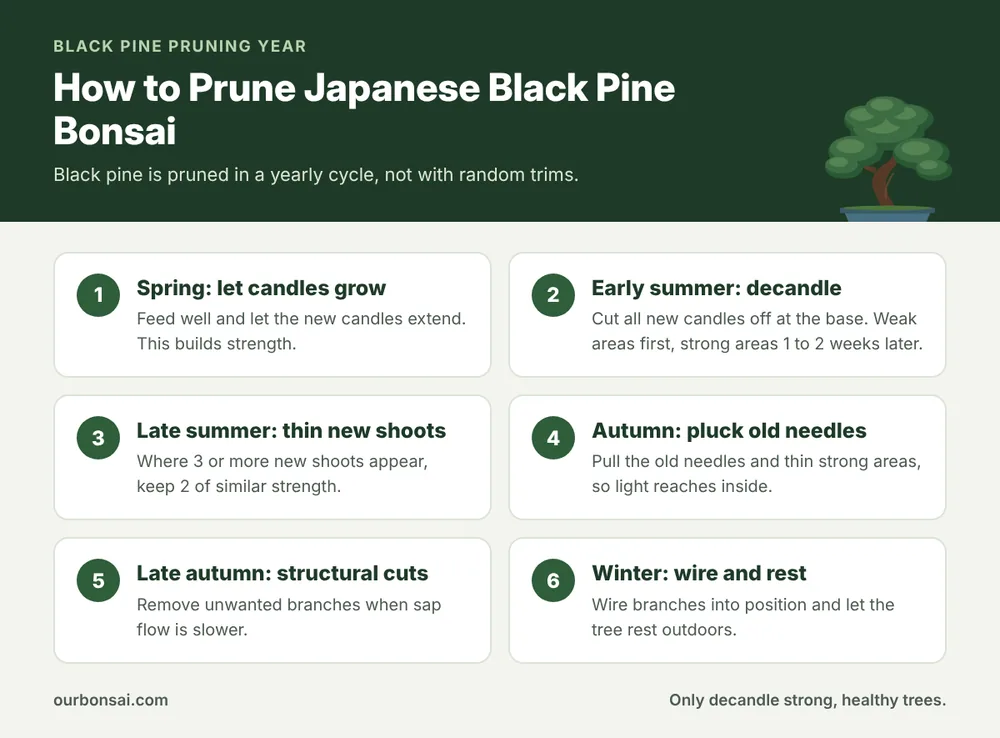
Step 1: Spring, let the candles grow
Feed the tree well in spring and let the candles extend fully. This growth recharges the tree and thickens branches. Do not pinch or cut yet.
Step 2: Early summer, decandle
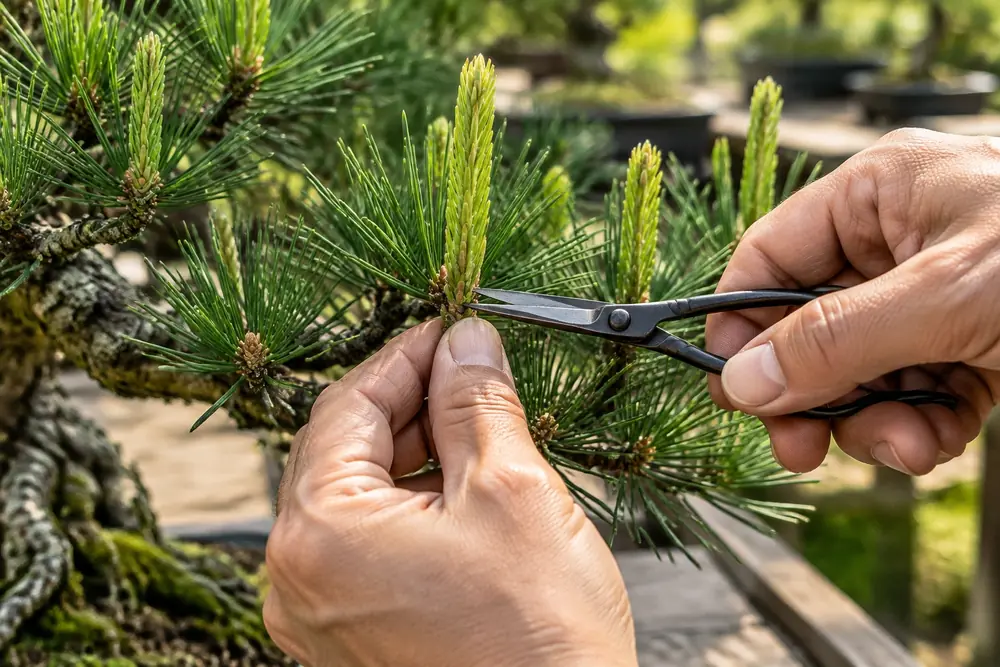
When the new needles on the candles are starting to separate and harden (usually in June in the Northern Hemisphere), cut every new candle off at its base with sharp scissors, leaving a tiny stub. Some growers decandle the weakest areas, usually the lower and inner branches, first, and the strongest areas, usually the top and outer tips, a week or two later. Waiting on the strong areas gives them less time to regrow, which balances vigor across the tree.
Water normally, but stop or reduce feeding for a few weeks after decandling.
Step 3: Late summer, reduce the new shoots
Within a few weeks, clusters of new buds appear at the cut stubs. By late summer, where three or more shoots have grown from one point, remove the extras and keep two of similar strength, pointing sideways rather than straight up or down.
Step 4: Autumn, pluck old needles and thin
In autumn, pull out the older needles from the previous years, especially on the strong top and outer areas, and leave more needles on the weaker inner branches. On the strongest shoots, leave about 6 to 8 pairs of needles; on weaker shoots, leave more. This balances energy and lets light reach the inner buds. Pull needles gently downward, or cut them, leaving a tiny bit of sheath.
Step 5: Late autumn, structural pruning
Once the tree has slowed down, remove unwanted branches: those that cross, grow straight up or down, or come off the trunk at the same height as another (bar branches). Pine sap flow is lower at this time, so cuts bleed less resin. Leave short stubs on larger cuts; pines can die back slightly behind a cut, and the stub can be cleaned up later or carved into a small deadwood feature (jin).
Step 6: Winter, wire and rest
Winter is a good time to wire black pine, since the branches are visible and the tree is dormant. Use annealed copper or thick aluminum wire; our bonsai wire guide covers sizes. Then let the tree rest outdoors; black pine needs a cold winter.
Pruning a young black pine still in development
Everything above applies to established trees whose trunk and main branches are already set. A young black pine that you are still growing thicker needs almost the opposite: plenty of unrestricted growth. Let it grow freely for several years in a large pot or the ground, with “sacrifice branches” left long to thicken the trunk. Only prune to remove branches you know you will never use, and to keep a few low branches close to the trunk. Decandling a young tree slows its development, so wait until the trunk has the thickness you want. Our guide to when to start pruning bonsai explains how to judge when a tree is ready for refinement.
Tools you need
- Sharp, fine bonsai scissors for candles and shoots.
- Tweezers for plucking needles in tight spots.
- A concave or knob cutter for branches. Our guide to the best Japanese bonsai tool kit covers sets that include all three, or browse bonsai tweezers and scissors.
Common black pine pruning mistakes
- Decandling a weak tree. It may not re-bud. Build strength for a season first.
- Decandling too late. The second flush will not harden before winter.
- Pinching candles like a white pine. Black pine responds poorly.
- Cutting branches flush in spring. Expect heavy resin and die-back. Leave stubs and do it in late autumn.
- Removing too many needles from weak areas, starving them further.
- Keeping the tree indoors. Black pine needs full sun and a cold winter outdoors.
The right soil supports all of this growth; see our guide to the best soil for Japanese black pine bonsai.
FAQ: how to prune japanese black pine bonsai
When should you decandle a Japanese black pine?
In early summer, usually June in the Northern Hemisphere, once the spring candles have extended and the new needles start to separate.
Can I decandle every year?
On a strong, refined tree, yes. On a tree still developing or recovering, skip a year.
What happens if I never decandle my black pine?
The tree grows longer needles and coarser branches, but it will stay healthy. Decandling is a refinement technique.
How many needles should I leave when plucking?
Roughly 6 to 8 pairs on strong shoots and more on weak shoots, so energy is balanced across the tree.
Final thoughts
Now you know how to prune japanese black pine bonsai: let candles grow in spring, decandle in early summer, reduce the new shoots to pairs, pluck old needles in autumn and save structural cuts for late autumn. Follow this cycle on a strong tree and you will get shorter needles, better ramification and a more mature-looking pine each year. For general evergreen care, see our guide to types of evergreen bonsai trees.