Fukien Tea Bonsai Yellow Leaves: Why They Turn and How to Fix It


This post contains affiliate links. As an Amazon Associate, OurBonsai earns from qualifying purchases at no extra cost to you. Read our disclosure.
In this guide
Fukien tea bonsai yellow leaves are a common sight, and the cause is usually one of a handful of care issues: watering, light, nutrition or pests. Fukien tea (Carmona microphylla) is a sensitive indoor tree, and its small glossy leaves react quickly when something is off. Before you change anything, look closely at the pattern: are old leaves deep inside yellowing, or new ones at the tips? Is the yellow even, between the veins, or in fine speckles? Each pattern points to a different cause.
This guide explains how to read the yellowing, the six most common causes, and how to fix each one.
When yellow leaves are normal
Fukien tea is evergreen, but it does shed older leaves now and then. A few yellow leaves deep in the canopy, where they get little light, are nothing to worry about, especially if the tree is producing healthy new shoots. It is a problem when many leaves yellow at once, when new growth is yellow, or when yellowing comes with leaf drop or spots.
6 causes of Fukien tea bonsai yellow leaves
1. Overwatering
Fukien tea likes evenly moist soil, but not wet soil. If the soil stays soggy for days, the fine roots begin to suffocate and rot. Leaves turn yellow, slowly at first, then drop. The soil may smell sour or grow green algae.
Fix: let the surface dry before watering again, empty the drip tray, and check the roots if the soil stays wet for days. Repot into a free-draining mix at the next chance; our list of the top 10 best soil for Fukien tea bonsai has good options. Our guide to root rot in bonsai explains how to deal with damaged roots.
2. Drying out
The opposite problem. A Fukien tea in a small pot can dry out in a day in a warm room. Leaves yellow and often drop quickly, sometimes while still partly green. Leaf tips may brown.
Fix: check the soil every day and water as soon as the surface starts to dry. A humidity tray slows drying of the leaves in heated rooms.
3. Hard water and nutrient shortage
This one is often overlooked. Fukien tea prefers slightly acidic conditions. In areas with hard, alkaline tap water, lime builds up in the soil over time and locks up iron. New leaves come out pale yellow with darker green veins, a pattern called chlorosis. A tree that has not been fed for months can also turn pale all over.
Fix: use rain water or filtered water when you can, feed every two weeks in the growing season with a balanced fertilizer, and consider a fertilizer that includes chelated iron. Our guide to the best fertilizer for Fukien tea bonsai has suitable picks, or browse bonsai fertilizer with iron.
4. Not enough light
Indoors, especially in winter, light can be far too weak for Fukien tea. The tree yellows and drops leaves it cannot feed, starting with those inside the canopy. New shoots are long and pale and it stops flowering.
Fix: move it to a bright window with some direct morning or evening sun, or add a grow light for 12 hours a day. Our guide to how much light a bonsai tree needs gives practical guidance.
5. Spider mites and other pests
Spider mites thrive in warm, dry indoor air. They cause fine yellow or pale speckles on leaves, and you may see delicate webbing under leaves and between twigs. Whiteflies and scale can also cause yellowing.
Fix: rinse the foliage gently with lukewarm water, then treat weekly with insecticidal soap until clear. Raise humidity, since mites hate moist air. Our guide to spider mites on bonsai trees has more detail.
6. Stress after a change
Fukien tea is notorious for reacting to change. A move to a new room, a cold draft, repotting or a heavy prune can all cause a wave of yellow leaves that drop within days.
Fix: keep the tree in one bright, stable spot at 60 to 75°F (15 to 24°C), away from vents and doors, and avoid making several changes at once.
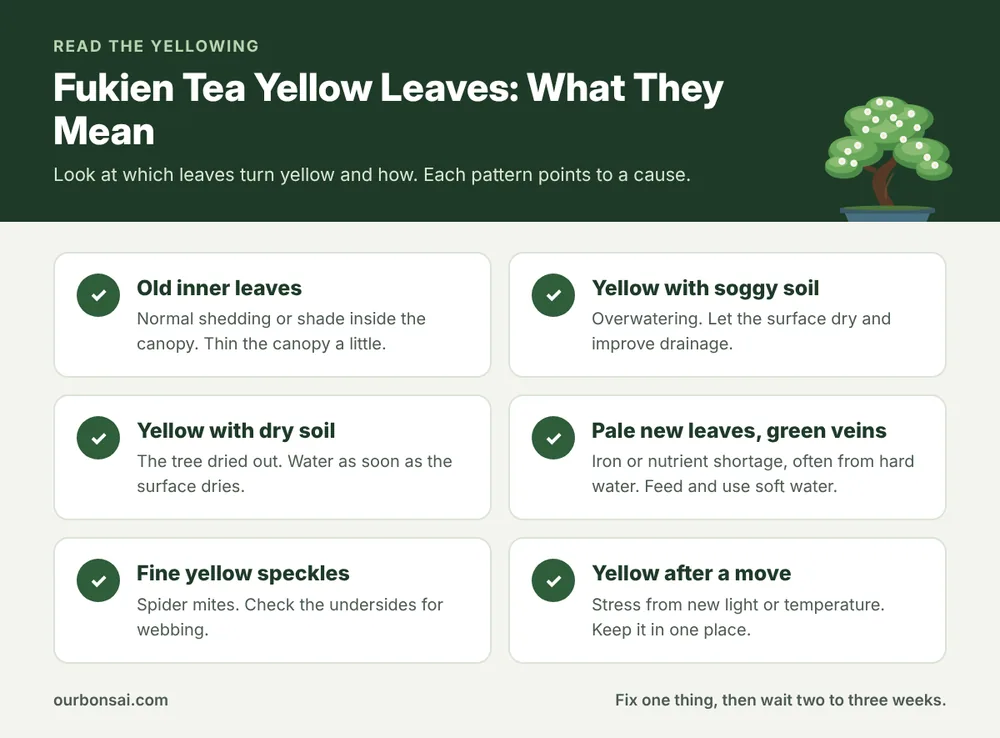
Quick diagnosis
| What you see | Most likely cause |
|---|---|
| A few old inner leaves yellow | Normal shedding |
| Many leaves yellow, soil soggy | Overwatering |
| Leaves yellow and drop fast, soil dry | Drying out |
| Pale new leaves with green veins | Hard water, iron or nutrient shortage |
| Fine yellow speckles, webbing | Spider mites |
| Sudden yellowing after a move | Stress |
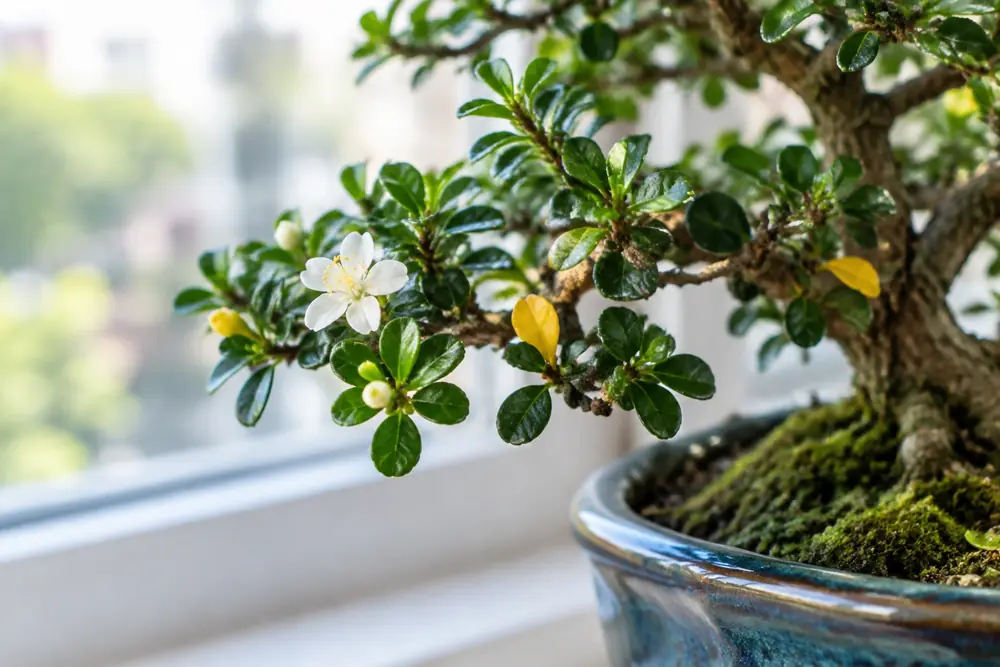
Yellow leaves in winter
Most Fukien tea owners see the worst yellowing between November and February. Three things combine: shorter, darker days, dry air from heating, and cold window glass at night. The tree cannot support as many leaves in weak light, so it sheds the oldest and most shaded ones first. Meanwhile, because it grows more slowly, it uses less water, and soil that dried in a day in summer may stay damp for two or three days.
To get through winter with fewer yellow leaves, move the tree to the brightest window, pull it slightly back from the glass at night, add a grow light if you can, keep a humidity tray under it, and check the soil before every watering rather than watering on a summer routine.
Should I remove yellow leaves?
Yes, once they are fully yellow. They will not turn green again, and removing them improves air flow and makes it easier to see new problems. Pinch or snip them off at the stalk. Leave partly yellow leaves for now.
How to prevent yellow leaves on Fukien tea
- Check the soil every day and water as soon as the surface starts to dry.
- Use a free-draining soil and empty the drip tray.
- Give it bright light, adding a grow light in winter if needed.
- Use soft water when possible, especially in hard water areas.
- Feed regularly during the growing season.
- Keep humidity up with a pebble tray.
- Inspect leaf undersides weekly for mites.
- Keep its spot stable and avoid sudden changes.
The Wikipedia page on Ehretia microphylla describes its warm, humid native habitat, and copying those conditions indoors goes a long way toward keeping the leaves green.
FAQ: fukien tea bonsai yellow leaves
Why are the leaves on my Fukien tea turning yellow and falling off?
Usually inconsistent watering or a sudden change in conditions. Check the soil daily and keep the tree in one stable, bright spot.
Do the white dots on Fukien tea leaves mean disease?
No. Tiny white dots on the upper surface are natural hairs, a normal feature of the species.
Can hard tap water cause yellow leaves?
Yes, over time. Lime in hard water can make iron unavailable, causing pale new leaves with green veins.
How long until new green leaves appear?
Once the cause is fixed, new healthy growth usually appears within three to five weeks.
Final thoughts
Fukien tea bonsai yellow leaves are the tree’s way of telling you something changed. Read the pattern, check the soil, look under the leaves, and fix the one thing that is wrong. With consistent water, bright light and a stable spot, this lovely flowering tree stays deep green. For more on shaping it once it is healthy, see our Fukien tea bonsai styles.