Bonsai Aftercare: What to Do After Repotting, Pruning and Wiring

This post contains affiliate links. As an Amazon Associate, OurBonsai earns from qualifying purchases at no extra cost to you. Read our disclosure.
In this guide
- Why aftercare matters
- General bonsai aftercare rules
- Aftercare after repotting
- Aftercare after heavy pruning
- Aftercare after wiring
- Aftercare after leaf pruning or defoliation
- Aftercare for a new bonsai you just bought
- Aftercare for collected or newly dug trees
- How to know recovery is going well
- Useful aftercare tools
- Aftercare by season
- Common bonsai aftercare mistakes
- FAQ: bonsai aftercare
- Final thoughts
Bonsai aftercare is the part of bonsai that gets talked about least, yet it often decides whether a tree thrives or struggles. Repotting, heavy pruning, wiring, leaf pruning and even bringing a new tree home all stress a bonsai. What you do in the following days and weeks determines how quickly it recovers and how strongly it grows afterward.
This guide covers aftercare for each of the common jobs, plus general rules that apply to every stressed tree.
Why aftercare matters
A bonsai lives on a tight budget. It has a small root system in a small pot. Every time you cut roots, remove branches or leaves, or bend branches, you reduce its ability to take up water or make food. Good aftercare lowers the demands on the tree until it has rebuilt what it lost.
The basic idea is the same as transplant shock in garden plants: reduce water loss, keep the roots evenly moist and give the tree time.
General bonsai aftercare rules
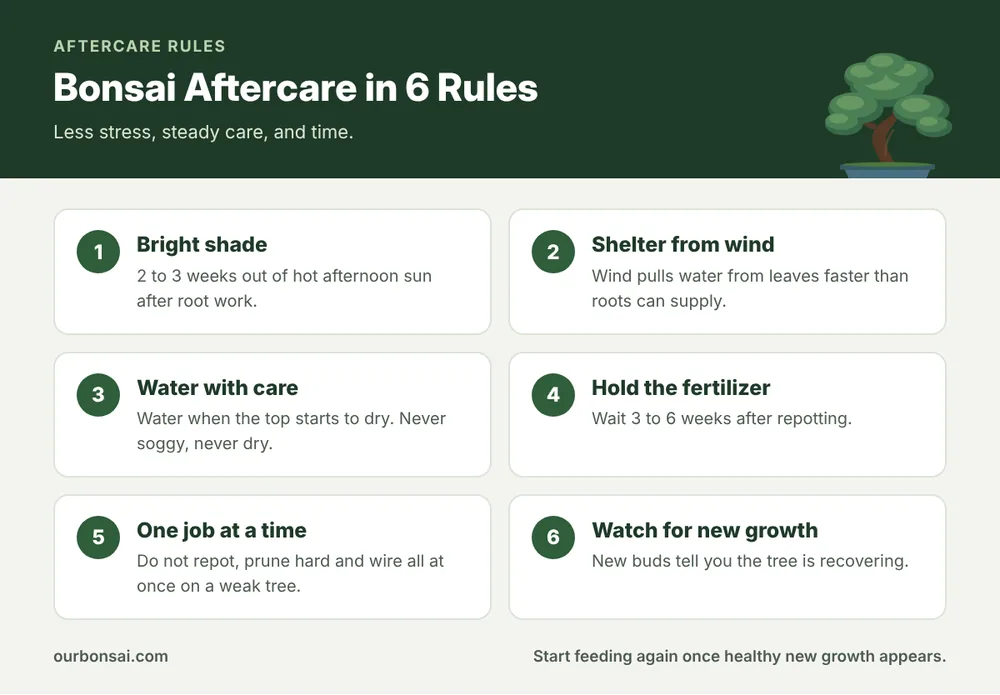
These apply after almost any major job. Then adjust for the specific work you did, below.
Aftercare after repotting
Repotting is the most stressful job for a bonsai because it removes roots.
- Water thoroughly right after repotting until the water runs clear from the drainage holes.
- Keep the tree in bright shade for two to three weeks. Morning sun is fine for most outdoor trees.
- Protect it from wind and frost. In early spring, a cold frame or sheltered corner is ideal. Our guide on repotting bonsai in autumn covers aftercare for autumn repots in cooler weather.
- Make sure it is tied in firmly. A tree that rocks in its pot keeps tearing new roots. Use bonsai wire through the drainage holes.
- Do not fertilize for three to six weeks. Then start at half strength.
- Watch watering closely. Fresh bonsai soil drains fast, but fewer roots mean slower uptake. Check daily.
For tropical trees, wait to repot until it is warm. Our guide on the best time to repot tropical bonsai explains timing.
Aftercare after heavy pruning
- Seal large cuts with cut paste, especially on maples and other smooth-barked trees. Our guide to a bonsai cut paste alternative lists options.
- Water a little less at first, since fewer leaves use less water. Check the soil before each watering.
- Keep feeding during the growing season if the roots were not disturbed. The tree needs energy to push new buds.
- Give good light so dormant buds on old wood are encouraged to grow.
Aftercare after wiring
- Keep the tree out of strong sun and wind for a week or two if you made strong bends.
- Do not fertilize heavily straight away on a tree that was also pruned or repotted.
- Check the wire every two weeks in the growing season so it does not bite into the bark.
- Avoid wiring and repotting at the same time on weak trees.
Aftercare after leaf pruning or defoliation
- Keep the tree in bright shade for a week or two.
- Water less, because a tree with no leaves uses very little water until the new buds open. Soggy soil now can cause root rot.
- Feed lightly once new leaves appear.
- Only defoliate healthy, vigorous trees, and never in the same year as heavy root pruning.
Aftercare for a new bonsai you just bought
A new tree has been moved from nursery to store to your home, often with changes in light, humidity and temperature at each step.
- Quarantine it away from your other trees for a few weeks to watch for pests. Our guide on how long to quarantine a new bonsai explains why.
- Find the right spot for its species, indoor or outdoor. See our bonsai placement guide.
- Check the soil right away. Store trees are often too wet or too dry.
- Do not repot immediately unless the soil is clearly harmful. Wait for the right season.
- Expect some leaf drop in the first weeks, especially on ficus and serissa.
Aftercare for collected or newly dug trees
Trees dug from the garden or wild (with permission) have lost most of their roots. They need the most careful aftercare of all:
- Keep them in bright shade and out of wind for a whole season.
- Use a very free-draining soil and water carefully.
- Do not prune, wire or feed heavily until they have grown strongly for a full year.
How to know recovery is going well
- New buds swell and open.
- New shoots extend and leaves are normal size and color.
- The soil dries at a steady, predictable rate.
- On conifers, fresh light green tips appear.
When you see these signs, gradually move the tree back into full sun (if it is a sun-loving species) and return to normal feeding. Our guide to bonsai fertilizer pellets vs liquid can help you restart feeding.
Useful aftercare tools
A few simple tools make aftercare easier:
- Shade cloth to cut sun by 30 to 50 percent over a bench. You can find garden shade cloth on Amazon.
- A humidity tray for indoor trees.
- A soil moisture meter while you learn how quickly freshly potted soil dries.
- A notebook or photos to record what you did and when.
Aftercare by season
The season you work in changes the aftercare:
- Spring: The best time for most big jobs. Trees recover fast, but watch for late frosts on freshly repotted trees and keep them sheltered on cold nights.
- Summer: Heat is the main risk. Shade is even more important, and you may need to check water twice a day. Avoid heavy root work on temperate trees.
- Autumn: Growth slows, so recovery is slower. Keep work light, and protect any freshly repotted tree from early frosts.
- Winter: Most outdoor trees are dormant. Limit work to light structural pruning and wiring on hardy species, and keep tropical trees warm and bright indoors.
Common bonsai aftercare mistakes
- Putting a freshly repotted tree straight back in full afternoon sun.
- Feeding immediately after root pruning.
- Overwatering a tree that has just lost most of its leaves.
- Doing several big jobs on a weak tree in the same season.
- Moving a new tree around the house trying to find a better spot every few days.
FAQ: bonsai aftercare
How long should a bonsai stay in the shade after repotting?
Usually two to three weeks, until new growth starts. Tropical trees in warm weather may need less; collected trees much longer.
When can I fertilize after repotting?
Wait three to six weeks, or until you see new growth, then start at half strength.
Should I water more after repotting?
Water thoroughly once, then water when the surface begins to dry. Do not keep the soil constantly wet.
Can I prune and repot at the same time?
Light pruning, yes. Heavy pruning and heavy root work together is too much for weak trees.
Final thoughts
Good bonsai aftercare is simple: lower the stress, keep watering steady, hold back on fertilizer and extra work, and watch for new growth. Whether you have just repotted, pruned, wired or brought a new tree home, a few weeks of gentle care set it up for a strong season. For year-round basics, see our bonsai care guide.