Bonsai Bud Selection: Which Buds to Keep and Which to Remove

This post contains affiliate links. As an Amazon Associate, OurBonsai earns from qualifying purchases at no extra cost to you. Read our disclosure.
In this guide
- What is bud selection?
- The basic rules of bonsai bud selection
- Bud selection on deciduous trees
- Bud selection on pines
- Bud selection on junipers
- Tools for bud selection
- How bud selection builds ramification
- Bud selection through the year
- Common bud selection mistakes
- Balancing strong and weak areas
- FAQ: bonsai bud selection
- Final thoughts
Bonsai bud selection is one of those skills that separates a bushy plant in a pot from a refined bonsai. Every bud on your tree is a potential branch. If you let them all grow, you get crowded, crossing shoots, swollen knuckles where many shoots emerge from one point, and a dense outer shell that shades out the inside. By choosing which buds to keep and removing the rest early, you control where branches grow and build fine, well-spaced ramification.
This guide explains the basic rules, then how to apply them to deciduous trees, pines and junipers.
What is bud selection?
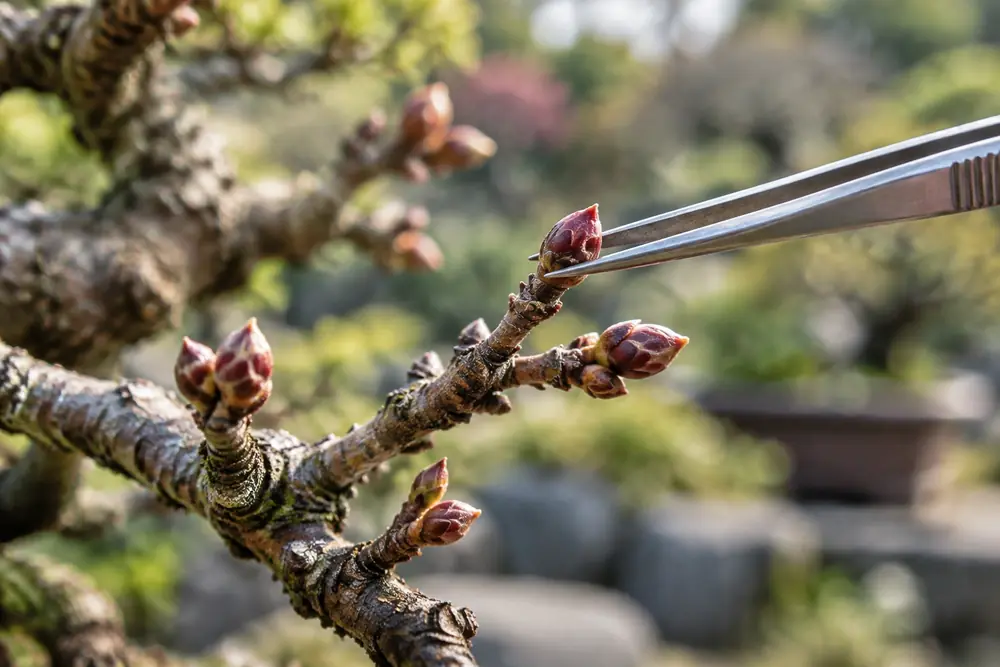
Bud selection simply means removing unwanted buds before they grow into shoots. It is done by hand or with fine tweezers, usually in spring as buds swell. Compared with pruning shoots later, it:
- Saves the tree energy, because it does not grow shoots you will cut off anyway.
- Leaves no cuts or scars.
- Directs growth exactly where you want it.
A bud is an undeveloped shoot. Each one can become a leaf, a branch, or a flower, depending on the species and the position.
The basic rules of bonsai bud selection
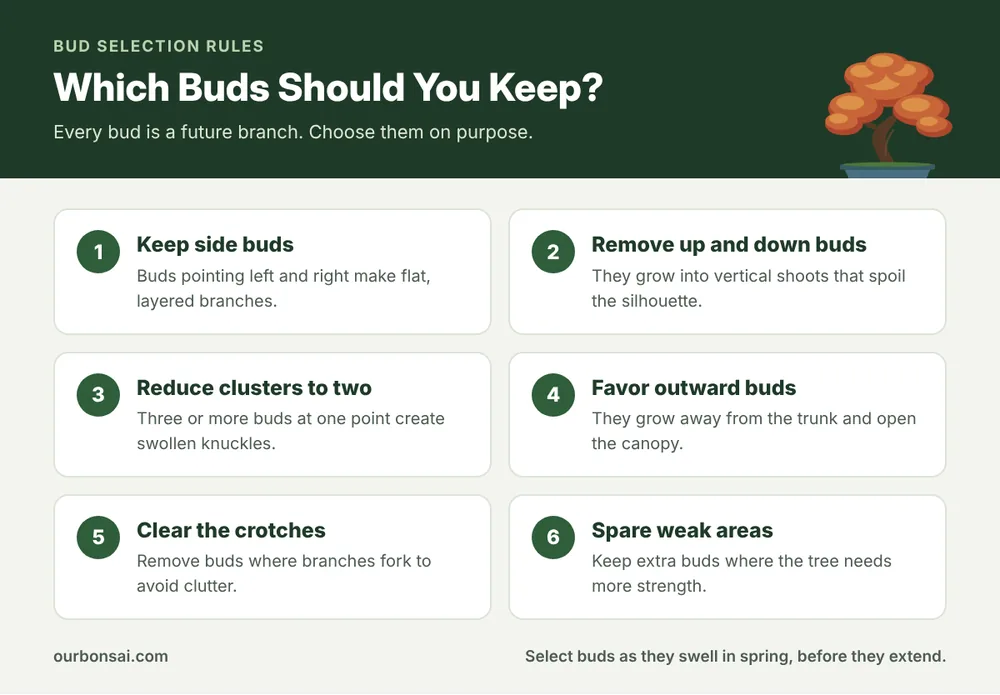
| Bud position | Keep or remove? | Why |
|---|---|---|
| Pointing sideways (left or right) | Keep | Builds flat, horizontal branch pads |
| Pointing straight up | Usually remove | Becomes a strong vertical shoot |
| Pointing straight down | Usually remove | Grows into an unnatural hanging shoot |
| Pointing back toward the trunk | Remove | Crowds the inside of the canopy |
| Pointing outward | Keep | Opens and extends the branch |
| In a branch fork (crotch) | Remove | Clutters the junction |
| Three or more at one point | Reduce to two | Prevents swollen knuckles |
These rules are guidelines, not laws. If a branch needs to fill a gap upward, keep an upward bud. If an area is weak, leave a few extra buds to build strength.
Bud selection on deciduous trees
Maples, elms, hornbeam and similar trees produce buds in spring at the branch tips and along the twigs.
Opposite-budding trees (maples)
Maples have buds in pairs, one on each side of the twig. When the buds open, each pair can grow into two shoots plus a central one. Common practice:
- At the tip, the central bud often grows strongest. On refined trees, many growers remove it so the two side buds develop evenly.
- Reduce clusters to two buds that point sideways.
Our guide to Japanese maple bonsai shows how these trees branch in pairs.
Alternate-budding trees (elms, beech, hornbeam)
Buds alternate along the twig. Keep buds on the sides of the branch, remove those directly on top and underneath, and favor buds that point in the direction you want the branch to grow.
When to do it
As buds swell and just begin to open in spring. You can rub off unwanted buds with your fingertip or remove them with tweezers. Shoots that have already extended can still be pinched or pruned, but earlier is better. Our guide on when to prune deciduous bonsai fits bud selection into the yearly cycle.
Bud selection on pines
Pines grow from clusters of buds at the branch tips. In spring, these extend into candles. Without selection, you often get three to five shoots at each tip, creating a “wheel” of branches and heavy knuckles.
- In autumn or early winter, reduce each cluster of buds to two, choosing a pair that points sideways.
- In spring, if more candles emerge than you want, reduce them again to two.
- On strong areas (usually the top and outer branches), be stricter.
- On weak areas, leave more buds to build strength.
This works together with needle thinning and, for black pines, summer decandling.
Bud selection on junipers
Junipers do not form obvious buds in the same way. Instead, you manage growth by thinning shoots and removing growth pointing up, down or back toward the trunk. Pinching every tip, as many beginners do, weakens the tree and encourages juvenile needle foliage. Our guide to juniper bonsai styles for beginners shows how to maintain juniper pads properly.
Tools for bud selection
- Fine bonsai tweezers for removing small buds and shoots precisely.
- Small, sharp scissors for buds that have already extended. See our guide to bonsai pruning shears.
- A magnifier helps on small trees.
Many tool kits include tweezers; our guide to the best Japanese bonsai tool kit covers sets. You can also buy bonsai tweezers on Amazon individually.
How bud selection builds ramification
Ramification is the fine, repeated branching that makes a bonsai look like an old tree. Each year, bud selection decides how each twig divides:
- Year one: a branch tip is reduced to two side buds.
- Year two: each of those grows and is reduced to two buds again.
- Year three: four tips become eight.
Repeated over several seasons, this gives the classic tree silhouette with dense, fine twigs at the edges and an open interior. Our guide on when to start pruning bonsai explains how to combine pruning and bud selection at different stages of development.
Bud selection through the year
- Late winter: Look over the tree while it is bare. Note which branches are too strong or too weak.
- Early spring: As buds swell, remove those pointing up, down and inward, and reduce clusters to two.
- Late spring: Pinch or cut any unwanted shoots that escaped. On pines, reduce candles if needed.
- Summer: Remove water sprouts and suckers that appear on the trunk and inner branches, unless you want a new branch there.
- Autumn: On pines, reduce bud clusters for next year. On deciduous trees, enjoy the color and plan next spring’s work.
Common bud selection mistakes
- Removing every bud on a weak branch, which can kill it.
- Leaving three or more buds at one point year after year, which creates bulging knuckles.
- Selecting buds on a tree that is still in development, when you want vigorous growth to thicken the trunk.
- Pinching junipers like other trees.
- Waiting until shoots are long and woody, then cutting them, which wastes the tree’s energy.
Balancing strong and weak areas
Most trees are strongest at the top and on the outer edges, and weakest low and inside. Bud selection is one of the best tools to even this out. On the strong top, remove more buds and leave just two at each point. On weak lower branches, leave extra buds, even ones pointing slightly up, so those branches gain leaves and strength. Over a few seasons, the lower branches catch up and the tree becomes more balanced. This idea of “taking from the strong and giving to the weak” runs through almost every bonsai technique, from pruning to fertilizing.
FAQ: bonsai bud selection
When is the best time for bud selection?
In spring, as buds swell and before they extend. For pines, autumn and early winter as well.
Can I remove buds on a newly bought tree?
Wait until the tree is healthy and established in your care. Bud selection is a refinement technique, best on strong trees.
Do I need to do bud selection on young trees?
Not much. Young trees in development usually benefit from free growth to thicken. Start selecting buds once branches are in place.
What if I removed the wrong bud?
Most trees produce backup buds. Wait and see what grows, then adjust next time.
Final thoughts
Bonsai bud selection is a quiet, fiddly job, but it has a big effect. Keep side buds and outward buds, remove those pointing straight up, down or inward, reduce clusters to two, and treat strong and weak areas differently. Repeat it each spring and you will see your tree’s branching grow finer and more natural year after year. For more maintenance basics, see our bonsai care guide.