Best Soil for Pomegranate Bonsai: Mix Recipes and Tips

This post contains affiliate links. As an Amazon Associate, OurBonsai earns from qualifying purchases at no extra cost to you. Read our disclosure.
In this guide
- What pomegranate roots need
- Best soil mixes for pomegranate bonsai
- Particle size and pot choice
- How to repot a pomegranate bonsai
- Watering and feeding in this soil
- Soil care through the seasons
- Signs your pomegranate needs fresh soil
- Common soil mistakes with pomegranate bonsai
- FAQ: best soil for pomegranate bonsai
- Final thoughts
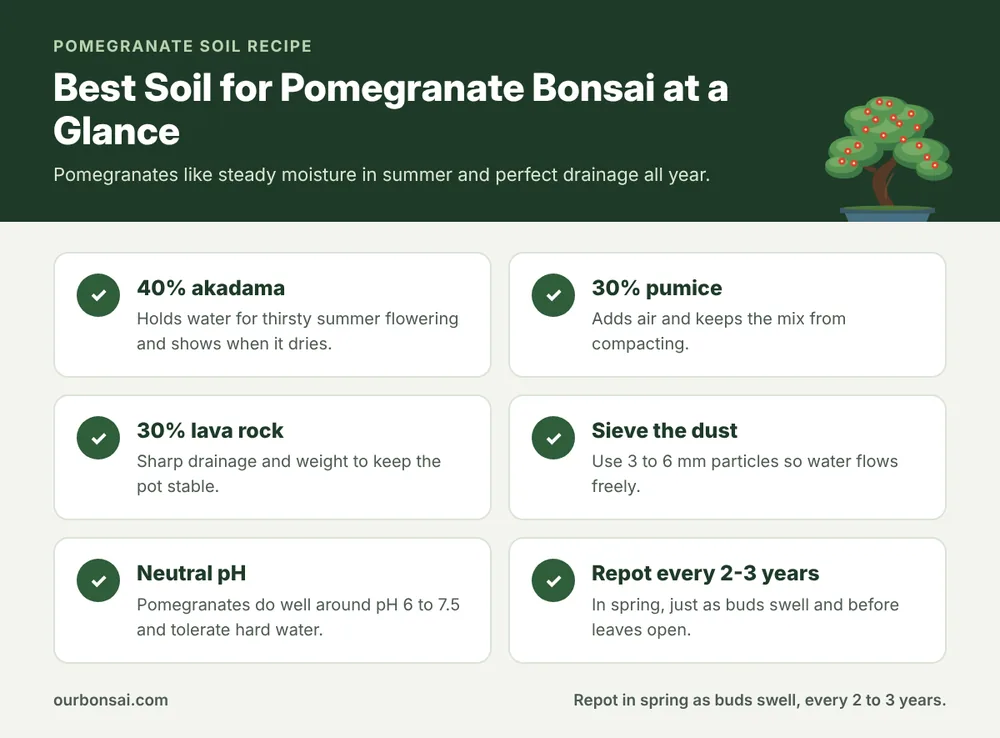
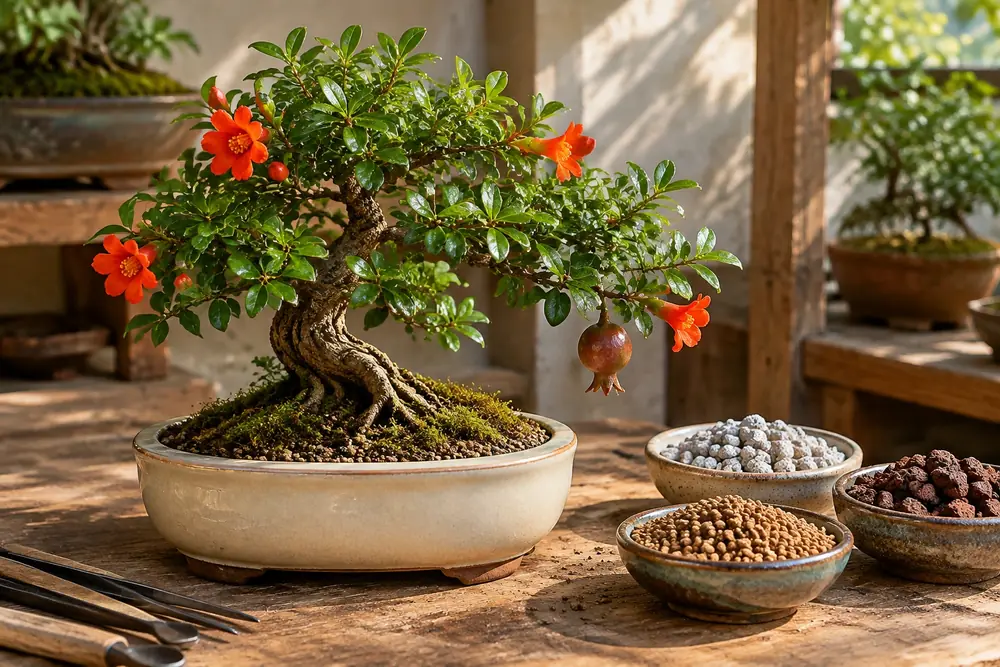
The best soil for pomegranate bonsai is a free-draining bonsai mix that still holds enough water for a tree that flowers and fruits through the summer. A simple, reliable recipe is 40% akadama, 30% pumice and 30% lava rock, sieved to remove dust. In hot, dry climates, raise the akadama to half the mix. In wet climates, add more lava. Pomegranates are not fussy about pH and handle neutral to slightly alkaline soil and hard tap water, which makes them easier than lime-hating flowering trees like azaleas.
This guide explains why pomegranates need this balance, gives you several recipes and walks you through repotting.
What pomegranate roots need
The pomegranate (Punica granatum) comes from Iran and the surrounding region, and has been grown across the Mediterranean and South Asia for thousands of years. The Wikipedia article on pomegranate describes a shrub that tolerates drought once established but produces its best flowers and fruit with steady water in summer.
For a bonsai in a small pot, that translates into:
- Fast drainage so roots never sit in water, especially in cool weather.
- Moderate water retention for summer, when flowering and fruiting use a lot of water.
- Good aeration for fine, healthy feeder roots.
- A neutral pH, roughly 6 to 7.5. Pomegranates tolerate slightly alkaline soil.
Regular potting soil fails because it stays wet for days in spring and autumn and compacts over time. Our guide to bonsai soil vs regular soil explains why that leads to root problems.
Best soil mixes for pomegranate bonsai
| Mix | Recipe | Best for |
|---|---|---|
| All-round | 40% akadama, 30% pumice, 30% lava rock | Most pomegranate bonsai |
| Hot, dry climate | 50% akadama, 25% pumice, 25% lava | Pots that dry out by afternoon |
| Wet climate | 30% akadama, 30% pumice, 40% lava | Rainy regions, large pots |
| Budget | 60% pumice, 20% lava, 20% fine pine bark | When akadama is not available |
| Development | 50% pumice, 30% fine bark, 20% lava | Young trees in larger training pots |
You can buy the ingredients separately, such as akadama bonsai soil and lava rock bonsai soil, or use a good pre-mixed bonsai soil. Our bonsai soil mix ratio guide explains what each ingredient does.
Why akadama works well for pomegranates
Akadama holds water inside each grain while leaving air gaps between them. It also changes color as it dries, from dark brown to light tan, which tells you when to water. For a thirsty flowering tree in summer, that is a big help.
Pre-mixed soils
Many good pre-mixed bonsai soils contain the same ingredients. Sieve them before use and check that they are mostly inorganic. Our premium bonsai soil review and Bonsai Jack gritty mix review compare two popular choices.
Particle size and pot choice
Use particles of about 3 to 6 mm for most pomegranate bonsai, and 2 to 4 mm for small shohin trees. Sieve out the dust so water drains quickly.
Pomegranates often look best in glazed pots in cream, blue or soft green, which set off the orange-red flowers and fruit. Because fruiting trees use more water, avoid extremely shallow pots unless you can water twice a day in summer. Make sure the pot has large drainage holes.
How to repot a pomegranate bonsai
Repot young trees every two years and older trees every three years, in spring.
- Timing. Repot as the buds swell in spring, before the leaves open. Avoid repotting during flowering.
- Prepare. Sieve and mix the soil, prepare the pot with mesh and tie-down wire.
- Remove the tree. Ease it out of the pot and use a root hook to loosen the outer roots.
- Prune roots. Remove up to a third of the root mass, focusing on thick, long roots and any circling roots. Pomegranates recover quickly from root pruning.
- Repot. Place the tree, tie it in firmly and work the new soil in around the roots with a chopstick.
- Water thoroughly until it drains clear.
- Aftercare. Keep the tree out of strong wind and hot afternoon sun for two weeks. Wait about four weeks before feeding.
Our guide to the best bonsai repotting tools covers what you need.
Watering and feeding in this soil
With a gritty mix, water thoroughly whenever the top of the soil starts to dry. In summer, especially when the tree is flowering or carrying fruit, that can be daily. In winter, when the tree is dormant and leafless, water sparingly but never let the root ball dry out completely.
Feed from spring to late summer. A balanced fertilizer in spring, then one slightly lower in nitrogen and higher in phosphorus and potassium around flowering, supports blooms and fruit. Our guide on bonsai fertilizer: pellets or liquid helps you choose a format.
Soil care through the seasons
- Spring: repot if due. Start feeding once new leaves open.
- Summer: check moisture daily. Top up any soil washed out by watering.
- Autumn: reduce watering as leaves color and fall.
- Winter: protect the pot from hard frost. Our pomegranate bonsai winter care guide explains how.
Signs your pomegranate needs fresh soil
Even a good mix wears out. Akadama slowly breaks down into fine particles, and roots fill the pot. Watch for:
- Water pooling on the surface for more than a few seconds.
- Soil that stays dark and wet for days in spring and autumn.
- Roots growing out of the drainage holes or circling on the surface.
- Weaker flowering than the year before, with smaller leaves, despite regular feeding.
- The tree drying out unusually fast in summer, because the pot is packed with roots.
If you notice two or more of these over winter, plan a repot for the coming spring.
Common soil mistakes with pomegranate bonsai
- Using regular potting soil. It holds too much water outside summer and invites root rot.
- Choosing a mix that is too coarse. Very open mixes may dry out too fast for a fruiting tree in summer.
- Not sieving. Dust blocks drainage.
- Repotting during flowering. You may lose the flowers and stress the tree.
- Skipping tie-down wire. A loose tree tears new roots every time it moves.
FAQ: best soil for pomegranate bonsai
Can I use regular potting soil for pomegranate bonsai?
It is not recommended. It stays wet too long and compacts, which leads to root problems. Use a gritty bonsai mix.
Do pomegranate bonsai need acidic soil?
No. Pomegranates do well in neutral to slightly alkaline soil and tolerate hard tap water.
How often should I repot a pomegranate bonsai?
Every two years for young trees and every three years for older trees, in spring as the buds swell.
Does soil affect flowering and fruiting?
Yes. Healthy roots in well-draining soil, with steady summer moisture and good feeding, support more flowers and better fruit set.
Is lava rock necessary for pomegranate bonsai?
Not strictly, but it helps. Lava adds drainage and weight, which keeps taller pomegranates from tipping over. If you leave it out, use more pumice.
Final thoughts
The best soil for pomegranate bonsai balances drainage with enough water-holding for summer flowering. A mix of akadama, pumice and lava, sieved and adjusted for your climate, keeps roots healthy all year. Repot every two to three years in spring, water by need and feed through the season, and your pomegranate will reward you with bright flowers and tiny fruit.