Japanese Black Pine Bonsai Dropping Leaves (Needles): Causes and Fixes


This post contains affiliate links. As an Amazon Associate, OurBonsai earns from qualifying purchases at no extra cost to you. Read our disclosure.
In this guide
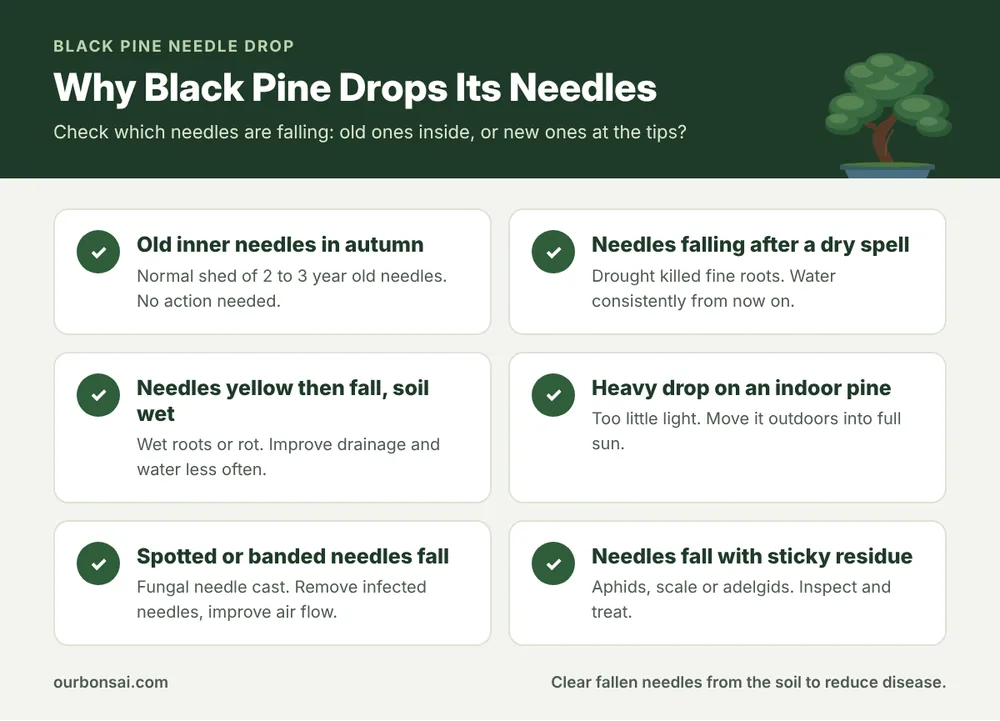
Japanese black pine bonsai dropping leaves, or more precisely needles, worries many owners, but much of it is natural. A healthy black pine (Pinus thunbergii) keeps each needle for about two to three years and then sheds the oldest ones, mostly in autumn. Those needles sit further back along the branches, away from the tips, and they turn yellow, then brown, before falling. That kind of needle drop is normal. Needle drop becomes a problem when new needles at the branch tips fall, when the drop happens in spring or summer, or when the whole canopy thins out.
This guide helps you tell normal shed from trouble, explains the main causes of abnormal needle drop, and shows how to fix each one.
Normal needle drop vs a problem
| What you see | Normal or not |
|---|---|
| Old needles behind the tips yellow and fall in autumn | Normal |
| A thin layer of brown needles on the soil each autumn | Normal |
| Green needles falling at a touch | Problem |
| New needles at the branch tips yellowing and dropping | Problem |
| Needle drop in spring or summer | Problem |
| One branch losing all its needles | Problem |
| Needles with spots or bands falling | Problem, often fungal |
If the shoots still carry plenty of firm, dark green needles from this year and last year, and only the oldest ones are falling, the tree is simply renewing itself.
Causes of Japanese black pine bonsai dropping leaves
1. Drought
Pines do not wilt, so a dry spell can go unnoticed. When a small pot dries out completely, fine roots die, and needles start yellowing and falling weeks later, often from the tips of the shoots.
Fix: check the soil every day during the growing season and water as soon as the top 1 to 2 cm is dry. In summer, shade the pot (not the needles) to keep the roots cool. Our article on watering bonsai in summer explains hot-weather routines.
2. Wet roots and root rot
The opposite problem is just as common. Dense soil, poor drainage or watering on a schedule keeps the roots soggy. Without air, the roots and their beneficial fungi die, and the tree drops needles, often after yellowing them first.
Fix: let the surface dry between waterings, remove any saucer and keep the tree out of long rainy spells. Repot into gritty soil in early spring; see our guide to the best soil for Japanese black pine bonsai. Our guide to root rot in bonsai shows how to check the roots.
3. Kept indoors or in shade
Black pine is a full-sun outdoor tree. Indoors, or in deep shade, it cannot make enough energy, so it drops needles steadily from the inside out until the branches are bare. The Wikipedia page on Pinus thunbergii describes its native habitat on sunny, windswept coasts.
Fix: move it outdoors into full sun, introducing strong sun over a week or two if it has been inside for a while. It also needs a cold winter rest outdoors.
4. Fungal needle diseases
Needle cast and needle blight fungi infect needles in wet, humid weather. Look for yellow spots or bands that turn brown, needles browning from the tip while the base stays green, and tiny black dots on dead needles. Infected needles fall early, usually starting low and inside the canopy.
Fix: remove infected needles and clear fallen needles from the soil, keep the foliage dry, space trees for air flow, and apply a copper fungicide to new growth in spring. Our guide to bonsai pests and diseases covers fungal problems in more detail.
5. Pests
Aphids, pine needle scale, adelgids (white woolly tufts) and spider mites all weaken needles until they yellow and drop. Look for sticky honeydew, white flecks on needles, or fine stippling.
Fix: wash pests off with a strong spray of water, then treat with insecticidal soap or horticultural oil. Our guide to aphids on bonsai trees has step-by-step treatment, or browse horticultural oil spray.
6. Stress from heavy work
Decandling, heavy pruning, needle plucking and repotting are all normal parts of black pine care, but on a weak tree, or done all at once, they can trigger extra needle drop and a slow decline. Give a stressed pine a full season of free growth to recover.
Needle drop in winter
Through winter, a dormant black pine outdoors should hold its current needles. Two winter problems can cause drop. The first is roots freezing solid in a small pot for long periods, which damages fine roots; needles then brown and fall in early spring. Protect pots during hard frosts by sheltering them or sinking them in mulch. The second is winter drought: on sunny, windy days the needles still lose water, and if the soil stays frozen or bone dry, the tree cannot replace it. Check the soil every week or so, and water on mild mornings when it is dry and not frozen.
If needles drop in early spring after a hard winter, wait for the candles. Strong candles mean the roots survived; weak or no candles mean the tree needs a gentle recovery year.
What to do about fallen needles
Clear fallen needles from the soil surface regularly. A mat of old needles keeps the soil damp, hides the surface so you cannot judge watering, and can carry fungal spores that reinfect the tree. Many growers also pluck old, yellowing needles from the branches in autumn to tidy the tree and let light into the inner buds.
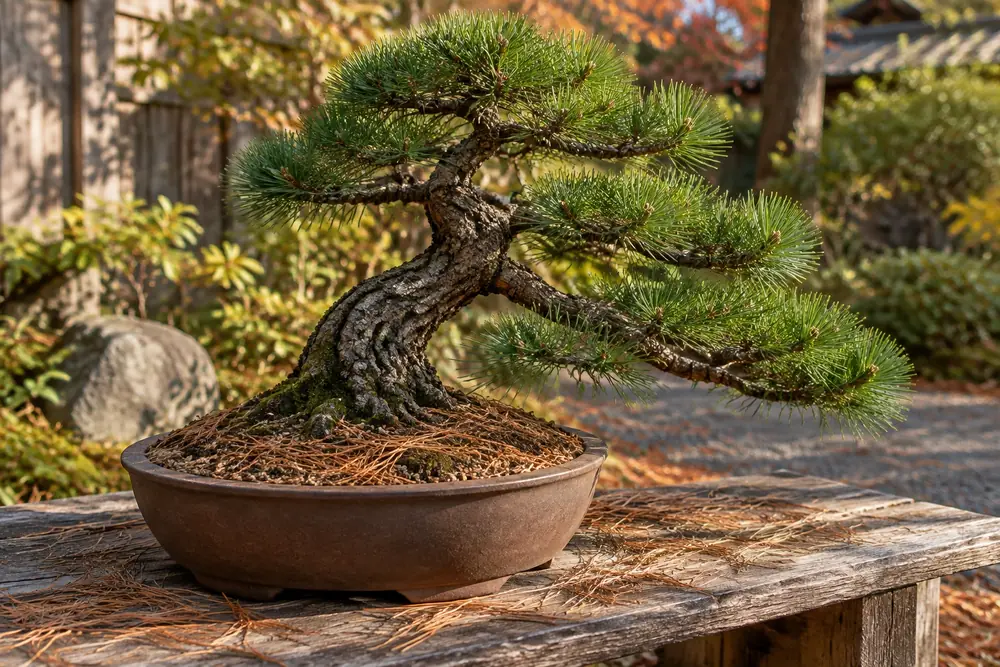
How to keep your black pine full and healthy
- Keep it outdoors in full sun all year, with a cold winter rest.
- Use gritty, fast-draining soil.
- Water by checking the soil, more in summer, much less in winter.
- Feed with organic fertilizer through the growing season.
- Inspect needles every few weeks for spots and pests.
- Give trees space for air to move between them.
- Only decandle or prune hard when the tree is strong.
Seasonal needle drop is part of being an evergreen. Our guide to types of evergreen bonsai trees explains how this works across different species.
FAQ: japanese black pine bonsai dropping leaves
Is it normal for my black pine to drop needles in autumn?
Yes, if it is the oldest needles behind the branch tips. Pines shed their two to three year old needles each autumn.
Why is my pine bonsai losing green needles?
Green needles falling usually means a sudden root problem, such as a dry spell, waterlogging or frost damage to the roots. Check the soil and roots.
Will a black pine grow new needles on bare branches?
Black pine rarely back-buds on old, bare wood. Needles grow from buds at the shoot tips. Keeping existing needles healthy is important.
Should I clean fallen needles off the soil?
Yes. It helps you judge watering and removes a source of fungal disease.
Final thoughts
Japanese black pine bonsai dropping leaves is normal when it is the oldest needles in autumn, and a warning when green or new needles fall, or when it happens in spring and summer. Check the soil, roots, light and needles for spots or pests, fix the cause, and give the tree time. A pine kept outdoors in full sun with gritty soil and steady watering will hold its needles and stay full and green.