How to Bend Thick Bonsai Branches Without Breaking Them

This post contains affiliate links. As an Amazon Associate, OurBonsai earns from qualifying purchases at no extra cost to you. Read our disclosure.
In this guide
- Why thick branches crack
- Best time to bend thick branches
- How to bend thick bonsai branches
- How to bend safely
- What if the branch cracks?
- Aftercare after heavy bending
- Trees that bend well and trees that do not
- Planning a heavy bend
- Shaping by pruning instead of bending
- FAQ: bend thick bonsai branches
- Final thoughts
Trying to bend thick bonsai branches the same way you bend thin twigs is the fastest way to hear a sickening crack. Thicker wood is stiffer, the outer fibers stretch more on the outside of the curve, and the bark is more likely to split. That does not mean thick branches cannot be moved. Bonsai growers use a set of proven techniques to bend heavy branches, even trunks, safely, by supporting the wood, spreading the force and working slowly.
This guide covers when to bend thick branches, the main techniques, and how to care for a branch after a heavy bend.
Why thick branches crack
When you bend a branch, the wood on the outside of the curve stretches and the wood on the inside compresses. The thicker the branch, the greater the stretch at the outside. If it stretches beyond its limit, the fibers tear, often with a crack you can hear. Bark can also peel or split along the outside. Species matter too: junipers are flexible, pines reasonably so, while maples, azaleas and most broadleaf trees are much more brittle.
Best time to bend thick branches
- Late winter to early spring, just as sap starts to move. The wood is more flexible, and the tree heals quickly as it starts to grow.
- Conifers such as junipers and pines are often bent from late autumn through winter, when they are less active and wire will stay on longer without biting.
- Avoid hard frosts. Frozen branches are brittle.
- Water the day before. Well-hydrated branches bend more easily.
How to bend thick bonsai branches
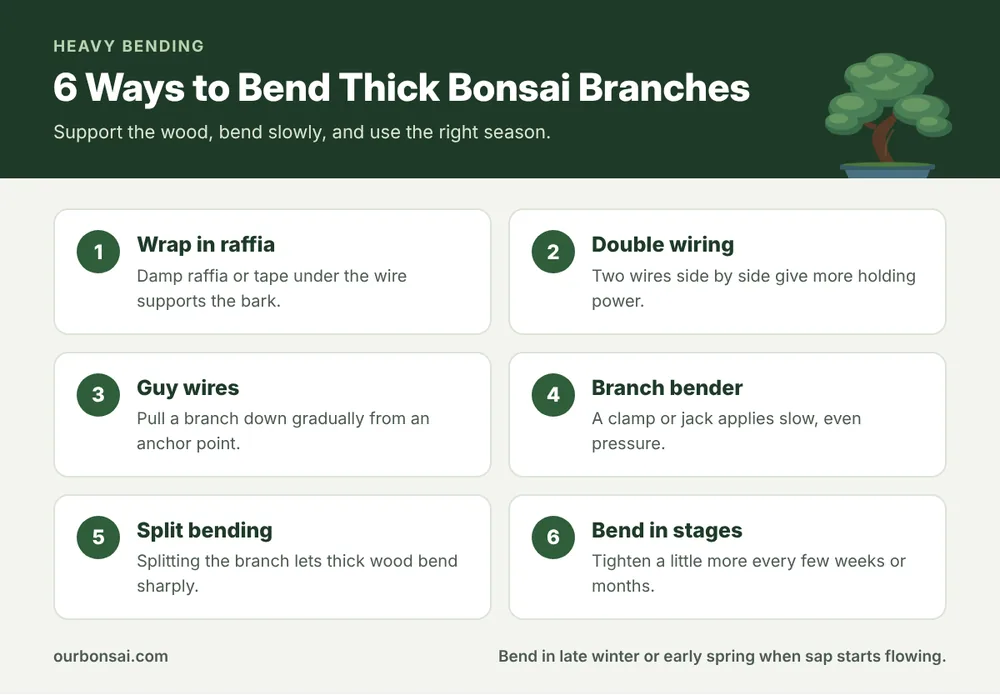
1. Wrap the branch in raffia or tape
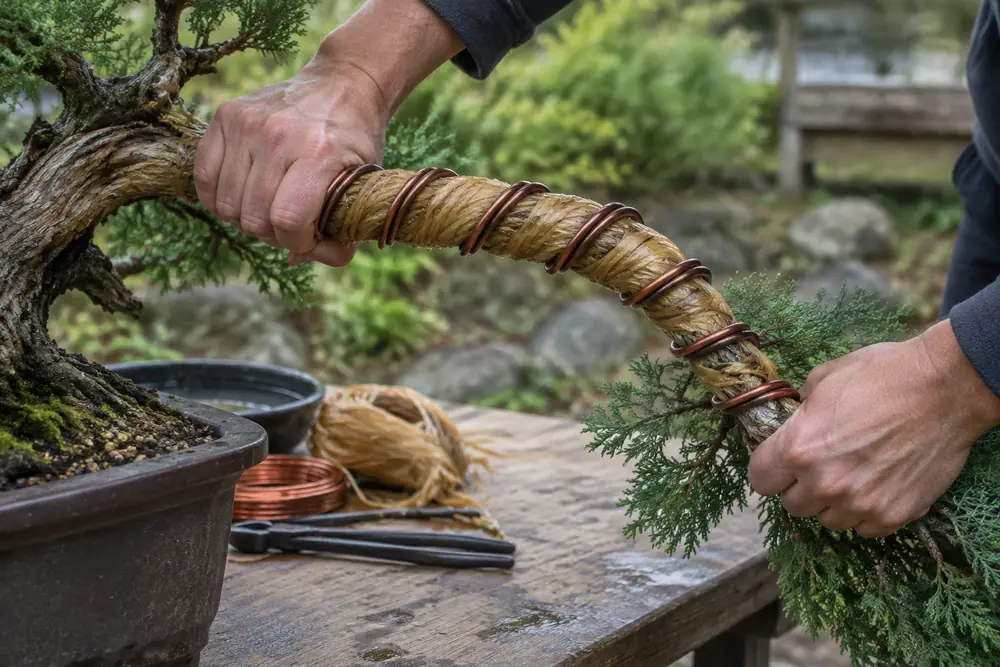
Soak natural raffia in water, then wrap it tightly and evenly along the section you will bend, overlapping each turn. Some growers use rubber tape or vinyl electrical tape instead. Then apply the wire over the wrapping. The wrap holds the bark and outer wood together so they stretch more evenly, and reduces the chance of cracks. Our guide to bonsai wire sizes helps you choose a heavy enough gauge.
2. Double wiring
On thick branches, one wire may not be strong enough. Run two wires of the same size side by side along the branch, close together and parallel. This doubles the holding power without needing a single very thick, hard-to-apply wire. Copper wire is often used on conifers because it holds better at a given thickness.
3. Guy wires
A guy wire runs from the branch to an anchor point, such as the pot, a root or a lower part of the trunk. Tightening it pulls the branch down slowly. Guy wires are ideal for lowering thick branches that are too stiff to wire into position. Protect the bark where the wire touches with a piece of rubber tube.
4. Branch benders, clamps and jacks
Specialist tools apply slow, steady pressure. A screw-driven clamp or jack can bend a thick branch or trunk a little at a time, tightening a turn every few days or weeks. You can find bonsai branch benders on Amazon and in some tool kits; see our guide to bonsai tool brands.
5. Split bending
For very thick branches or trunks, growers sometimes split the branch lengthwise through the section to be bent, using a splitting tool or a careful saw cut. The split halves can then slide against each other, allowing a much sharper bend. The split is then wrapped tightly with raffia and wire. It is an advanced technique, best on vigorous species such as junipers. A carving tool or branch splitter is used.
6. Bend in stages
You do not have to reach the final position in one session. Bend partway, leave it for a few weeks or months, then bend a little further. The branch gradually adapts. With guy wires and benders, staging is easy: just tighten a little more each time.
How to bend safely
- Support the outside of the curve with your thumbs, not the inside.
- Bend slowly, listening and feeling for small cracking sounds. If you hear one, stop and hold the position.
- Bend along the whole wired section, not just at one point.
- Do not twist while bending unless you mean to; twisting adds stress.
What if the branch cracks?
A small crack is not always fatal:
- Hold the branch in its new position.
- Wrap the cracked area tightly with raffia or tape to close the crack.
- Seal any open bark with cut paste. See our guide to a bonsai cut paste alternative.
- Leave the wire on to support it.
- Keep the tree healthy and growing; the crack usually heals over a season.
A branch that is completely snapped through, with the bark broken all around, usually cannot be saved.
Aftercare after heavy bending
- Keep the tree out of strong sun and wind for a week or two.
- Do not repot or prune heavily in the same season.
- Feed normally once the tree is growing.
- Check the wire every couple of weeks and remove raffia or wire before it bites. Heavy wire on thick branches can stay on longer, but it still must come off in time.
For style ideas where heavy bends add character, see our guide to juniper bonsai styles for beginners.
Trees that bend well and trees that do not
- Bend well: Junipers, most pines, young Chinese elms, ficus aerial roots and young shoots.
- Moderate: Japanese maple and trident maple when young; older wood becomes stiff.
- Brittle: Azaleas, boxwood, older maples and many fruiting trees.
On brittle species, it is often better to shape by pruning (cut and grow) than by bending thick wood.
Planning a heavy bend
Before you pick up any wire, take a few minutes to plan:
- Photograph the tree from the front and mark where the branch should end up.
- Decide where the bend happens. A curve spread along a longer section is much safer than a sharp kink at one point.
- Check the branch for old wounds or wire scars, which are weak points that crack first.
- Prepare everything first: raffia soaking, wire cut to length, guy wire anchors ready. You want to bend once, steadily, not stop halfway to look for tools.
- Think about the next step. If the bend needs to go further next year, leave room for a second stage.
Shaping by pruning instead of bending
On brittle species, or where a branch is simply too thick, the “clip and grow” method is often the better choice. Instead of bending the branch, cut it back to a side shoot that already points in the direction you want, let that shoot grow, then cut again. Each cut changes the direction of the branch. It takes longer but is completely safe. Many fine deciduous bonsai are shaped almost entirely this way.
FAQ: bend thick bonsai branches
Can you bend a thick bonsai branch?
Yes, with support. Wrap it in raffia, use heavy or double wire, guy wires or a bender, and bend slowly in the right season.
How long should wire stay on a thick branch?
Often longer than on thin branches, sometimes a full growing season or more. Check regularly so it does not bite.
Is raffia necessary?
For heavy bends on thick branches, it greatly reduces the risk of cracking. For moderate bends, it is optional.
What is the best season to bend thick branches?
Late winter to early spring for most trees; late autumn to winter for many conifers. The Wikipedia article on bonsai cultivation also discusses timing for wiring.
Final thoughts
To bend thick bonsai branches without breaking them, prepare the wood with raffia or tape, use enough wire (or two wires), lean on guy wires and benders for slow pressure, and bend in stages in the right season. Listen to the wood, stop at the first crack, and support any damage. Patience gives you dramatic bends that would be impossible in one go. For quality tools, see our guide to the best Japanese bonsai tool kit.