How Often to Water Schefflera Bonsai (Indoor and Outdoor)

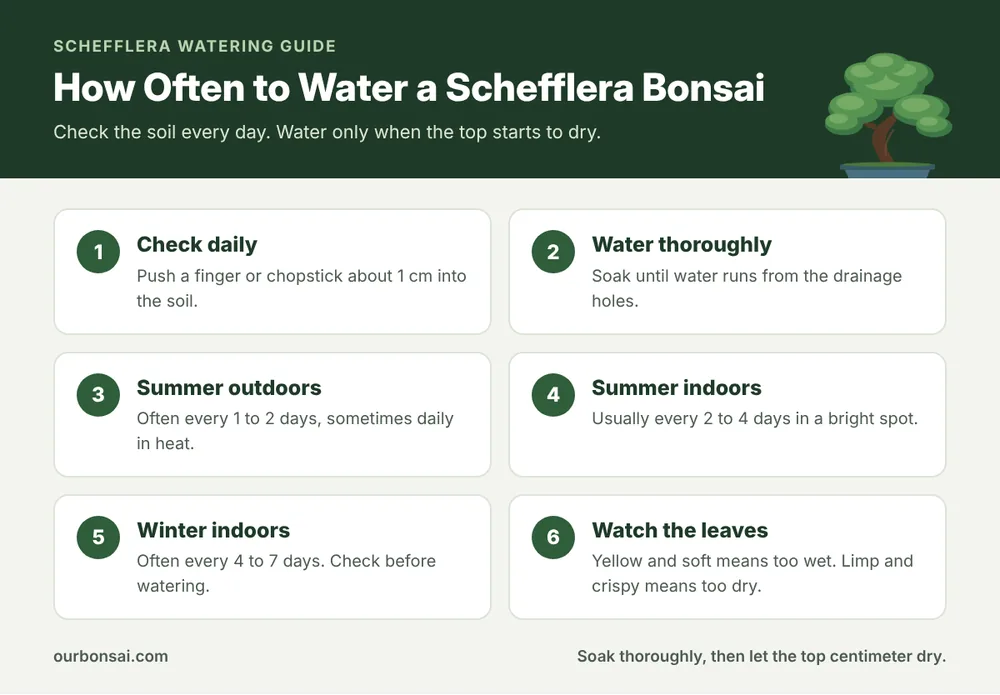
If you are wondering how often to water schefflera bonsai, the honest answer is: when the top centimeter of soil starts to feel dry, not on a fixed day. In practice, that is usually every two to four days indoors in summer, every one to two days outdoors in hot weather, and every four to seven days indoors in winter. Dwarf schefflera likes steady moisture but rots if its roots stay soggy, so check the soil every day and water thoroughly only when it needs it.
In this guide
- How schefflera uses water
- How to check if your schefflera needs water
- Typical watering intervals
- What changes how often you water
- How to water a schefflera bonsai
- Signs of overwatering
- Signs of underwatering
- Watering schefflera in winter
- Watering schefflera outdoors in summer
- Does schefflera need misting?
- Water quality and fertilizer
- Common mistakes
- FAQ: how often to water schefflera bonsai
- Final thoughts
This guide explains how to check the soil, what affects how often you water and how to spot problems early.
How schefflera uses water
Dwarf schefflera (Schefflera arboricola) is a tropical tree with thick, fleshy roots and glossy leaves. The Wikipedia article on Schefflera arboricola notes it grows in warm, humid forests where rain is frequent but the ground drains quickly. In a bonsai pot, that means it wants a mix that is evenly moist, never bone dry and never waterlogged.
It is more forgiving than many indoor bonsai. Its thick roots and leaves store some water, so a missed day rarely harms it. Constant overwatering, on the other hand, is the most common cause of decline. Our main dwarf schefflera bonsai care guide covers light, feeding and pruning too.
How to check if your schefflera needs water
- Finger test. Push a finger about 1 cm (half an inch) into the soil. If it feels dry, water. If it feels cool and damp, wait.
- Chopstick test. Push a wooden chopstick into the soil and leave it for 10 minutes. If it comes out dark and damp, wait. If it is dry and clean, water.
- Weight test. Lift the pot right after watering and again a day or two later. A light pot needs water.
- Moisture meter. Useful for beginners, though less accurate in gritty bonsai soil. See our guide to the best soil moisture meter for indoor plants.
Typical watering intervals
| Situation | Typical interval | Notes |
|---|---|---|
| Outdoors, summer, full sun | Every 1 to 2 days | Daily in heat waves |
| Outdoors, summer, part shade | Every 2 to 3 days | Check after windy days |
| Indoors, summer, bright window | Every 2 to 4 days | Faster with a grow light |
| Indoors, winter, heated room | Every 4 to 7 days | Dry air speeds drying |
| Indoors, winter, cool room | Every 5 to 10 days | Easy to overwater |
| Just repotted | Check daily | Keep evenly moist, not soggy |
These are only starting points. Always check the soil before watering.
What changes how often you water
- Soil. Gritty bonsai soil dries faster than potting compost. Our guide to the bonsai soil mix ratio explains good mixes.
- Pot size and type. Small, shallow and unglazed pots dry fastest.
- Light and heat. More light means faster growth and more water use.
- Air humidity. Dry indoor air in winter dries the soil surface quickly.
- Season. Growth slows in winter, so roots use less water.
- Tree size. A large canopy in a small pot drinks a lot.
How to water a schefflera bonsai
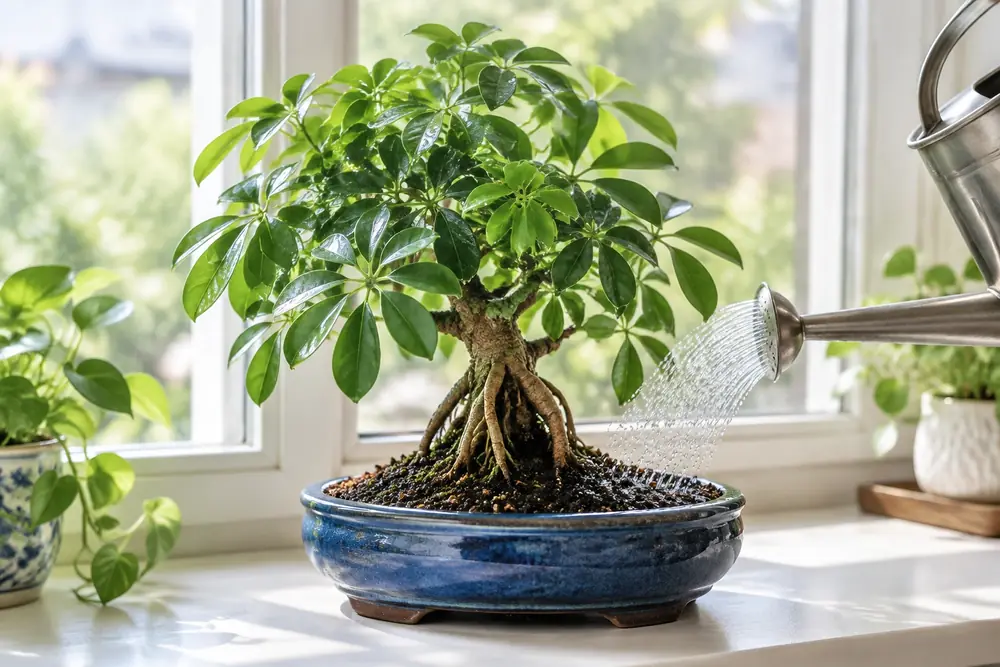
- Water the soil, not the leaves. Use a watering can with a fine rose so the soil is not washed away.
- Soak thoroughly. Water until it runs freely from the drainage holes, wait a minute, then water again so the whole root ball is wet.
- Drain completely. Never leave the pot sitting in a saucer of water.
- Use room-temperature water. Cold water can shock tropical roots in winter.
If the soil has dried out completely and water runs straight off, place the pot in a bowl of water for 10 to 15 minutes, then let it drain. Our guide to the best bonsai watering tools shows useful cans and nozzles.
Signs of overwatering
- Yellow leaves, often starting with older ones.
- Leaves dropping while the soil feels wet.
- Soft, dark spots on leaves or stems.
- A sour or musty smell from the soil.
- Fungus gnats around the pot.
- Soil that stays wet for many days.
If you see these, let the soil dry more between waterings and check the roots. Dark, mushy roots point to root rot in bonsai.
Signs of underwatering
- Leaves droop and feel limp.
- Leaf edges turn brown and crispy.
- Leaves drop suddenly, often green ones.
- The soil pulls away from the pot edge.
- The pot feels very light.
A quick soak usually revives a thirsty schefflera within a few hours. If leaves stay limp in moist soil, the roots may already be damaged.
Watering schefflera in winter
Indoors in winter, light is lower and growth slows, so the tree uses less water. At the same time, central heating dries the air and the soil surface. Check the soil every few days rather than daily, and water only when the top centimeter is dry. Keep the tree away from radiators and heating vents. Our guide on watering indoor bonsai in winter explains how to adjust.
A humidity tray under the pot helps with dry air, but it does not replace watering.
Watering schefflera outdoors in summer
Many growers move schefflera outside from late spring to early autumn, once nights stay above about 12 °C (55 °F). Outdoors in good light, it grows faster and drinks much more. Check every morning, and again in the evening on hot, windy days. Our guide to watering bonsai in summer has heat wave tips.
Does schefflera need misting?
Misting raises humidity for only a few minutes and does not replace watering. It does help keep the leaves clean and can benefit aerial roots in dry rooms. If you like misting, do it in the morning so leaves dry before evening.
Water quality and fertilizer
Schefflera is not fussy about water. Tap water is fine for most growers. Over time, minerals from hard water and fertilizer salts can build up as a white crust on the soil and pot. Flush the pot every month or so by watering heavily two or three times in a row, and repot every two to three years. Feed every two weeks in the growing season with a diluted liquid fertilizer, always on moist soil. Our guide on bonsai fertilizer: pellets or liquid compares the options.
Common mistakes
- Watering on a fixed schedule. Check the soil instead.
- Small sips. Water thoroughly so the whole root ball gets wet.
- Leaving water in the saucer. Roots sit in water and rot.
- Watering in winter like in summer. Growth slows, so the soil stays wet longer.
- Using dense potting compost. It holds too much water for a bonsai pot.
FAQ: how often to water schefflera bonsai
How often should I water my schefflera bonsai indoors?
Usually every two to four days in summer and every four to seven days in winter, but always check that the top centimeter is dry first.
Can I water my schefflera bonsai once a week?
Only if the soil is still moist after a week, which can happen in winter in a cool room. In summer, once a week is usually too little.
Should I water schefflera from the top or bottom?
From the top, thoroughly, is best. Bottom soaking is useful only when the soil has dried out completely.
Why is my schefflera dropping leaves after watering?
Often because it was overwatered or the soil stays wet. Let it dry more between waterings and check the roots.
Does schefflera like tap water?
Yes, it tolerates tap water well. If your water is very hard, rainwater now and then helps prevent mineral build-up on the soil.
Final thoughts
How often to water schefflera bonsai comes down to one habit: check the soil every day and water thoroughly when the top centimeter is dry. That usually means every few days indoors, more often outdoors in summer and less often in winter. Use gritty soil, never leave the pot in standing water and adjust as the seasons change, and your schefflera will stay glossy and full.