How to Prune Ginseng Ficus Bonsai: Step-by-Step Guide

This post contains affiliate links. As an Amazon Associate, OurBonsai earns from qualifying purchases at no extra cost to you. Read our disclosure.
In this guide
If you want to know how to prune ginseng ficus bonsai, the short answer is: let new shoots grow six to eight leaves, then cut them back to two or three, and do any heavier cutting in late spring or summer when the tree is growing strongly. The ginseng ficus, a Ficus microcarpa grown on a thick swollen root bulb, is one of the most forgiving bonsai to prune. It buds back readily, even from older wood, and a regular trimming routine quickly turns the sparse canopy of a store-bought tree into a dense, rounded crown that balances the heavy bulb below.
This guide covers when to prune, maintenance trimming, structural cuts, leaf pruning, dealing with the white sap, and how to look after the tree afterward.
Why prune a ginseng ficus?
Most ginseng ficus are sold with a few long, leggy branches growing out of the top of the bulb. Left alone, those shoots keep extending toward the light, the leaves grow large, and the canopy looks thin and out of proportion. Pruning does three things:
- Builds density. Each cut wakes up buds behind it, so one shoot becomes two or three.
- Keeps the tree in proportion. A compact, rounded canopy suits the heavy bulb far better than long whips.
- Reduces leaf size. Shorter shoots with more branching carry smaller leaves over time.
Ficus are tropical figs that grow almost year round in warm conditions. The Wikipedia page on Ficus microcarpa describes how vigorous the species is in the wild, and that vigor is exactly what makes it so easy to shape.
When to prune ginseng ficus bonsai
| Type of pruning | Best time | Notes |
|---|---|---|
| Maintenance trimming | Whenever shoots have 6 to 8 leaves | Year round indoors if the tree is growing |
| Structural cuts (thick branches) | Late spring to midsummer | Fast healing and quick budding |
| Leaf pruning | Early summer | Only on strong, healthy trees |
| Heavy cutting | Avoid in winter | Low light means slow recovery |
Indoors under good light, a ginseng ficus can be trimmed lightly at almost any time of year. The one season to be careful with is winter on a windowsill, when light is weak and growth slows. Light trimming is fine then, but leave major cuts until late spring. Our guide on when to start pruning bonsai explains how to judge when a tree is strong enough.
How to prune ginseng ficus bonsai step by step
1. Look at the tree first
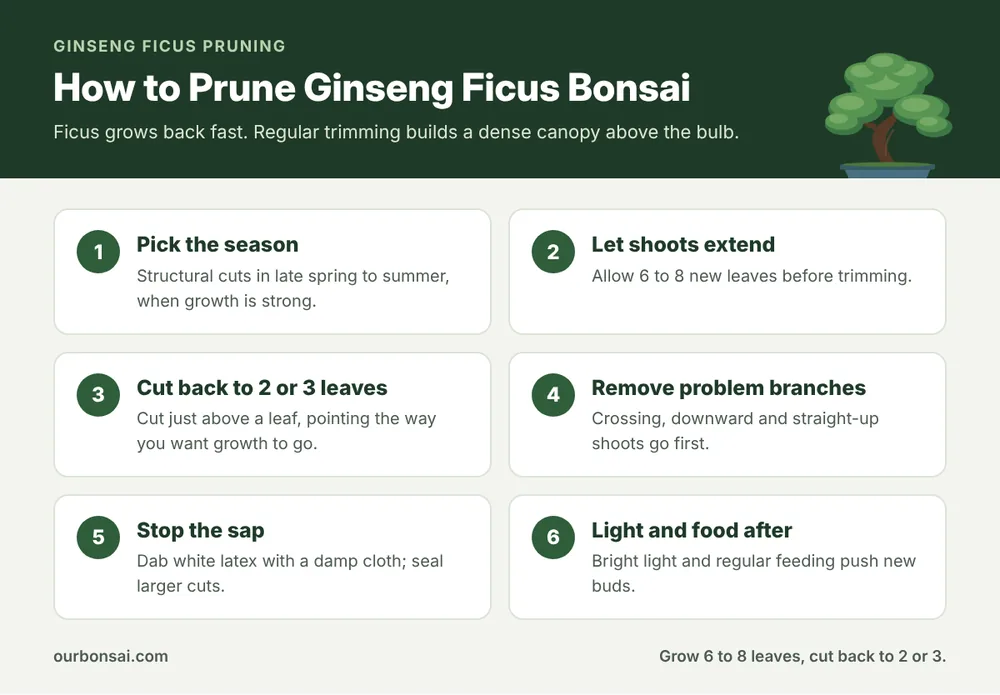
Turn the tree around and decide which side is the front, usually the side where the bulb looks most interesting. Picture the canopy you want: on most ginseng ficus, a broad, rounded dome that is a little wider than the bulb looks balanced.
2. Let shoots extend
Do not trim every new shoot the moment it appears. A shoot needs leaves to feed the tree and to thicken. Let it grow six to eight leaves.
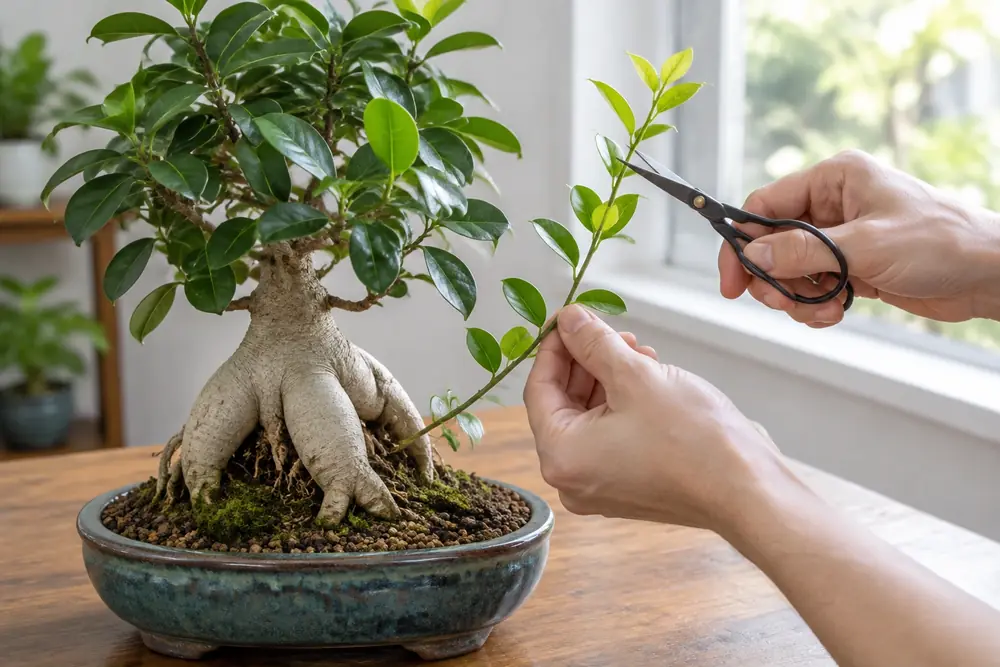
3. Cut back to two or three leaves
Cut just above a leaf whose bud points in the direction you want the next shoot to grow, usually outward or sideways. Within a few weeks, new shoots will appear from the buds at the base of the remaining leaves.
4. Remove problem branches
While you work, take out:
- Branches that cross or rub against each other.
- Shoots growing straight down or straight up from the tops of branches.
- Shoots growing back into the center of the canopy.
- One of two branches emerging from the same point at the same height.
5. Balance strong and weak areas
The top of the tree usually grows hardest. Trim the top more often and harder than the lower and outer branches, which need more leaves to gain strength. Our article on when to prune deciduous bonsai explains the same principle of balancing strong and weak areas, which applies to ficus too.
Dealing with the white sap
Ficus bleed a milky white latex when cut. It is normal and stops on its own within a minute or two. Dab it with a damp cloth or tissue rather than letting it dry on the bark. The sap can irritate sensitive skin, so wash your hands afterward, and keep it away from your eyes.
For cuts larger than a pencil, seal the wound with cut paste to keep the edges from drying out. Our list of bonsai cut paste alternatives helps if you have none at hand.
Structural pruning: reshaping the canopy
Many store-bought ginseng ficus have one or two thick branches that are far too long, or a canopy grafted on in a straight line. Ficus handle hard pruning well, so you can reshape boldly in late spring or summer:
- Shorten long branches back to a point where there are buds or small side shoots, even if that leaves a bare stub for a few weeks. Ficus usually bud back on older wood.
- Choose a new leader near the top if the original apex is too tall, and remove the old top above it.
- Thin crowded areas so light reaches the inner branches.
- Wire young branches to set their direction once they have hardened a little. Ficus bark marks easily, so check the wire every few weeks. Our bonsai wire guide covers sizes.
Avoid removing more than about a third of the foliage at once. The thick bulb stores reserves, but the tree still needs leaves to recover.
Leaf pruning a ginseng ficus
On a strong, healthy tree growing outdoors in summer or under bright light, you can remove most of the large leaves, cutting each leaf stalk and leaving the stalk base and bud. The tree pushes a flush of new, smaller leaves and often extra buds. Do not leaf prune a weak tree, a tree that has just been repotted, or a tree kept on a dim windowsill. It is an optional refinement technique, not a routine one.
Tools you need
- Sharp bonsai scissors for shoots and leaf stalks.
- A concave cutter for thicker branches, leaving a slightly hollow cut that heals flat.
- A damp cloth for the sap.
Our guide to the best bonsai pruning shears for beginners covers good starter scissors, or browse bonsai concave cutters.
Aftercare
- Bright light. New buds need light. Place the tree in the brightest window you have, or under a grow light.
- Steady watering. Water when the top of the soil dries. A tree with fewer leaves uses less water, so check before watering.
- Feeding. Feed every two weeks during growth to fuel the new shoots.
- Warmth and humidity. Keep it away from cold drafts and heaters.
If leaves yellow or drop after pruning, it is usually a reaction to low light or a change in position, not to the cuts. Our guide to ficus bonsai pests and diseases helps if you notice anything unusual on the new growth.
Common mistakes
- Trimming every shoot as soon as it appears, which keeps the tree weak.
- Heavy pruning in winter on a dim windowsill.
- Leaving long stubs with no buds that later die back.
- Removing too much at once, especially right after repotting.
- Ignoring the top, so it grows strong while lower branches thin out.
FAQ: how to prune ginseng ficus bonsai
How often should I prune my ginseng ficus?
Trim whenever new shoots have six to eight leaves, which can be every few weeks in spring and summer. Do larger cuts once a year in late spring.
Can I cut a ginseng ficus back hard?
Yes. Ficus bud back well from older wood, especially in late spring and summer under good light. Leave some leaves on each branch.
Will pruning make the leaves smaller?
Over time, yes. More branching and shorter shoots produce smaller leaves, and leaf pruning on strong trees speeds this up.
What is the white liquid when I cut my ficus?
It is latex sap, normal for figs. Dab it away with a damp cloth and wash your hands.
Final thoughts
Now you know how to prune ginseng ficus bonsai: let shoots grow, cut back to two or three leaves, remove crossing and awkward branches, make bigger cuts in late spring or summer, and give the tree bright light and food afterward. With a steady routine, the canopy fills in quickly and balances that striking bulb. For styling ideas once the canopy is dense, see our ginseng ficus bonsai styles, and for the soil side of care, our ficus ginseng bonsai soil recipe.