Japanese Maple Bonsai Dropping Leaves: Causes and Fixes

This post contains affiliate links. As an Amazon Associate, OurBonsai earns from qualifying purchases at no extra cost to you. Read our disclosure.
In this guide
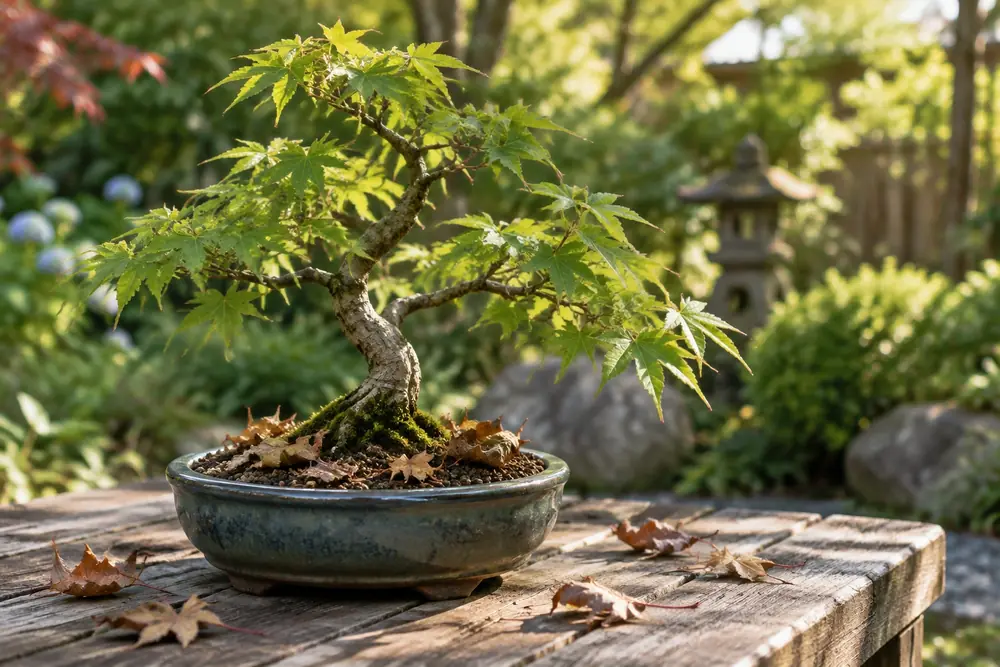
Japanese maple bonsai dropping leaves is completely normal in autumn. Japanese maples (Acer palmatum) are deciduous, so every year they color up and drop all their leaves before resting through winter. Leaf drop in spring or summer is a different story. When a maple sheds green, yellow or crispy leaves during the growing season, it is reacting to stress, almost always involving the roots: drying out, overheating, sitting wet, or struggling after damage. The good news is that a maple with healthy buds and live branches usually recovers once the cause is fixed.
This guide explains how to tell normal leaf fall from a problem, the common causes of summer leaf drop, and what to do about each one.
Normal autumn leaf drop
As days shorten and nights cool in autumn, Japanese maples break down the green chlorophyll in their leaves, show their autumn colors, then form a layer at the base of each leaf stalk that lets the leaf fall. This process, called abscission, protects the tree through winter. The Wikipedia page on Acer palmatum describes the wide range of autumn colors across cultivars.
If the leaves color and fall in autumn, the buds for next year are firm and plump, and the twigs bend rather than snap, the tree is simply going dormant. Keep it outdoors, protect the pot from hard frost, and wait for spring.
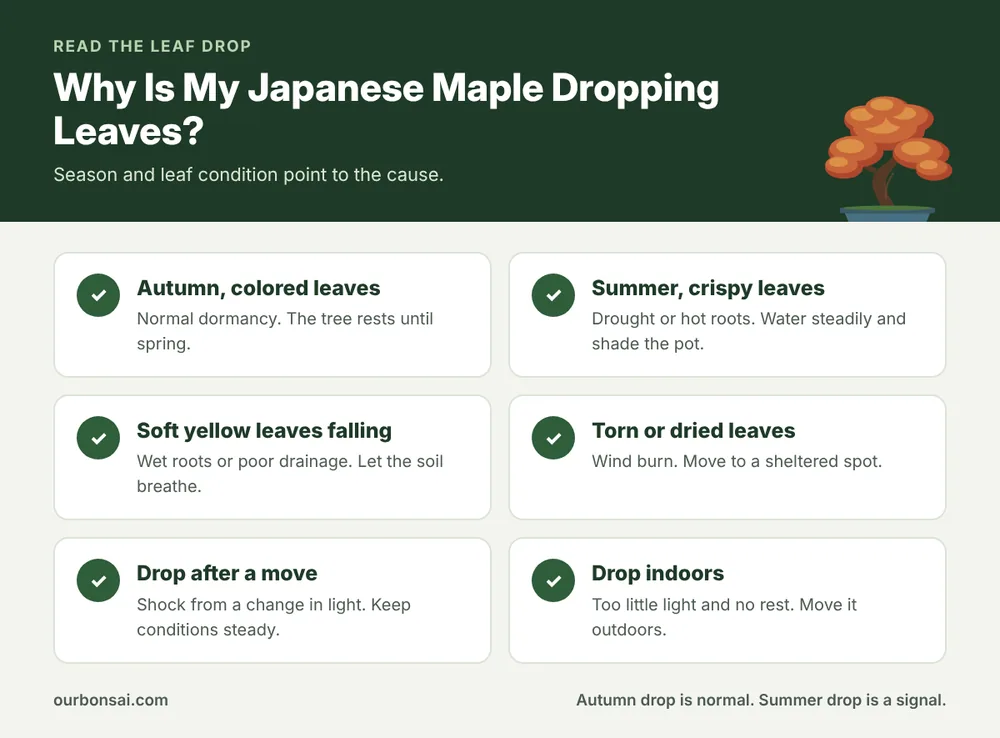
When leaf drop is a problem
| What you see | Most likely cause |
|---|---|
| Leaves crisp at the edges, then fall, in summer | Drought, hot roots or strong sun |
| Soft, yellow leaves dropping, soil always wet | Overwatering or poor drainage |
| Torn or dried leaves on the windward side | Wind burn |
| Sudden drop after moving the tree | Shock from a change in light or position |
| Leaves fall while kept indoors | Low light, dry air, no proper rest |
| Few leaves open in spring, then drop | Roots damaged over winter |
| Drop after repotting or heavy pruning | Root loss or stress |
Causes of Japanese maple bonsai dropping leaves
1. Drought and hot roots
This is the most common summer cause. Maples have thin leaves and fine roots, and a small bonsai pot can dry out in a few hours on a hot day. The leaves scorch at the edges, curl and then drop. The pot itself can also heat up in full sun, cooking the roots even when the soil is moist.
Fix: check the soil morning and afternoon in summer, water as soon as the surface begins to dry, and shade the pot. A pot set on a bench in full afternoon sun is at real risk. Our article on watering bonsai in summer has practical tips.
2. Too much sun
Japanese maples come from forest edges and do best with morning sun and afternoon shade. In hot climates, full afternoon sun scorches leaves, which then fall. Variegated and pale cultivars burn first.
Fix: move the tree to a spot with morning sun, or put a 30 to 50 percent shade cloth over the bench from early summer. Browse garden shade cloth if you need one.
3. Overwatering and poor drainage
Roots in dense, waterlogged soil cannot breathe. They start to rot, and the tree drops soft, yellowing leaves. The soil stays dark and smells sour.
Fix: water only when the top centimeter starts to dry, remove any saucer, and repot into a free-draining akadama-based mix in early spring. Our guide to root rot in bonsai explains how to check and treat the roots.
4. Wind
Maple leaves are thin and tear easily. Strong, dry wind dries them out faster than the roots can replace the water, and they brown and drop.
Fix: place the tree in a sheltered spot, behind a fence or among other plants, especially in spring when new leaves are soft.
5. Moving the tree or keeping it indoors
A sudden change in light, such as moving a tree from shade into full sun, or bringing it indoors, triggers leaf drop. Japanese maples are outdoor trees that need seasons. Kept indoors for long, they drop leaves and weaken. Our guide to Japanese maple bonsai indoors explains how long it can safely stay inside.
Fix: keep the tree outdoors all year and change its position gradually.
6. Root damage over winter
Roots in a pot freeze much harder than roots in the ground. If they were damaged in a hard winter, the tree may open a few leaves in spring and then drop them as it runs out of reserves.
Fix: protect the pot from hard freezes next winter, by sinking it into the ground or mulch or moving it to an unheated shed. This year, keep the tree shaded and evenly moist, and avoid any heavy work.
7. Repotting and pruning stress
Losing some leaves after a heavy root prune or a full leaf prune is not unusual. Space out major work, and never repot, prune hard and defoliate in the same season.
Checking whether the tree is still healthy
When leaves drop out of season, check what is still alive before you do anything else:
- Buds. Firm, plump buds at the leaf axils mean the tree can leaf out again.
- Scratch test. Scrape a tiny area of bark on a thin twig. Green, moist tissue means alive.
- Bend test. Live twigs bend, dead ones snap.
- Roots. Light, fibrous roots are healthy; dark, mushy ones are rotting.
Our guide to bonsai losing leaves suddenly covers these checks for other species too.
How to help a maple recover
- Fix the cause you identified above: watering, shade, drainage or position.
- Do not overwater a tree that has lost its leaves. It uses far less water now.
- Keep it in light shade and out of wind while it pushes new buds.
- Hold off on fertilizer until new leaves have fully opened.
- Skip pruning and repotting for the rest of the season.
- Be patient. A maple that drops leaves in early summer often pushes a second flush within a few weeks. If it drops them in late summer, it may wait until next spring.
How to prevent leaf drop
- Grow it outdoors all year, with morning sun and afternoon shade in summer.
- Use a free-draining, akadama-rich soil; our bonsai soil mix ratio guide explains a good mix.
- Check the soil daily during the growing season.
- Shelter the tree from strong wind.
- Protect the pot from hard frost in winter.
- Do one major job per year, not several.
FAQ: japanese maple bonsai dropping leaves
Is it normal for my Japanese maple bonsai to lose its leaves?
In autumn, yes. It is deciduous and drops all its leaves before winter. Leaf drop in spring or summer means stress.
Why is my Japanese maple dropping green leaves?
Usually a sudden shock: drying out, a move into strong sun, or being brought indoors. Check the soil and the tree’s position.
Will my maple grow new leaves after dropping them in summer?
Often, yes. If the buds and twigs are alive, a healthy tree can push new leaves within a few weeks, or wait until spring.
Should I water more when my maple drops leaves?
Only if the soil is dry. A tree with fewer leaves uses less water, and overwatering is a common cause of leaf drop.
Final thoughts
Japanese maple bonsai dropping leaves is normal in autumn and a warning in summer. Look at the season, the leaf condition and the soil first, then fix the watering, sun, wind or position that triggered it. With healthy buds and roots, your maple will recover and leaf out again. For the bigger picture when a tree is struggling, see our guide to why bonsai leaves wilt, and our guide to deciduous bonsai tree types.