Best Soil for Money Tree Bonsai: Mix and Repotting Tips

The best soil for money tree bonsai is a loose, well-aerated mix of roughly equal parts akadama, pumice (or lava) and fine pine bark, sifted to about 2 to 6 mm, with a pH between 6 and 7. That gives a money tree (Pachira aquatica, and the very similar Pachira glabra often sold under the same name) more water-holding capacity than a pine or juniper would want, but still enough drainage that the top 2 cm of soil dries out in 3 to 5 days indoors. Most money trees sold in stores arrive in dense peat soil, and that is the main reason they rot within a year.
In this guide
Why money trees need a different mix
In the wild, Pachira grows along rivers and in swampy ground in Central and South America. You would think that means it wants wet soil. In a pot, it does not. A river bank is wet but full of moving, oxygenated water. A bonsai pot of soaked peat is stagnant.
The money tree also has a swollen trunk base that stores water, a bit like a caudex. That makes it more drought-tolerant than its leaves suggest and more prone to rot if the base sits in wet soil. So the mix should:
- hold more water than a conifer mix, because the tree is a fast-growing tropical,
- drain freely so no water stands around the roots,
- keep the trunk base dry.
How to mix it
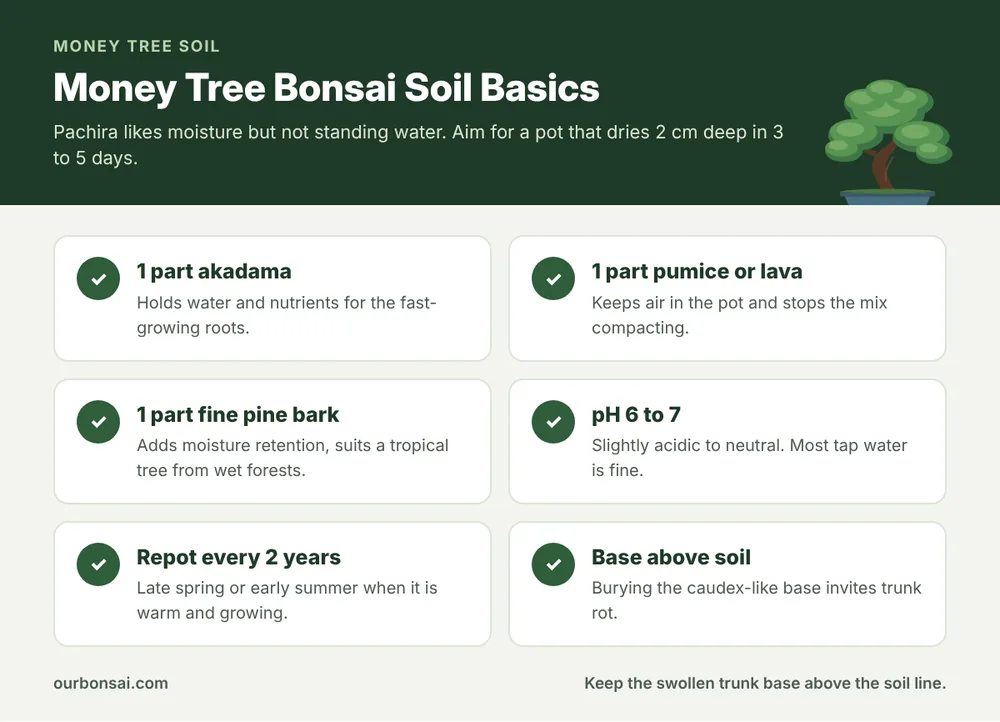
- Measure one part each of akadama, pumice and fine pine bark by volume. A yogurt pot makes a good scoop.
- Sift each component through a 2 mm screen and throw away the dust. For a small tree in a pot under 15 cm, use the 2 to 4 mm fraction. For a large braided tree, 3 to 6 mm.
- Combine dry. Stir thoroughly so the bark is spread evenly rather than layered.
- Moisten slightly before use. Dry akadama and bark can repel water at first.
No akadama? Use 50 percent pumice, 20 percent lava and 30 percent bark. No bark? Coconut coir chips work. Avoid plain peat, compost and garden soil. The principles are the same as in our guide to good potting soil for bonsai: structure first, water retention second.
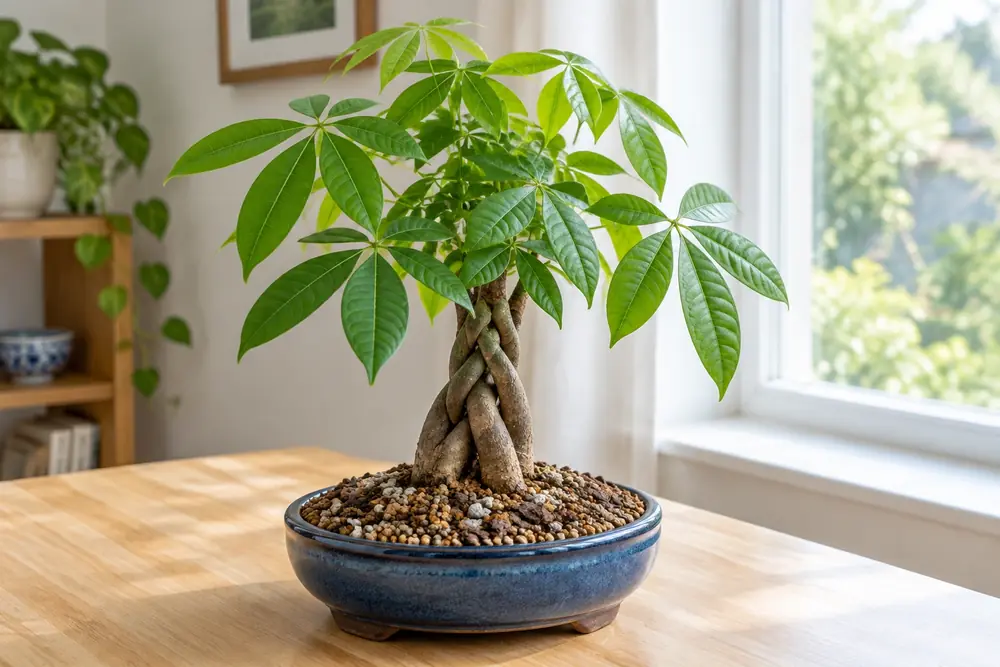
Braided trunks: a special case
Many money trees are three to five young stems braided together. Each stem has its own roots, and the stems compete. Two things follow for soil and repotting.
First, braids hide rot. One stem can die while the others look fine, and the dead stem then rots against the living ones. When you repot, press each stem near the base. A soft, wrinkled or loose stem is dead and should be cut out cleanly.
Second, the braid creates a tight crotch where water collects. Keep the soil level just below where the stems join, and water the soil, not the trunk.
Best soil for money tree bonsai by growing conditions
| Conditions | Mix | Watering rhythm |
|---|---|---|
| Indoors, bright window, normal home | 1 akadama : 1 pumice : 1 bark | When top 2 cm is dry, about every 4 to 7 days |
| Indoors, dry heated room in winter | Same mix, add a humidity tray | Every 5 to 8 days |
| Outdoors in summer (above 15 C at night) | 2 akadama : 1 pumice : 1 bark | Every 1 to 3 days |
| Under strong grow lights, warm | 1 akadama : 1 pumice : 1 bark | Every 3 to 5 days |
A gravel tray under the pot raises local humidity without wetting the soil. We compared a few in our review of bonsai humidity trays.
When and how to repot
Repot every 2 years while the tree is young, and every 3 years once it is in a finished pot. Money trees grow roots fast in warmth, so the best window is late spring to early summer, when room temperatures stay above about 18 C (65 F). Our article on when to repot tropical bonsai explains why warm-season repotting suits tropicals.
- Remove the tree and tease out the old soil. If it came from a store in peat, remove as much as you can this first time; Pachira tolerates heavy root work in warm weather.
- Cut away black, mushy roots and trim healthy ones by up to a third.
- Check each braided stem for rot.
- Repot at the same depth or slightly higher, never deeper.
- Water, keep in bright indirect light for a week, and wait 3 to 4 weeks before feeding.
Troubleshooting soil problems
- Yellow leaves dropping one after another, soil still damp after a week: too much water held in the pot. Switch to the mix above. Our guide to root rot in bonsai covers the rescue steps.
- Soft, wrinkled trunk base: rot inside the trunk. Cut back to firm tissue if possible; a fully soft stem cannot be saved.
- Leaves curling and crisping, soil bone dry: the mix is too coarse for your room, or the pot is too small. Add more akadama or bark.
- White crust on the soil surface: salts from fertilizer or hard water. Flush with plenty of water.
Frequently asked questions
Can I use regular houseplant potting soil for a money tree bonsai?
For a large houseplant money tree, yes, with extra perlite. For a bonsai in a shallow pot, no. Fine potting soil stays waterlogged in a shallow container.
Is cactus soil good for money trees?
It is closer than regular potting soil, but most bagged cactus mixes are still fine-textured. Mix it with an equal amount of pumice before using it.
How often should I water a money tree in this soil?
When the top 2 cm feel dry. Indoors that is usually every 4 to 7 days. In a bright spot in summer it can be every 2 to 3 days.
Should I add moss on top?
A thin layer looks nice but hides how wet the soil is. If you use it, check moisture with a chopstick rather than by looking.
Summary
A money tree in a bonsai pot wants a loose, middle-of-the-road mix: equal parts akadama, pumice and fine bark, with the trunk base kept clear of the soil. Repot every 2 years in warm weather and replace store peat at the first repot. For styling ideas once the roots are sorted, see our picks for money tree bonsai styles indoors, and for the species itself, the Wikipedia article on Pachira aquatica.