Best Soil for Meyer Lemon Bonsai: Mix and Repotting Tips

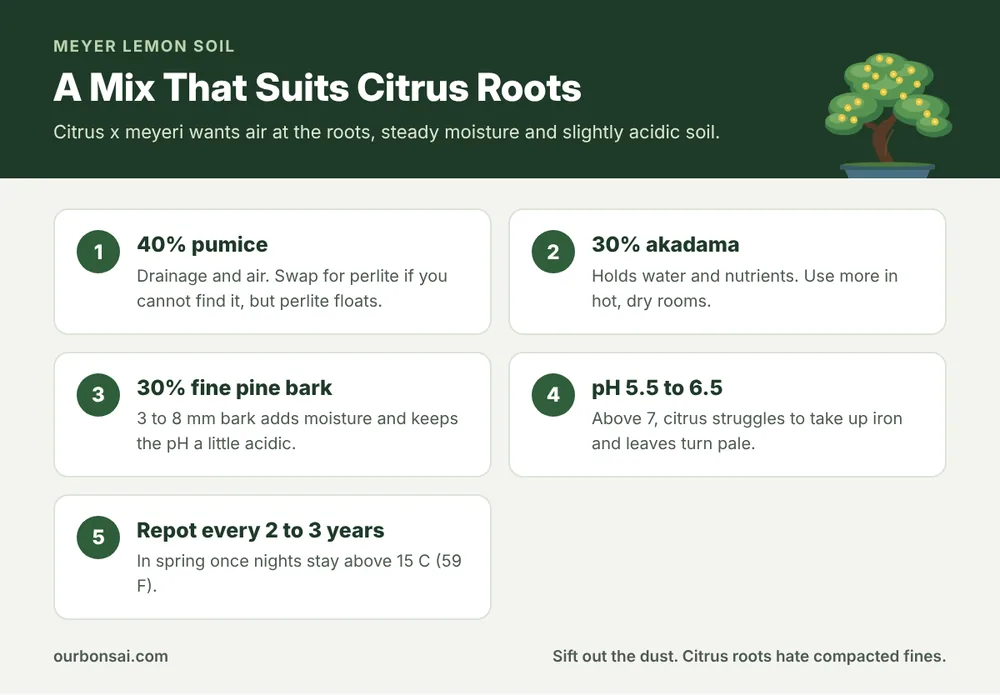
The best soil for meyer lemon bonsai is a gritty, slightly acidic mix that drains in seconds but still holds some moisture: about 40 percent pumice, 30 percent akadama and 30 percent fine pine bark, sifted to 2 to 6 mm, with a pH between roughly 5.5 and 6.5. That blend keeps citrus roots supplied with air (they rot quickly in wet, compacted soil) while holding enough water that a fruiting tree does not wilt and drop its lemons between waterings. In a typical indoor setting, a pot of this mix needs water every 2 to 4 days in summer and every 5 to 8 days in winter.
In this guide
What Meyer lemon roots need
Meyer lemon (Citrus x meyeri) is a hybrid between citron and a mandarin-pomelo cross, originally from China and brought to the United States in 1908. It is one of the most container-friendly citrus trees, which is why it shows up as a bonsai. But it has demanding roots:
- Lots of oxygen. Citrus feeder roots are fine and shallow. In heavy soil they suffocate, then rot.
- Even moisture. Unlike a pine, citrus reacts badly to drying out completely. Flowers and young fruit drop first.
- Slightly acidic conditions. In alkaline soil or with hard tap water, iron and manganese get locked up and new leaves turn yellow with green veins.
The goal is to satisfy all three at once. Ordinary potting soil fails the first test. Pure grit fails the second.
The best soil for meyer lemon bonsai: indoor and outdoor versions
Where the tree spends most of the year changes how fast the pot dries.
Indoor tree, under lights or in a sunny window. Use the 40/30/30 mix above. Indoor air is still, pots dry slowly, and the extra drainage protects against overwatering, which is the most common cause of death for indoor citrus.
Outdoor tree in a warm climate (USDA zones 9 to 11), or outdoors all summer. Increase water retention: 30 percent pumice, 40 percent akadama, 30 percent bark. Sun and wind can dry a shallow bonsai pot by early afternoon in July.
Hard tap water. If your water leaves white crust on the pot, keep the bark share at 30 percent or more and flush the pot with rainwater every few weeks to stop salts building up.
| Ingredient | What it does for citrus | Drawback |
|---|---|---|
| Pumice | Air space, drainage, holds water inside the grain | Light, so tie the tree in well |
| Akadama | Moisture and nutrient retention, shows dryness by color | Breaks down in 2 to 3 years |
| Fine pine bark | Holds water, keeps pH slightly acidic | Decomposes; must be sifted |
| Lava rock | Weight and drainage | Holds less water; use as a pumice swap |
| Perlite | Cheap drainage | Floats to the surface, crumbles |
| Peat or compost | Holds water | Compacts and stays soggy; avoid as a main component |
If you want to understand the general ratios behind these numbers, our page on bonsai soil mix ratios explains how each part shifts drainage and retention. For why bagged potting mix is the wrong starting point, read about bonsai soil versus regular soil.
Repotting a Meyer lemon bonsai
Citrus grows roots quickly, so repot a young tree every 2 years and an older one every 3. Spring is the right time, once night temperatures stay above about 15 C (59 F) and the tree is pushing new leaves. Avoid repotting while the tree carries heavy fruit or is in full bloom, because it may abort both.
- Water the day before.
- Remove the tree and comb out about one third of the old soil, starting at the edges and the bottom.
- Cut back circling and thick roots by up to a quarter of the root mass. Citrus is less tolerant of heavy root pruning than ficus.
- Fill the bottom of the pot with a thin layer of coarse grains, add the new mix, set the tree and tie it in.
- Water thoroughly and keep it in bright, indirect light for 10 to 14 days.
Wait about 4 weeks before feeding again. When you restart, a citrus fertilizer that includes iron, zinc and manganese works better than a general-purpose feed.
When soil is behind yellow leaves
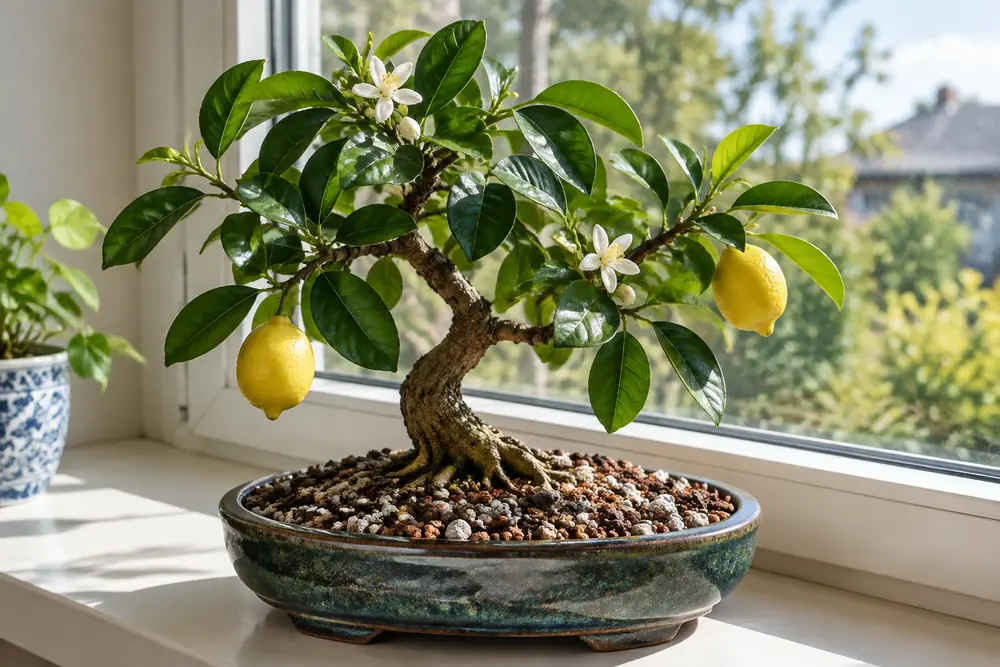
Many “my Meyer lemon is turning yellow” problems trace back to the pot.
- Uniform pale yellow, soil always damp: roots short of oxygen. Repot into a coarser mix and water less often. Our guide to root rot in bonsai shows how to check the roots.
- Yellow leaves with green veins on new growth: iron deficiency, often from high pH. Use rainwater or slightly acidified water and a fertilizer with chelated iron.
- Older leaves yellowing first, growth slow: nitrogen shortage. Feed more regularly during growth; fast-draining soil washes nutrients out.
- Leaves crisp at the edges with a white crust on the soil: salt buildup from hard water or too much fertilizer. Flush the pot with three or four times its volume of water.
Frequently asked questions
Can I use cactus or citrus potting mix from a garden center?
It can work for a large container lemon, but most of these mixes are too fine for a shallow bonsai pot. If that is all you have, blend it 50/50 with pumice and sift out the dust.
Is akadama necessary?
No. A mix of 50 percent pumice, 20 percent lava and 30 percent fine bark works well too. Akadama mainly helps you see when the pot is drying.
How deep should the pot be for a fruiting Meyer lemon?
Deeper than for most bonsai. A pot 8 to 12 cm deep gives enough soil volume to keep the tree from drying out while it carries fruit. Very shallow pots make fruit drop much more likely.
Can I put my Meyer lemon bonsai outdoors?
Yes, in warm months, and it usually grows better outside. Bring it in before nights drop below about 5 C (41 F). It tolerates a brief light frost, but bonsai roots in a pot are far more exposed than roots in the ground.
Bottom line
Give a Meyer lemon bonsai a coarse mix with roughly a third fine bark, keep the pH slightly acidic, and repot every 2 to 3 years in spring. That covers most of the root problems that lead to yellow leaves and dropped fruit. For more on keeping citrus and other flowering trees happy indoors, see our guide to flowering indoor bonsai tree care and our notes on indoor grow lights for bonsai. Background on the hybrid itself is on the Wikipedia page for Meyer lemon.