How to Repot Juniper Bonsai: When, Soil and Steps

If you are wondering how to repot juniper bonsai, the short version is this: repot in early spring (usually March to April in the Northern Hemisphere), every 2 to 3 years for a young tree and every 3 to 5 years for an older one, remove no more than about one third of the roots, and use a gritty mix of akadama, pumice and lava. Then keep the tree out of wind and strong afternoon sun for about two weeks and skip fertilizer for 4 to 6 weeks. Junipers recover well from a careful repot. Most failures come from cutting too many roots, bare-rooting, or repotting in midsummer heat.
In this guide
Does your juniper actually need repotting?
Junipers grow more slowly underground than many deciduous trees, so a calendar alone is not a good guide. Lift the tree gently by the trunk base (after removing any tie-down wire) and look at the root ball. Repot when you see any of these:
- Roots circling the inside of the pot in a solid mat.
- Water pooling on the surface for more than a few seconds before soaking in.
- Roots growing out of the drainage holes.
- Soil that has turned to a fine, muddy texture, which happens as akadama breaks down.
If the roots are only just reaching the pot walls and water still drains quickly, wait another year. Repotting too often weakens a juniper because it keeps cutting the fine roots before the tree can use them.
Best timing by situation
| Situation | When to repot | Notes |
|---|---|---|
| Outdoor juniper, cold winter climate | Early spring, as foliage tips turn pale green | The most reliable window |
| Outdoor juniper, mild climate (zones 8 to 10) | Late winter to early spring | Avoid repotting into summer heat |
| Emergency (root rot, broken pot) | Any time except a heat wave | Disturb the roots as little as possible |
| Collected (yamadori) juniper | Spring, and only after 1 to 2 years of recovery | Keep a large share of native soil |
| Tree you just styled heavily | Wait a full growing season | Never wire hard and repot in the same spring |
Some growers repot junipers in late summer, around August to early September, when roots grow a second time. It works in mild climates, but beginners have better results in spring.
Tools and soil for repotting a juniper
You need a root hook or chopstick, sharp root scissors, aluminum or copper wire for tying the tree in, mesh for the drainage holes, and fresh soil. A turntable helps but is optional. Our roundup of bonsai repotting tools covers what is worth buying.
For soil, use a gritty mix that drains in seconds. Roughly equal parts akadama, pumice and lava rock, sifted to 2 to 6 mm, suits most junipers. In wet climates, cut the akadama to 20 percent. Our juniper bonsai soil recipe has more variations.
How to repot juniper bonsai, step by step
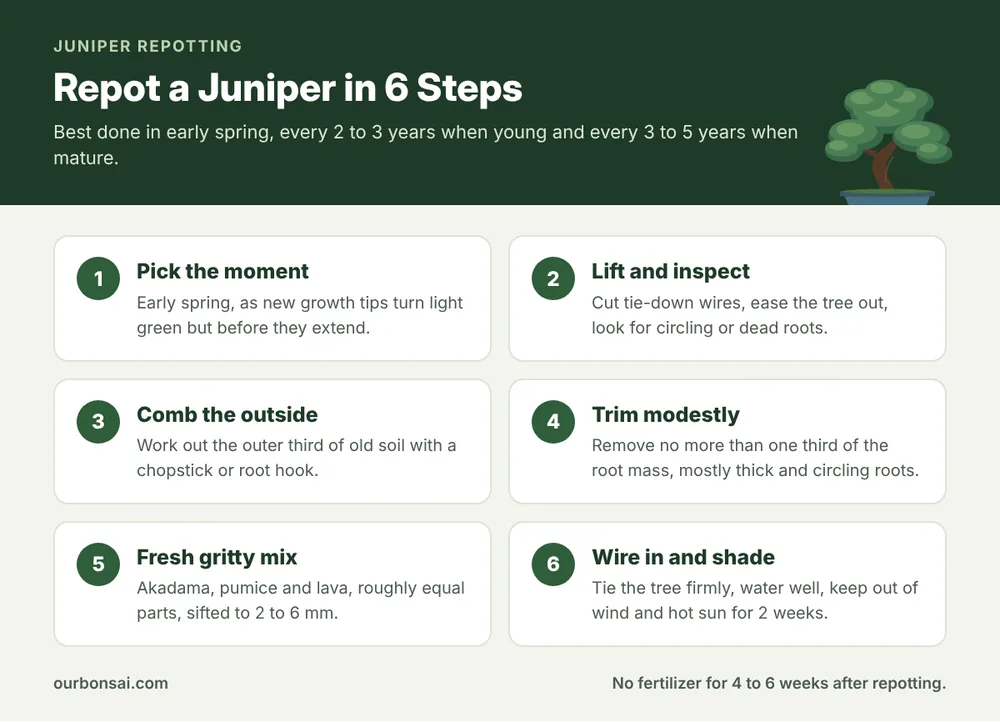
- Water lightly the day before. A slightly moist root ball comes out in one piece and is easier to comb.
- Cut the old tie-down wires under the pot and lift the tree out. If it sticks, run a thin knife around the inside wall.
- Look for the white fungus. Healthy juniper roots often carry fine white mycorrhizal threads. That is good. Keep some of it.
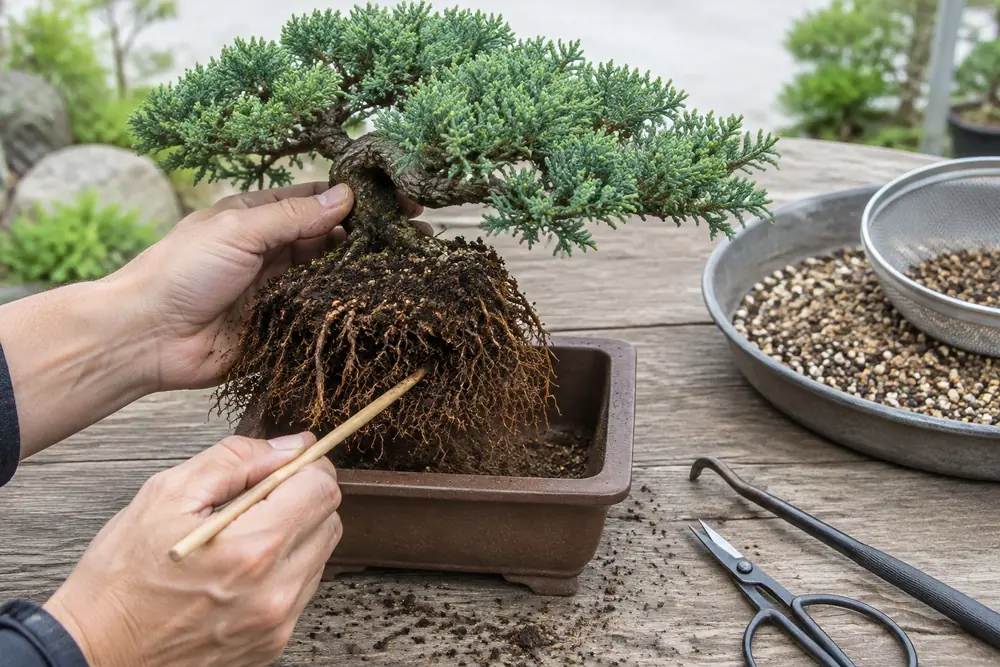
- Comb out the outer layer. Using a chopstick, work from the outside toward the center and from the bottom up, loosening roughly the outer third of the soil. Never wash or bare-root a juniper.
- Trim roots. Cut circling roots back to the edge of the combed area, and cut thick downward roots back to make room for a shallow pot. Do not remove more than about one third of the total root mass in one session.
- Prepare the pot. Fix mesh over the drainage holes, thread two tie-down wires, add a thin layer of coarse grains and then a mound of fresh mix.
- Set the tree. Position it at the planting angle you want, twist the wires over the root ball until the tree cannot rock, then work new soil into every gap with a chopstick.
- Water thoroughly until the water runs clear, which also flushes dust out of the new mix.
If the tree has an old, compacted core of field soil, do not try to remove it all at once. Take out a wedge of it at each repot over several years. A sudden change from heavy soil to pure grit can leave the core wet while the outside dries.
Aftercare for the first month
Days 1 to 14. Place the tree in bright shade or morning sun only, sheltered from wind. Junipers lose water through their foliage faster than the trimmed roots can replace it, so wind is the bigger threat. Mist the foliage once or twice a day in dry weather.
Weeks 2 to 4. Move it back into full sun gradually. Water when the top centimeter of soil is dry, not on a fixed schedule.
Week 4 to 6. Start a light feed once you see fresh growth extending. Our picks of fertilizers for juniper bonsai include slow-release organic pellets that are gentle on new roots.
Do no pruning or wiring for the rest of that growing season apart from pinching a few runaway shoots.
Mistakes to avoid
- Bare-rooting. Junipers do not recover reliably when all soil is washed off. Keep the core.
- Repotting an indoor juniper in December “because it has time.” It is not dormant in a warm room, and it should not be indoors at all. Junipers are outdoor trees; read why in our guide to Japanese juniper indoors.
- Loose trees. If the tree rocks in the wind, new roots tear. Wire it in tightly.
- Watering on a timer right after repotting. The new mix drains fast, but the old core may stay wet. Check both.
- Browning tips after repotting. A few brown tips are normal stress. Widespread browning usually means too many roots were cut or the tree dried out. See juniper bonsai turning brown for diagnosis.
Frequently asked questions
Can I repot a juniper in summer?
Only in an emergency. Heat increases water loss through the foliage while the roots are reduced, which is a bad combination. If you must, do the minimum, keep the tree in shade and mist it often.
How much root can I cut from a juniper?
About one third of the root mass on a healthy tree. Weak trees should have only the circling roots trimmed.
Should I put the juniper in a bigger pot?
For a tree still in development, yes, a pot one size larger lets the trunk thicken. For a finished tree, return it to the same pot after root pruning.
Is it normal for a juniper to look dull after repotting?
Yes, for 2 to 3 weeks. Foliage may lose a bit of shine. If it starts dropping or turning brown all over, check that the soil is not staying soaked or drying out completely.
Final thoughts
Repotting a juniper is less about technique and more about restraint: right season, a third of the roots at most, firm wiring, and two weeks of shelter. Get those four right and the tree will push new growth within a month. For species background, the Wikipedia page on Juniperus procumbens covers the most common bonsai juniper, and our Japanese juniper bonsai care guide covers the rest of the year.