Best Soil for Japanese White Pine Bonsai: Mix and Repotting Tips

The best soil for japanese white pine bonsai is a fast-draining, mostly mineral mix: roughly 40 percent pumice, 30 percent lava rock and 30 percent akadama, sifted to a grain size of 3 to 6 mm (about 1/8 to 1/4 inch). Organic matter should be close to zero. White pine (Pinus parviflora) is one of the most drought-tolerant trees in bonsai and one of the least forgiving of soggy roots, so the mix should let a watered pot dry to the touch on top within 1 to 2 days in summer and roughly 3 to 5 days in cool weather.
In this guide
That is the short answer. The rest explains why white pine needs a drier mix than black pine, what to change for your climate, and how to repot without killing the fungus that the tree depends on.
Why white pine is fussier than other pines
Japanese white pine grows wild on mountain slopes in Honshu, Shikoku and Kyushu, often on thin, rocky ground. Its root system evolved for quick drainage and cool, airy soil. Put it in a dense mix and the fine roots suffocate first, then the needles yellow from the inside of the tree outward.
There is a second reason. Many white pines sold as bonsai are grafted onto Japanese black pine rootstock because black pine roots grow faster and are more robust. A grafted tree tolerates a slightly wetter mix than a seedling or own-root white pine. If you can see a graft line low on the trunk, you have more margin. If you cannot, assume own roots and keep the mix lean.
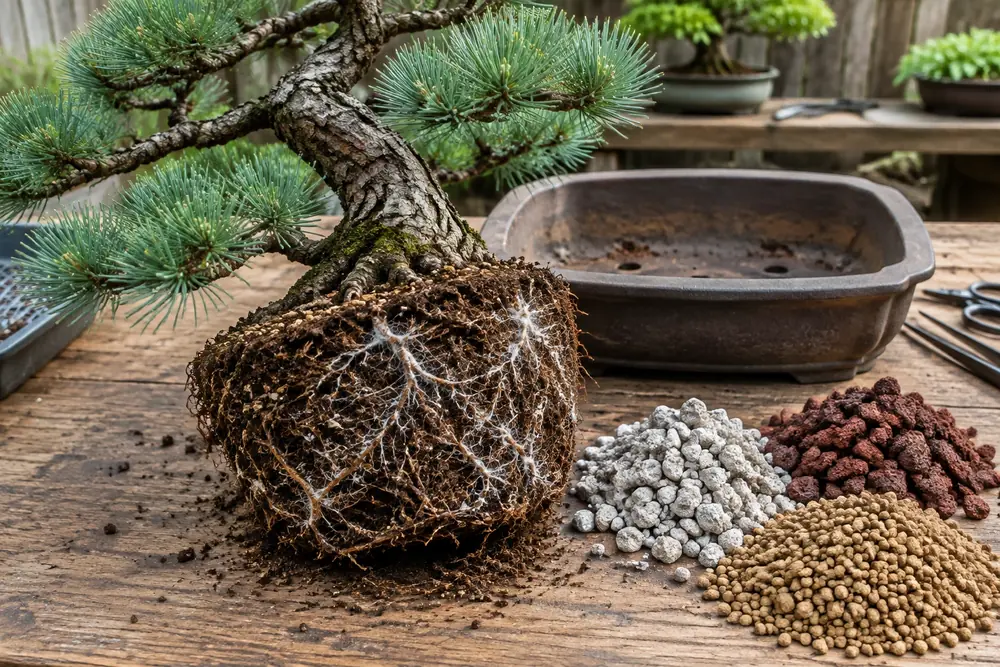
Pines also live in partnership with mycorrhizal fungi, the white, cottony threads you see when you slide the root ball out. These fungi extend the root system and help the tree take up phosphorus and water. A gritty, well-aerated mix keeps them alive. A wet, compacted mix kills them.
The best soil for japanese white pine bonsai, ingredient by ingredient
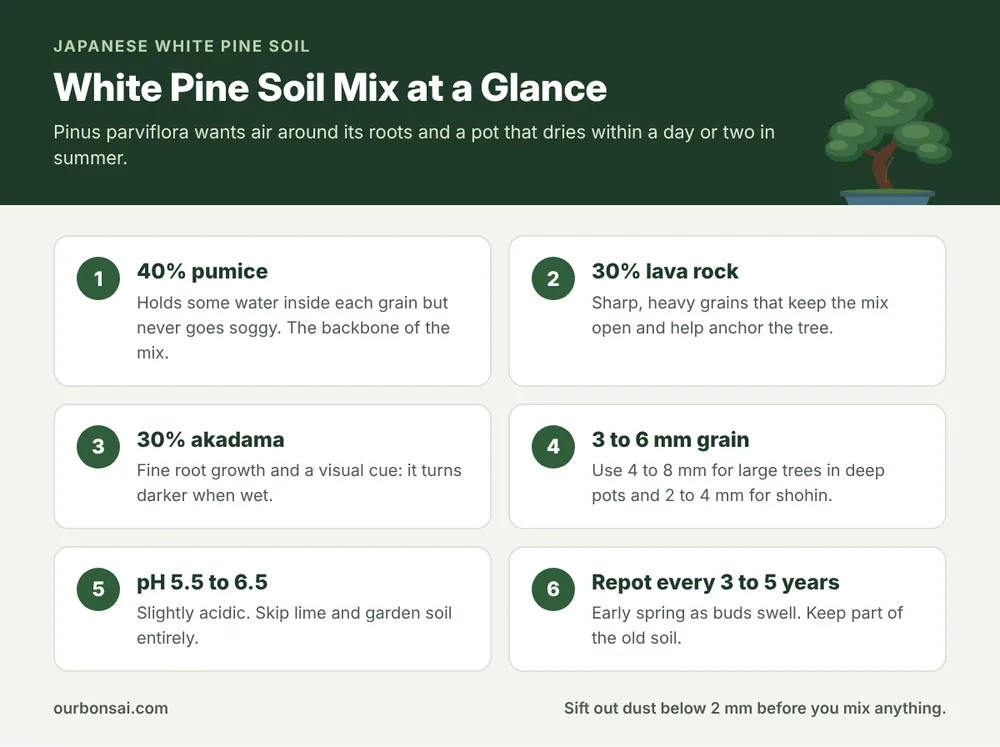
Pumice is the main component. It is light, porous and holds water inside the grain while the gaps between grains stay full of air. It does not break down, so the pot stays open for years.
Lava rock adds weight and rough edges. Roots grip it well, which helps a freshly repotted tree stay put. It holds a little less water than pumice.
Akadama is a baked Japanese clay. It encourages fine feeder roots and shows you when the pot needs water, because it goes from dark brown to light tan as it dries. The catch: it breaks down in 2 to 3 years, especially after hard freezes, and turns into mud. For white pine, keep it at a third or less.
Some growers use pure pumice and lava with no akadama at all, especially in rainy regions. That works. Others add 10 percent fine pine bark for trees in hot, dry climates where pots dry out by noon. Our page on bonsai soil mix ratios explains how each ingredient changes water retention if you want to fine-tune.
Adjusting the mix to your climate
| Your conditions | Suggested white pine mix | Why |
|---|---|---|
| Cool, wet winters (UK, Pacific Northwest) | 50% pumice, 40% lava, 10% akadama | Less akadama means less mush after frost and faster drying |
| Hot, dry summers (Texas, inland California) | 35% pumice, 25% lava, 30% akadama, 10% fine bark | Holds more water so the pot does not dry out by midday |
| Humid summers (US Southeast) | 40% pumice, 40% lava, 20% akadama | Extra air space protects against root rot in muggy heat |
| Shohin pots under 15 cm | Same ratios at 2 to 4 mm | Smaller grains suit smaller pots and finer roots |
Whatever recipe you choose, sift every component. Dust under about 2 mm fills the air gaps and defeats the purpose. A kitchen colander will not do it; a set of bonsai sieves will.
What not to use
- Bagged potting soil or garden soil. Too fine, too much organic matter. It stays wet for a week and compacts. See the difference between bonsai soil and regular soil if you are not sure why it matters.
- Pure akadama. Fine for some deciduous trees, risky for white pine in a wet climate.
- Peat-based “bonsai soil” from garden centers. Many contain mostly peat and a little grit. Check the bag; if it feels spongy, it is not right for a pine.
- Lime or wood ash. White pine prefers slightly acidic conditions, roughly pH 5.5 to 6.5.
If you would rather buy than mix, a pre-blended inorganic mix works. Our reviews of premium bonsai soil cover a few that are mostly pumice and lava.
When and how to repot a white pine
Repot every 3 to 5 years for a developing tree and every 5 years or so for a refined one. The right moment is early spring, when the buds begin to lengthen but before the new needles open. In most of the US that is March to early April.
- Water the tree lightly the day before so the root ball holds together.
- Lift the tree and comb out roughly the outer third of the root ball with a chopstick. Leave the core alone.
- Keep about half of the old soil. It carries the mycorrhizal fungus that the new mix needs.
- Trim only long, circling roots. Never bare-root a white pine.
- Add a drainage layer of 6 to 9 mm grains, then the main mix, working it into gaps with a chopstick.
- Tie the tree in firmly with wire through the drainage holes.
- Water until it runs clear, then keep the tree out of wind and strong afternoon sun for 2 to 3 weeks.
Hold off on fertilizer for about four weeks. The pine already has energy stored, and fresh cut roots burn easily.
Signs the soil is wrong
- Water sits on the surface for more than a few seconds. The mix has broken down or was too fine.
- Needles yellow on older growth while new candles stay short. Often roots are staying wet too long.
- Green algae or moss covering most of the surface. The surface is wet all the time.
- Tree wobbles in the pot a year after repotting. Roots are not growing well, often a sign of a dead or rotted root zone. Our guide to root rot in bonsai explains what to do next.
Frequently asked questions
Can I use the same soil for Japanese white pine and black pine?
Mostly, yes. Black pine tolerates a little more water and more akadama. If you keep both, use your white pine mix for both and water the black pine slightly more often. Our article on the best soil for Japanese black pine bonsai gives its own ratios.
Should I add mycorrhizal powder from the store?
It rarely hurts, but old soil from a healthy pine is a better source. If you are repotting a pine that has no visible white fungus, a commercial pine mycorrhizal inoculant is worth a try.
How often should I water a white pine in this mix?
Water when the top centimeter of soil is dry. In summer that can be daily; in winter, perhaps every week or two. Let the surface dry between waterings, which pines like.
Is kanuma good for white pine?
No. Kanuma is very acidic and soft, made for azaleas. It holds too much water for a pine.
Final thoughts
White pine rewards a lean, mineral mix and a light hand at repotting. Pumice, lava and a modest share of akadama, sifted and sized to the pot, will keep the roots dry enough and the fungus alive. Repot only when the pot is full, keep half the old soil, and the tree will settle back in within a season. For the botany and native range of the species, the Wikipedia entry on Pinus parviflora is a good reference, and our list of evergreen bonsai trees compares it with other conifers.