How to Repot Schefflera Bonsai: When, Soil and Aerial Roots

Here is how to repot schefflera bonsai in one paragraph: repot every 2 years (every year for a young, fast tree) in late spring or summer, when temperatures stay above about 18 C (65 F). Schefflera grows roots quickly, so a healthy tree can lose up to half of its root mass. Use a moisture-holding but well-drained mix such as equal parts akadama, pumice and fine pine bark. Keep any long aerial roots and guide them into the soil. After repotting, place the tree in bright shade for about two weeks and wait 3 to 4 weeks before fertilizing.
In this guide
Why schefflera is easy to repot
The dwarf umbrella tree (Schefflera arboricola, now sometimes listed as Heptapleurum arboricola) comes from Taiwan and Hainan, where it grows as a shrub or epiphyte in warm, humid forests. It produces roots readily, including aerial roots from its trunk and branches. That vigor is why it suits beginners and why it handles repotting so well.
The flip side is that it fills a bonsai pot quickly. A schefflera left for 3 or 4 years in the same pot becomes root-bound, sheds leaves from the inner canopy and stops responding to pruning. Our dwarf schefflera bonsai care guide covers the rest of its needs.
When to repot
Look for these signs:
- roots circling the inside of the pot or poking out of the drainage holes,
- water taking longer to soak in, or running straight down the sides,
- the root ball lifting the tree above the rim,
- leaf drop that is not explained by light or watering changes.
Then pick a warm moment. Unlike temperate trees, schefflera does not need to be dormant. It needs heat so the cut roots regrow fast. Late spring through midsummer is ideal indoors. Avoid repotting in winter, when growth slows in low light and cool rooms. Our article on the best time to repot tropical bonsai explains the reasoning in more detail.
Soil for a schefflera bonsai
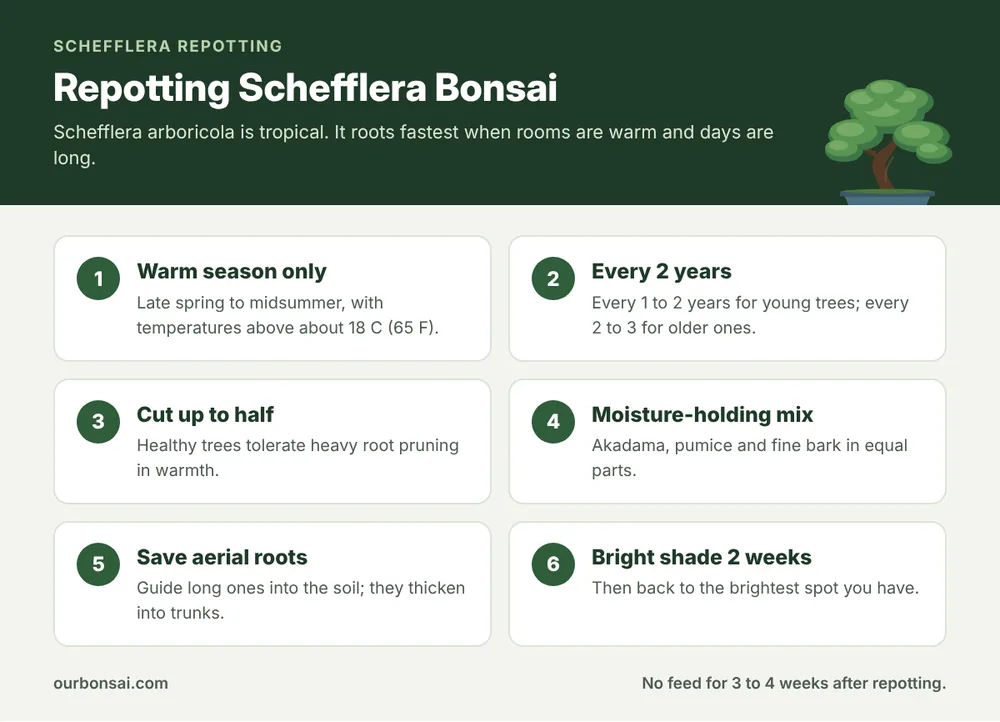
Schefflera likes more moisture than a juniper, but its fleshy roots still rot in soggy soil. A good balance:
- 1 part akadama
- 1 part pumice or lava
- 1 part fine pine bark
Sift to 2 to 6 mm. In a warm, dry indoor room, add a little more akadama or bark. If the tree lives outdoors in a humid summer, increase the pumice. pH is not critical; slightly acidic to neutral suits it.
Many schefflera bonsai are sold in dense peat or clay-heavy nursery soil. That is fine in a big nursery pot under misting, but in a shallow bonsai pot in a living room it stays wet for days. The first repot is your chance to replace it. Because the species is so vigorous in warmth, you can remove most of that old soil in one go, which is not true of pines or junipers.
How to repot schefflera bonsai, step by step
- Water the tree the day before so the root ball is moist but not dripping.
- Lay out your tools: root hook or chopstick, sharp scissors, a concave cutter for thick roots, mesh, wire and the new soil. Our repotting tools guide shows the basics.
- Lift the tree out. If it is stuck, slide a thin knife around the pot wall.
- Comb out old soil. Work from the outside in. With a vigorous schefflera in summer, you can remove most of it.
- Prune roots. Cut thick roots heading straight down and any circling roots. Remove black or mushy roots completely. On a healthy tree, up to half the root mass can go.
- Prepare the pot with mesh over the holes and tie-down wires in place.
- Position the tree, wire it in and work fresh soil into the root ball with a chopstick.
- Water thoroughly until it drains clear.
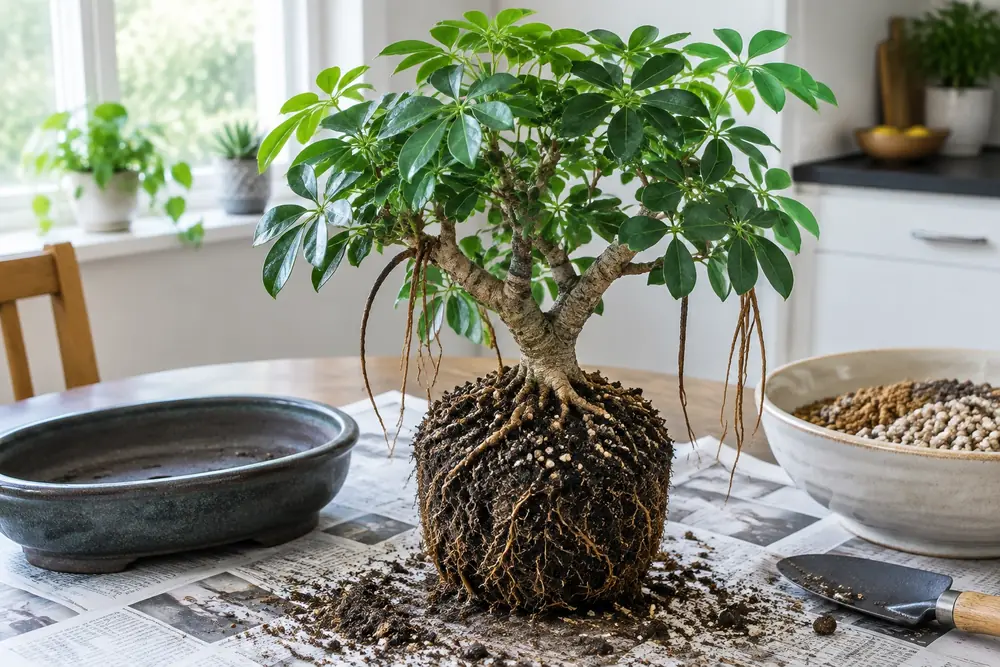
Working with aerial roots
Aerial roots are the thin brown roots that hang from branches and the trunk. In bonsai, they are an asset: once they reach soil, they thicken and can be trained into a banyan-style root forest.
At repotting:
- Keep long aerial roots and lead them into the soil. You can pin them to the trunk with raffia or tape until they take hold.
- Trim short, dry ones that will not reach the soil if they spoil the look.
- Raise humidity if you want more of them. A humidity tray and occasional misting encourage new aerial roots; dry indoor air stops them.
After repotting
| Time | What to do |
|---|---|
| Days 1 to 14 | Bright shade, no direct midday sun, no cold drafts. Mist leaves daily if the air is dry. |
| Weeks 2 to 3 | Return to strong light. New leaves should appear. |
| Weeks 3 to 4 | Resume feeding at half strength, then full strength. |
| Week 6 onward | Pruning and defoliation are fine again if the tree is growing strongly. |
A few yellow leaves in the first week are normal. Ongoing leaf drop with constantly wet soil points to rot; see our page on root rot in bonsai.
Mistakes to avoid
- Repotting in a cold room in winter. Roots barely grow, and the cut ends rot.
- Using dense houseplant soil. It stays wet in a shallow pot.
- Cutting off all the aerial roots. You lose one of the best features of the species.
- Placing it in full sun straight after. Even a sun-loving schefflera scorches with half its roots missing.
- Overwatering a smaller root system. Water only when the top centimeter is dry.
Frequently asked questions
Can I repot schefflera and defoliate it at the same time?
Experienced growers sometimes do both in early summer on very strong trees. For most people, it is safer to repot first and defoliate 6 to 8 weeks later.
How much root can I remove?
Up to half on a healthy tree in warm weather. If the tree has been struggling, remove only dead and circling roots.
Should I go up a pot size?
If you are still thickening the trunk, yes. For a tree already at its final size, root prune and return it to the same pot.
My schefflera dropped leaves after repotting. Is it dying?
Not necessarily. Some leaf drop is common, especially if light or temperature also changed. If the stems stay firm and green and new buds appear within 3 to 4 weeks, it is recovering.
Final thoughts
Schefflera rewards warm-season repotting with quick root growth and a burst of new leaves. Give it a balanced mix, keep its aerial roots, and avoid winter repots. For more on the species and its native range, see the Wikipedia article on Schefflera arboricola, and for a store-bought example, our review of the Hawaiian umbrella bonsai.