Best Left-Handed Bonsai Tools: Shears, Pruners and What Needs No Lefty Version


As an Amazon Associate we earn from qualifying purchases. See our affiliate disclosure.
In this guide
- Our Top Picks at a Glance
- Which Bonsai Tools Are Handed?
- 1. TianBonsai Left-Handed Bonsai Scissors 210 mm (Best Left-Handed Bonsai Scissors)
- 2. Felco F9 Left-Handed Pruner (Best Left-Handed Pruner)
- 3. Felco F16 Left-Handed Pruner (Best for Small Hands)
- 4. Felco F17 Left-Handed Pruner with Revolving Handle (Best for Long Sessions)
- 5. Felco F10 Left-Handed Pruner (Best for Large Hands)
- 6. Spear & Jackson Razorsharp Left-Handed Pruner (Best Mid-Price Left-Handed Pruner)
- 7. Zenport Left-Hand Pruning Shear (Best Value Left-Handed Pruner)
- 8. SAKAGEN Hand Creation Left-Handed Floral Scissors (Best for Fine Detail Work)
- 9. Fiskars SoftGrip Bypass Pruner (Best Cheap Ambidextrous Pruner)
- Also Worth a Look
- How to Build a Left-Handed Bonsai Kit
- Frequently Asked Questions
- Final Verdict
Quick answer: left-handed bonsai growers need only two kinds of tool made for them: scissors and bypass pruners. The TianBonsai left-handed 210 mm bonsai scissors are the only true left-handed bonsai shears we found on Amazon and they are good ones, in 5Cr15MoV alloy steel. For a left-handed pruner, Felco's Swiss range is the standard: the Felco F9 for most hands, the F16 for smaller hands and the F10 for large ones. Everything else, concave cutters, knob cutters, wire cutters, jin pliers, splitters, root hooks, is symmetrical, so buy the best you can afford from any brand.
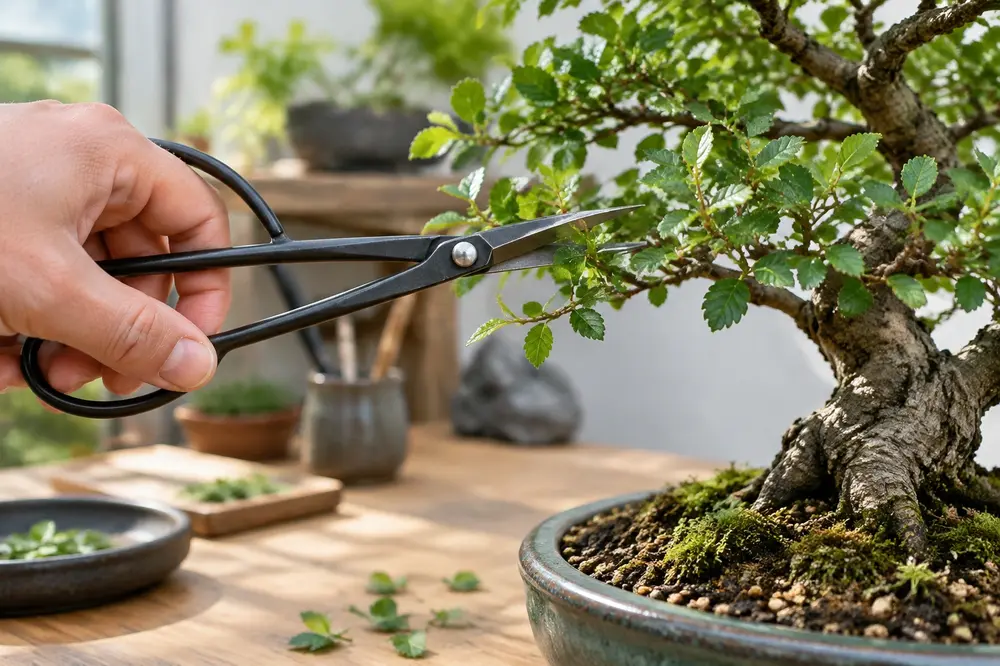
About one person in ten is left-handed, and most of them have spent a lifetime using right-handed scissors badly. In bonsai it matters more than in the kitchen, because the point of a fine shear is to see exactly where the blade meets the twig. Hold right-handed scissors in your left hand and two things happen: your thumb pushes the blades apart instead of together, so they fold the stem rather than cut it, and the upper blade hides the cut line from your eye. True left-handed scissors reverse the blade stack so both problems disappear. The reassuring part is how few tools are affected.
Our Top Picks at a Glance
| Tool | Details | Best for |
|---|---|---|
| TianBonsai Left-Handed Bonsai Scissors 210 mm | 5Cr15MoV alloy steel, long handles, with bag | Best left-handed bonsai scissors |
| Felco F9 Left-Handed Pruner | Swiss-made bypass, 210 mm, 25 mm cut, 245 g | Best left-handed pruner |
| Felco F16 Left-Handed Pruner | Swiss-made bypass, 7.7 in, for smaller hands | Best for small hands |
| Felco F17 Left-Handed Pruner with Revolving Handle | Swiss-made bypass, 7.9 in, rotating handle | Best for long sessions |
| Felco F10 Left-Handed Pruner | Swiss-made bypass, 210 mm, 290 g, large hands | Best for large hands |
| Spear & Jackson Razorsharp Left-Handed Pruner | Carbon steel bypass, soft grips | Best mid-price left-handed pruner |
| Zenport Left-Hand Pruning Shear | Stainless bypass, 1 in cut, replaceable blade | Best value left-handed pruner |
| SAKAGEN Hand Creation Left-Handed Floral Scissors | Made in Japan, fluorine-coated, 6.7 in | Best for fine detail work |
| Fiskars SoftGrip Bypass Pruner | Ambidextrous design, 5/8 in cut | Best cheap ambidextrous pruner |
Which Bonsai Tools Are Handed?
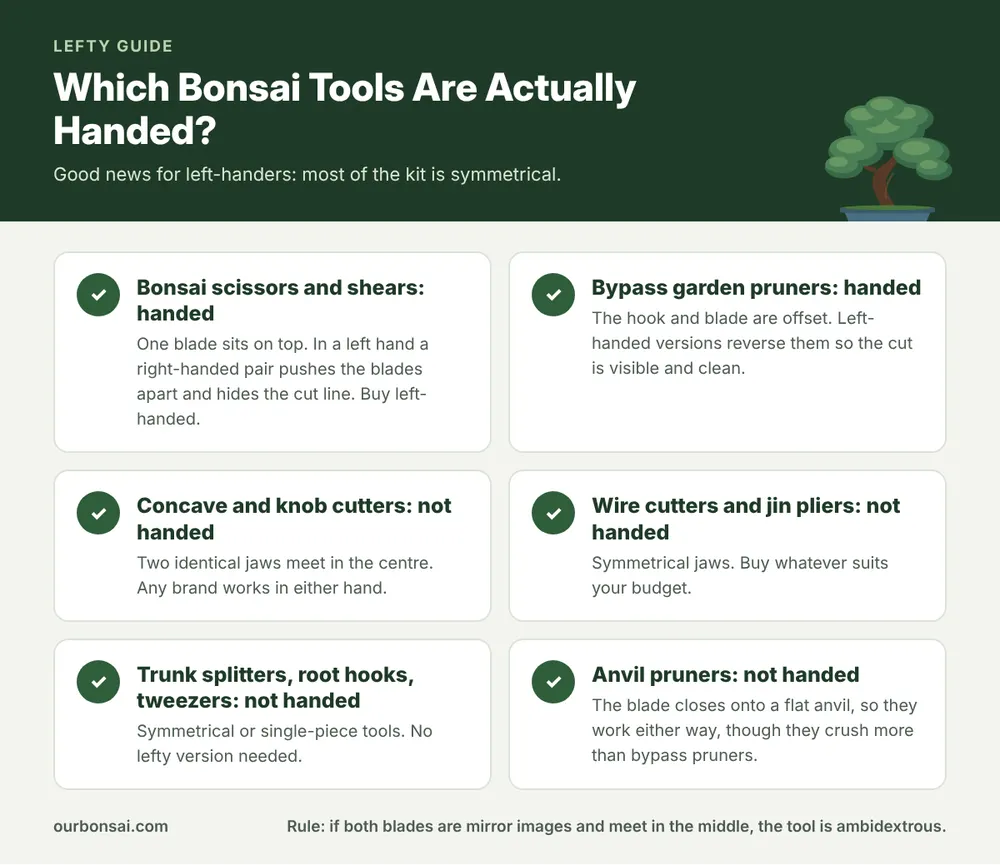
Think about how the blades meet. Scissors and bypass pruners have one blade passing beside the other, so they are mirror-imaged and come in left and right versions. Concave cutters, knob cutters, wire cutters and jin pliers have two identical jaws that meet in the middle; there is no left or right, and the cutters in our knob cutter guide and wire cutter guide suit either hand. Anvil pruners close a blade onto a flat bar and are also ambidextrous. Root hooks, rakes, tweezers, saws and splitters are symmetrical too. So a left-handed bonsai kit is an ordinary kit with the scissors and the pruners swapped. If you are assembling one on a budget, start with our budget tool set guide and replace only the scissors.
1. TianBonsai Left-Handed Bonsai Scissors 210 mm (Best Left-Handed Bonsai Scissors)
| Model | MT-LBS-210L, left-handed |
|---|---|
| Steel | 5Cr15MoV alloy, group forged |
| Length | 210 mm |
| Grade | Professional |
| Included | Tool bag |
TianBonsai is the one maker we found that produces a dedicated left-handed bonsai scissor, and it is from their professional series rather than a budget line: 5Cr15MoV alloy steel, the same grade as their best right-handed shears. The 210 mm long-handled pattern is the classic Japanese bonsai scissor for reaching into dense foliage to pick buds and trim twigs, and with the blades stacked for a left hand you can finally see what you are cutting.
It comes with a small tool bag. The maker also notes left-handed options for its compact 180 mm scissors for shohin work, though that listing had limited stock when we checked. For the rest of the brand's range see our TianBonsai tools review.
Pros
- Genuine left-handed blade stack
- Professional-grade alloy steel
- Long handles for reaching into foliage
- Reasonable price
Cons
- Only one left-handed bonsai scissor model on the market
- Plain finish
Best for: every left-handed bonsai grower; this is the one essential purchase.
2. Felco F9 Left-Handed Pruner (Best Left-Handed Pruner)
| Type | Bypass, left-handed |
|---|---|
| Length and weight | 210 mm (8.3 in), 245 g |
| Cut capacity | 25 mm (1 in) |
| Handles | Forged aluminium, cushion stop, shock absorber |
| Extras | Sap groove, wire-cutting notch, fine blade adjustment, all parts replaceable |
Felco pruners are the pruner most professional gardeners carry, and the F9 is the left-handed mirror of their classic F8. Forged aluminium handles, a hardened steel blade you can replace, a sap groove, a notch for cutting wire and a lifetime warranty. For bonsai, a pruner handles the jobs scissors should not: thick roots at repotting, cutting back nursery stock, removing a branch before the concave cutter tidies the stub.
It is a tool that lasts decades with occasional new blades. Felco has made pruners in the Swiss Jura since the 1940s.
Pros
- True left-handed bypass geometry
- Replaceable blade and parts
- Lifetime warranty
- 25 mm cutting capacity
Cons
- Expensive for a pruner
- Too big for fine bonsai work; pair with scissors
Best for: roots, nursery stock and coarse pruning.
3. Felco F16 Left-Handed Pruner (Best for Small Hands)
| Type | Bypass, left-handed, compact |
|---|---|
| Length | 7.7 in |
| Handles | Forged aluminium with rubberised grips |
| Blades | Carbon steel, micrometric adjustment |
| Warranty | Lifetime on handles, all parts replaceable |
The F16 is the left-handed version of Felco's compact F6, sized for smaller hands. Same forged aluminium handles, same replaceable carbon steel blade, same fine adjustment mechanism, in a shorter body that closes comfortably in a small palm. If the F9 feels like a stretch to open fully, this is the one.
A compact pruner is also handier around a bonsai bench than a full-size one.
Pros
- Sized for smaller hands
- Felco build and parts availability
- Lifetime warranty
Cons
- Smaller cut capacity than the F9
- Still a premium price
Best for: left-handers with small or medium hands.
4. Felco F17 Left-Handed Pruner with Revolving Handle (Best for Long Sessions)
| Type | Bypass, left-handed |
|---|---|
| Length | 7.9 in |
| Handle | Revolving lower handle |
| Blades | Carbon steel, micrometric adjustment |
| Warranty | Lifetime, all parts replaceable |
Felco's revolving handle rotates as you squeeze, so the grip rolls across your fingers instead of rubbing one spot. It is designed for people who make hundreds of cuts a day and for anyone with hand or wrist pain. The F17 is the left-handed version, otherwise identical in quality and parts to the rest of the range.
Give it a few sessions; the rolling handle feels odd at first and then you will not want to go back.
Pros
- Revolving handle reduces strain
- Felco quality and parts
- Left-handed geometry
Cons
- Highest price here
- Rolling handle takes getting used to
Best for: left-handers with arthritis or who prune for hours.
5. Felco F10 Left-Handed Pruner (Best for Large Hands)
| Type | Bypass, left-handed, for large hands |
|---|---|
| Length and weight | 210 mm (8.3 in), 290 g |
| Cut capacity | 25 mm |
| Handles | Forged aluminium, cushioned shock absorber |
| Note | All components replaceable |
The F10 is the big-handed lefty's pruner: the same 210 mm length as the F9 but with a wider grip and the ergonomic cushioned handle of Felco's F10 series. Hardened steel blade, narrow pointed anvil for getting close to the trunk, sap groove and wire notch. The listing noted limited stock when we checked.
If the F9 feels cramped, this is the answer.
Pros
- Built for large hands
- Felco durability
- 25 mm capacity
Cons
- Heaviest pruner here
- Limited stock
Best for: left-handers with large hands.
6. Spear & Jackson Razorsharp Left-Handed Pruner (Best Mid-Price Left-Handed Pruner)
| Type | Bypass, left-handed |
|---|---|
| Blades | Carbon steel |
| Handles | Soft-grip |
| Size | 8.46 x 2.36 in, 0.6 lb |
Spear & Jackson is a long-established British garden tool maker, and its Razorsharp left-handed pruner is a sound alternative to Felco at a lower price: carbon steel bypass blades, soft-grip handles, designed from the start for left-handers rather than adapted. Stock was limited when we checked.
Parts are not replaceable the way Felco's are, so treat it as a tool with a long life rather than an indefinite one.
Pros
- True left-handed design
- Carbon steel blades
- Lower price than Felco
Cons
- Limited stock
- Not user-serviceable
Best for: left-handers who want a proper pruner without the Felco price.
7. Zenport Left-Hand Pruning Shear (Best Value Left-Handed Pruner)
| Type | Bypass, left-handed |
|---|---|
| Blade | Stainless steel, replaceable |
| Cut capacity | Up to 1 in |
| Features | Shock absorber, sap groove |
Zenport makes horticultural tools for the trade, and its left-hand pruner has the features you want at the price you would rather pay: a replaceable stainless bypass blade, a shock absorber, a sap groove and a 1 inch capacity. The listing showed limited stock.
A good second pruner to keep with the repotting tools.
Pros
- Replaceable blade
- Full feature set
- Good price
Cons
- Limited stock
- Less refined than Felco
Best for: budget-minded left-handers.
8. SAKAGEN Hand Creation Left-Handed Floral Scissors (Best for Fine Detail Work)
| Type | Left-handed florist scissors |
|---|---|
| Made in | Japan |
| Blades | Fluorine-coated, rust-resistant |
| Size | 6.7 x 4.3 in, 6.5 oz |
| Award | Japan Good Design Award |
Not a bonsai tool by name, but Japanese florist scissors are what many bonsai growers use for leaf pruning, defoliation and pinching soft growth, and SAKAGEN's Hand Creation series is the best-selling florist scissor in Japan. This is the dedicated left-handed version: short, fluorine-coated blades that shrug off sap, a compact 6.7 inch body and a Good Design Award. Stock was limited when we checked.
Keep them for soft growth; they are not for woody twigs.
Pros
- Genuine left-handed Japanese scissors
- Non-stick coated blades
- Compact and light
Cons
- For soft growth only
- Limited stock
Best for: defoliation, leaf pruning and pinching on deciduous and tropical trees.
9. Fiskars SoftGrip Bypass Pruner (Best Cheap Ambidextrous Pruner)
| Type | Bypass, ambidextrous shape |
|---|---|
| Cut capacity | 5/8 in |
| Blade | Hardened steel, low-friction coating |
| Handles | SoftGrip |
| Warranty | Lifetime |
Fiskars designs this pruner's handle shape to suit either hand. Be clear about what that means: the blade geometry is still conventional, so a left-hander loses some of the clean bypass action, but the grip does not fight you and for stems up to 5/8 inch it cuts well. It is cheap, rust-resistant and backed by a lifetime warranty.
It is the pruner to buy if you want something in the tool roll today and are saving for a Felco. Our guide to pruning shears for beginners covers the right-handed options in more depth.
Pros
- Very low price
- Comfortable in either hand
- Lifetime warranty
Cons
- Not a true left-handed blade stack
- Small cutting capacity
Best for: a cheap first pruner, or a spare.
Also Worth a Look
- Any concave cutter, knob cutter or wire cutter from our best bonsai tool brands guide works in the left hand; the Kaneshin and Wazakura cutters are as good for lefties as for anyone.
- Left-handed Japanese bonsai scissors from makers such as Masakuni and Kaneshin exist but are sold through specialist bonsai shops rather than Amazon; if you want forged Japanese steel in a lefty shear, that is where to look.
How to Build a Left-Handed Bonsai Kit
Swap only what is handed
Buy left-handed bonsai scissors and a left-handed pruner. Then buy your concave cutter, knob cutter, wire cutter and jin pliers exactly as a right-hander would, because they are symmetrical. That keeps the cost of being left-handed to two tools.
Check the blade stack, not the label
Some tools sold as left-handed merely have reversed grips. On true left-handed scissors, held in your left hand with the points away from you, the blade nearest your eye is on the left. If the listing photos show the blades the other way round, it is a right-handed tool.
Match the pruner to your hand
Felco sizes its left-handed pruners the same way as its right-handed ones: F16 for small hands, F9 for medium, F10 for large, F17 if you want the revolving handle. Measure your palm width and compare it with the maker's guidance before you buy.
Know what each tool is for
Scissors trim twigs, buds, leaves and fine roots. Pruners handle thick roots and rough reduction. The concave cutter removes branches so the wound heals flat. The wire cutter takes wire off. Our tools overview and pruning guide explain the sequence.
Teach the right-handers
If you share tools at a club, label your left-handed scissors. A right-hander using them has exactly the problems you have had for years, and will blunt them trying.
Frequently Asked Questions
Do left-handed people need special bonsai tools?
Only for scissors and bypass pruners, which have an offset blade stack. Concave cutters, knob cutters, wire cutters, jin pliers, splitters, root hooks and tweezers are symmetrical and work in either hand.
What are the best left-handed bonsai scissors?
The TianBonsai MT-LBS-210L professional left-handed bonsai scissors in 5Cr15MoV alloy steel are the only dedicated left-handed bonsai shears we found on Amazon, and they are good ones.
What is the best left-handed pruner for bonsai?
The Felco F9 is the standard left-handed bypass pruner, with the F16 for small hands, the F10 for large hands and the F17 for a revolving handle. The Spear & Jackson Razorsharp and Zenport left-hand pruners cost less.
Can a left-hander use a right-handed concave cutter?
Yes. The two jaws are identical and meet in the centre, so there is no left or right version.
Why are right-handed scissors hard to use left-handed?
Your thumb pushes the blades apart instead of together, so stems fold rather than cut, and the upper blade hides the cutting line from your eye. Left-handed scissors reverse the blade stack.
Are ambidextrous pruners as good as true left-handed ones?
They are more comfortable than right-handed pruners but keep a conventional blade stack, so the cut is slightly less clean for a left-hander. They are a good cheap option.
Do Japanese makers sell left-handed bonsai shears?
Some do, such as Masakuni and Kaneshin, but mainly through specialist bonsai shops rather than Amazon.
Final Verdict
Buy the TianBonsai left-handed bonsai scissors, then pick the Felco that fits your hand: F9 for most, F16 for small hands, F10 for large, F17 for a rolling handle. Fill the rest of the roll with ordinary cutters from any good brand, because they were never handed in the first place.