How to Repot Pomegranate Bonsai: Timing, Soil and Flowers

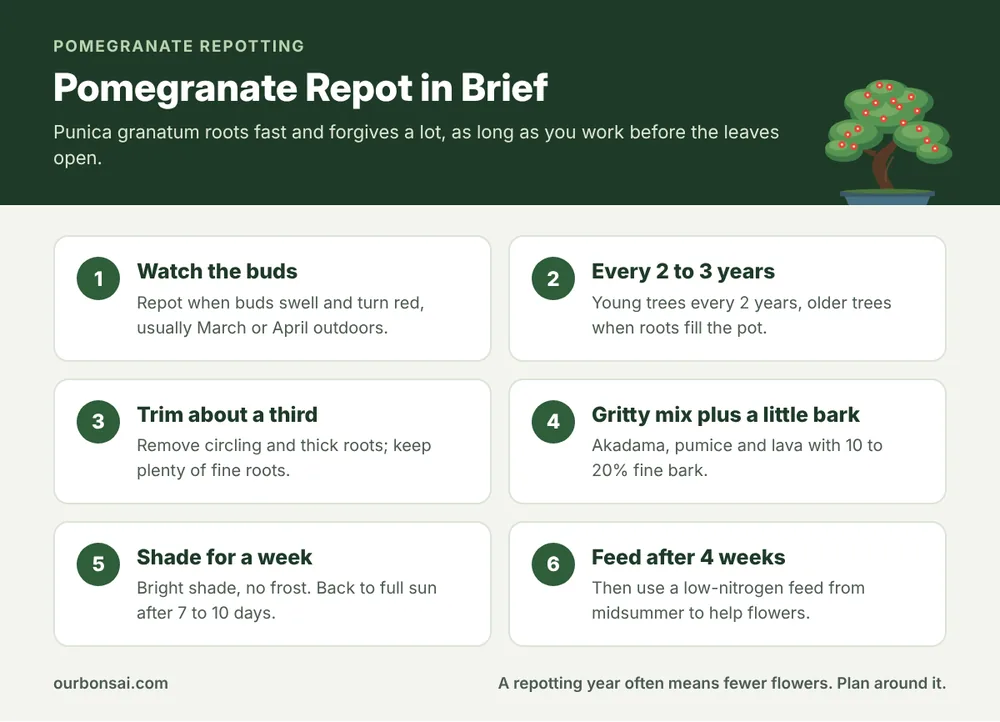
If you want to know how to repot pomegranate bonsai, focus on timing first. Repot in early spring just as the buds swell and turn red (usually March to April outdoors in the Northern Hemisphere), and do it every 2 to 3 years. Trim roughly one third of the roots, set the tree in a gritty mix of akadama, pumice and lava with 10 to 20 percent fine bark, keep it in bright shade for 7 to 10 days, and wait about 4 weeks before feeding. Pomegranates root vigorously and seldom struggle after a repot. The real cost is usually fewer flowers that summer, because the tree spends energy on roots instead.
In this guide
Pomegranates and their roots
The pomegranate (Punica granatum) comes from the region stretching from Iran to northern India and has been grown around the Mediterranean for thousands of years. It is a deciduous shrub or small tree, hardy outdoors to roughly USDA zone 7 or 8. Most bonsai are the dwarf form ‘Nana’, which has small leaves, small orange-red flowers and walnut-sized fruit.
Underground, pomegranates make dense, fibrous roots that fill a bonsai pot in two seasons. They also sucker readily, sending shoots up from the roots and base of the trunk. Both habits make repotting easy to recover from, and both mean you should not leave it too long. A pot-bound pomegranate stops growing, sheds inner leaves and flowers poorly.
When to repot (and when not to)
Repot when:
- buds are swelling and showing red, but the leaves have not opened,
- the root ball is a solid mat or roots grow out of the drainage holes,
- water sits on the surface instead of soaking in.
Do not repot when:
- the tree is in full leaf in midsummer, unless roots are rotting,
- frost is still forecast for the week ahead (cover the tree if it is),
- the tree is carrying fruit you want to keep.
Indoors, a pomegranate that never went dormant can be repotted in spring when growth starts, but it should really get a cool winter rest. Our guide to pomegranate bonsai winter care explains how to give it one.
Soil mix
Pomegranates like good drainage but use plenty of water in summer heat, so they do best in a mix that holds a bit more than a pine mix. A reliable recipe:
- 40 percent akadama
- 30 percent pumice
- 20 percent lava rock
- 10 to 20 percent fine pine bark
Sift everything to 2 to 6 mm. The pH can be slightly acidic to neutral, around 5.5 to 7. If you only have pumice and lava, add 20 percent bark and you will be close. Our bonsai soil mix ratio page shows how to adjust each part for your climate.
How to repot pomegranate bonsai, step by step
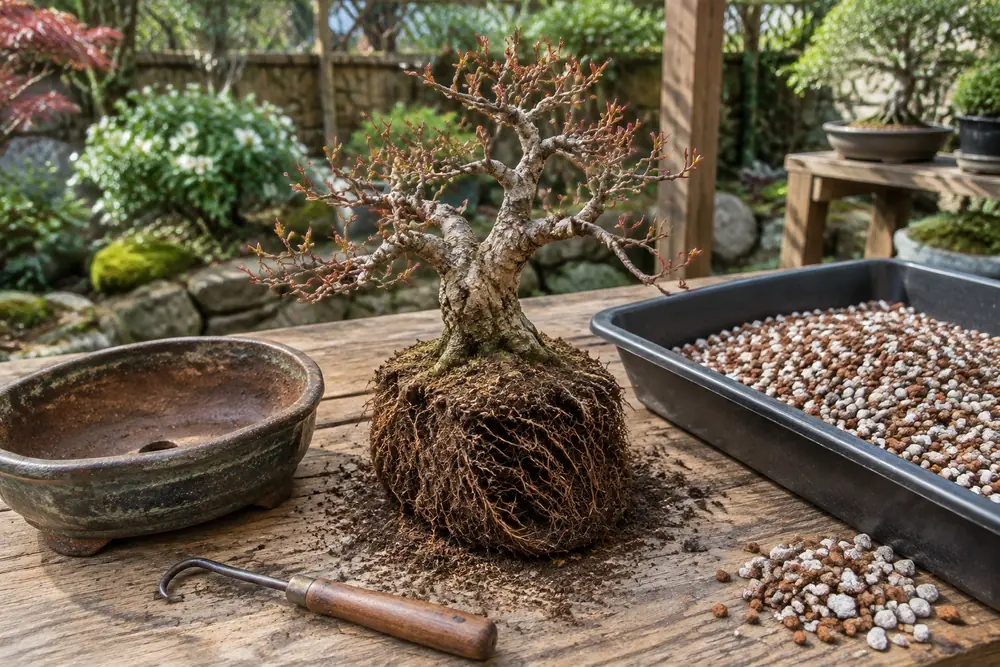
1. Prepare everything first. Pot with mesh and tie-down wires, sifted soil, root hook, scissors and a spray bottle. A repotting mat keeps the bench clean and makes it easier to save leftover soil.
2. Lift and clean. Remove the tree and comb out the outer third of the root ball with a chopstick or root hook. Pomegranate roots are tough; you can work fairly firmly.
3. Remove suckers. Any shoots coming from roots or below the soil line should be cut flush now, while you can see where they start.
4. Prune roots. Cut back thick and circling roots and anything rotten. On a healthy tree, about one third of the root mass can go. Keep the fine roots near the trunk.
5. Pot up. Add a thin drainage layer, a mound of mix, then the tree. Twist the tie-down wires over the root ball until it is firm.
6. Fill and water. Work soil into all gaps with a chopstick, then water until it runs clear.
How repotting affects flowers and fruit
Pomegranates flower on new shoots grown in the current year. A tree that has just lost a third of its roots will grow fewer and shorter shoots in its first weeks, so it often produces fewer flowers. You can soften the effect:
- Repot every 2 to 3 years rather than every year, so most years are full flowering years.
- Do only light root pruning on a tree you want to show in flower.
- From midsummer, switch to a low-nitrogen, higher-potassium feed to encourage buds.
- Remove most small fruits that set in a repotting year. Fruit is heavy work for a tree rebuilding roots.
Pomegranates are among the more rewarding flowering bonsai; our list of flowering indoor bonsai trees compares them with others.
Aftercare checklist
| When | Care |
|---|---|
| Days 1 to 10 | Bright shade, out of wind, frost-free. Water when the top centimeter dries. |
| Weeks 2 to 3 | Move gradually into full sun. Leaves should open normally. |
| Week 4 onward | Start a balanced fertilizer at half strength, then full strength after 2 more weeks. |
| First summer | Let shoots grow 4 to 6 leaves before trimming them back to 1 or 2. |
The method for trimming the new shoots is the same as for most deciduous trees, covered in our guide on when to prune deciduous bonsai.
Common problems after repotting
- Buds stall and do not open for 3 weeks or more. Usually too cold or too wet. Move it somewhere warmer and let the soil dry a little.
- Leaves open then yellow and drop. Often overwatering of a smaller root system.
- A rush of suckers from the base. A stress response. Remove them as they appear unless you want a multi-trunk tree.
- The tree wobbles. Re-tighten the tie-down wires. Movement tears new roots.
Frequently asked questions
Can I repot a pomegranate bonsai in autumn?
It is possible in mild climates after leaf fall, but roots will not grow much until spring, and the tree spends winter with cut roots in damp soil. Spring is safer.
How much root can a pomegranate lose?
About a third on a healthy tree. Vigorous older trees can tolerate up to half in warm spring weather, but flowering will suffer that year.
Should I use a deeper pot for fruiting?
A pot 2 to 3 cm deeper than usual helps a fruiting tree keep water through hot days. Very shallow pots dry out fast and the fruit splits or drops.
Is the dwarf pomegranate repotted the same way?
Yes. ‘Nana’ is simply smaller and slightly slower. The timing and soil are the same.
Final thoughts
Repotting a pomegranate is mostly about catching the swelling-bud window and not overdoing the root work if you want flowers that year. Do that, and the tree will usually leaf out within two weeks. For the plant’s natural range and growth habit, see the Wikipedia article on pomegranate, and for a real dwarf tree example, our dwarf pomegranate bonsai review.