Best Soil for Pyracantha Bonsai: Mix and Repotting Tips

The best soil for pyracantha bonsai is an open, mostly mineral mix of roughly equal parts akadama, pumice and lava rock, sifted to 2 to 6 mm. Pyracantha (firethorn) is not fussy about pH and grows anywhere from about 5.5 to 7.5, so you do not need special acidic ingredients. What it does need in a shallow pot is fast drainage plus enough water-holding capacity to stop the tree drying out in late summer, when it is ripening berries. In this mix, an outdoor tree usually needs water once a day in summer and every 3 to 7 days in cool weather.
In this guide
Best soil for pyracantha bonsai: the quick recipe
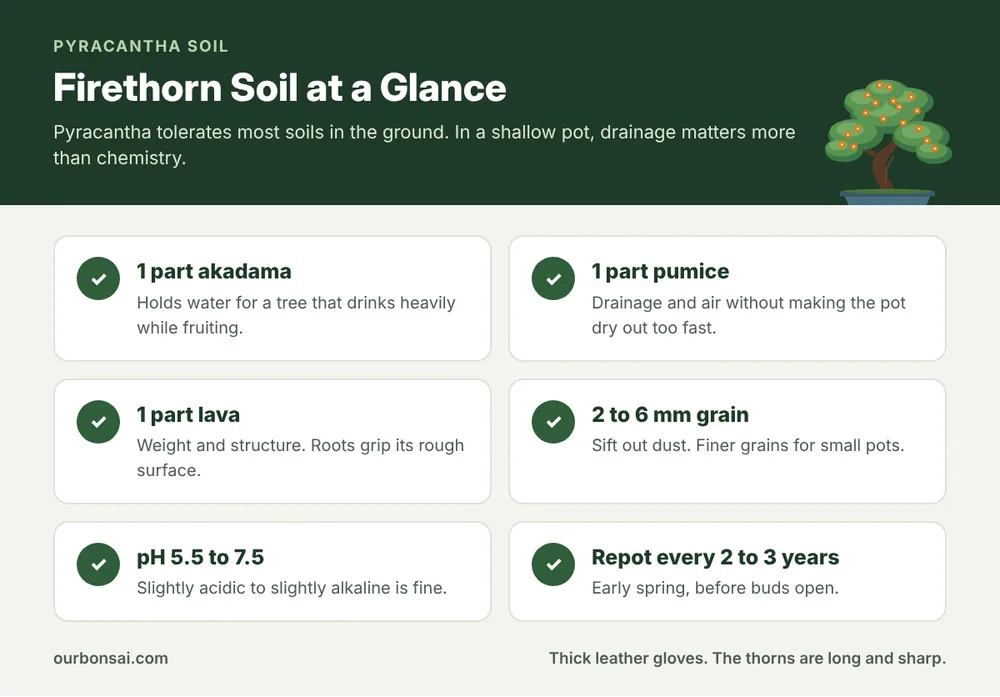
- Standard outdoor mix: 1 part akadama, 1 part pumice, 1 part lava.
- Hot, sunny garden or small pots: 2 parts akadama, 1 part pumice, 1 part lava, plus a handful of fine bark.
- Very wet climate: 1 part akadama, 2 parts pumice, 1 part lava.
If akadama is hard to find or expensive where you live, a 50/50 blend of pumice and lava with 15 percent sifted pine bark works well. Our page on bonsai soil mix ratios explains how each ingredient shifts the balance.
How do you know your version is right? Water the pot thoroughly and watch. Water should disappear from the surface within a couple of seconds and pour from the drainage holes almost at once. Lift the pot an hour later: it should feel noticeably heavier than when dry, which tells you the grains are holding water inside. If it feels as light as before, the mix is too coarse for your conditions. If water lingers on top, there is too much dust or the akadama has started to break down.
Why this mix suits firethorn
Pyracantha is a genus of thorny evergreen shrubs in the rose family. The common European firethorn (Pyracantha coccinea) is native from southern Europe into western Asia; several popular hybrids come from Chinese species. In gardens it is known as a plant that tolerates poor, dry, clay or chalky soil. That toughness leads some people to pot it in plain garden soil. In a bonsai pot, that is a mistake.
Garden soil in a 5 to 10 cm deep container behaves differently from the same soil in the ground. It stays saturated after watering, then shrinks and cracks as it dries. Pyracantha roots in that environment rot in winter and scorch in summer. A granular mix keeps air between particles no matter how much you water, which is the one thing the tree cannot do without.
The difference between bonsai soil and regular soil is explained in more detail in our separate guide.
Soil, water and berries
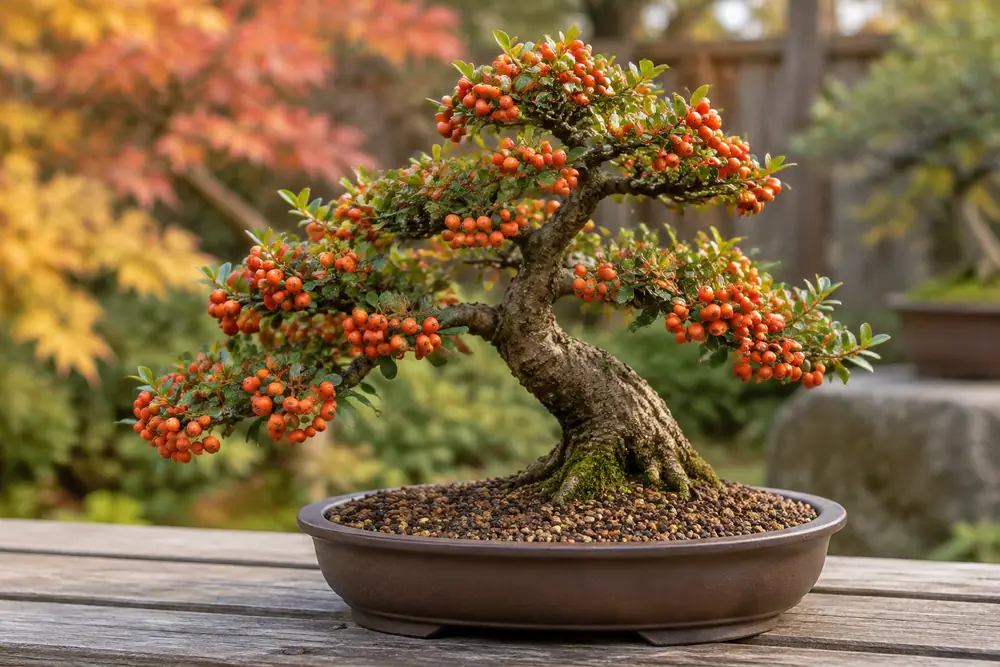
Firethorn is grown as bonsai for its spring blossom and the clusters of red, orange or yellow berries that follow. Berries form and swell from midsummer to autumn. That is when the tree uses the most water.
Two soil-related things affect the display:
- Drying out in August. A pot that dries completely even once in hot weather can make the tree drop half-formed fruit. A slightly more water-retentive mix (more akadama, a little bark) helps if you cannot water twice a day.
- Too much nitrogen in the soil. Rich organic soil or heavy nitrogen feeding produces long green shoots and few flowers. Keep organic matter low and feed with a balanced or low-nitrogen fertilizer after flowering.
| Soil issue | What you see | Fix |
|---|---|---|
| Mix too fine or broken down | Water pools on top, leaves yellow in winter | Repot into fresh, sifted mix |
| Mix too coarse for the pot | Wilting by early afternoon in summer | Add 20% more akadama or some bark |
| Too much organic matter | Long leafy shoots, few flowers | Use a mineral mix and lighter feeding |
| Salt buildup | Brown leaf edges, white crust | Flush the pot with plenty of water |
Repotting pyracantha safely
Repot every 2 to 3 years for a young tree and every 3 to 4 years once it is refined. The best time is early spring, before the buds open. Some growers repot just after flowering instead, but that sacrifices most of that year’s berries.
Pyracantha does not like heavy root reduction as much as trident maple or ficus do. Keep root pruning to about a quarter to a third of the root mass.
- Put on thick leather gloves and long sleeves. The thorns are long and sharp, and scratches can become irritated.
- Lift the tree and comb out the outer third of the old soil with a root hook.
- Cut circling and thick roots; leave the fine fibrous roots near the trunk.
- Set the tree on a thin drainage layer and a mound of fresh mix.
- Tie it in firmly with wire, fill the gaps, water well.
- Keep it in light shade, out of strong wind, for about two weeks, then return it to full sun.
A pair of sturdy root scissors and a concave cutter make the job quicker. Our guide to repotting tools explains which ones are worth having.
Warning signs to watch for
- Leaves and shoots suddenly blackening as if scorched. This may be fireblight, a bacterial disease that affects pyracantha and other rose-family plants. It is not caused by soil. Cut infected shoots well below the damage, disinfecting the blade between cuts.
- Gray or black scab on leaves and berries. Pyracantha scab, a fungal disease worse in wet, stagnant conditions. Good airflow and keeping water off the foliage help.
- Steady yellowing in winter with damp soil. Likely waterlogged roots. Check the drainage holes are clear and the mix has not broken down.
Frequently asked questions
Can I use cotoneaster soil for pyracantha?
Yes. Cotoneaster and pyracantha are close relatives with similar needs. The same mix works for both. You might like our ideas for cotoneaster bonsai styles too.
Does pyracantha need acidic soil?
No. It tolerates slightly alkaline soil well. Hard tap water is not a problem, though it can leave white crust on the surface over time.
Can a pyracantha bonsai live indoors?
Not long term. It is an outdoor shrub that needs cold winters and full sun. Protect the pot from hard freezes below about -10 C (14 F) but keep it outside.
What size pot works best?
A pot roughly as deep as the trunk is thick, with large drainage holes. Fruiting trees appreciate a slightly deeper pot because it holds more water through summer.
Wrap-up
Firethorn is forgiving about chemistry and unforgiving about waterlogged roots. Use a sifted mix of akadama, pumice and lava, adjust it toward more water retention for a hot garden, and repot every 2 to 3 years in early spring with gloves on. For more on the genus, see the Wikipedia page on Pyracantha, and for other hardy species that live outside year-round, our list of outdoor bonsai trees.