How to Repot Olive Bonsai: When, Soil and Root Pruning

Here is how to repot olive bonsai in brief: repot in mid-spring, once nights stay above about 10 C (50 F) and the buds are swelling, every 2 to 4 years depending on the tree’s age. Olives tolerate heavy root work, so you can remove up to about half the root mass from a vigorous tree. Use a free-draining mineral mix such as equal parts akadama, pumice and lava (olive is happy at neutral to slightly alkaline pH, so a little limestone grit does no harm). Afterwards, keep the tree warm and bright but out of strong wind for 2 to 3 weeks, and hold off on fertilizer until new shoots reach 3 to 5 cm.
In this guide
Why olives are easy to repot, with one condition
The European olive (Olea europaea) is a Mediterranean evergreen that survives drought, poor stony soil and hard pruning. Its roots regenerate quickly. Many bonsai growers treat it as one of the most forgiving species to repot.
The condition is warmth. Olive roots grow little in cold soil. A tree repotted in early March in a cold climate sits with cut roots in wet soil for weeks, and that is when rot gets in. Wait for genuinely mild weather, which in many US and European gardens means April or even early May. If your tree lives indoors under lights, you have more flexibility, but spring is still best because the tree is naturally ready to push roots.
Signs it is time
- Roots circling the pot wall and pushing out of the drainage holes.
- Water running straight off the surface or draining much more slowly than it did.
- The tree lifting itself in the pot.
- A store-bought olive still in its original dense nursery compost.
For a tree that was just collected or bought, give it one growing season to settle before a big repot unless the soil is clearly waterlogged.
Soil for olive bonsai
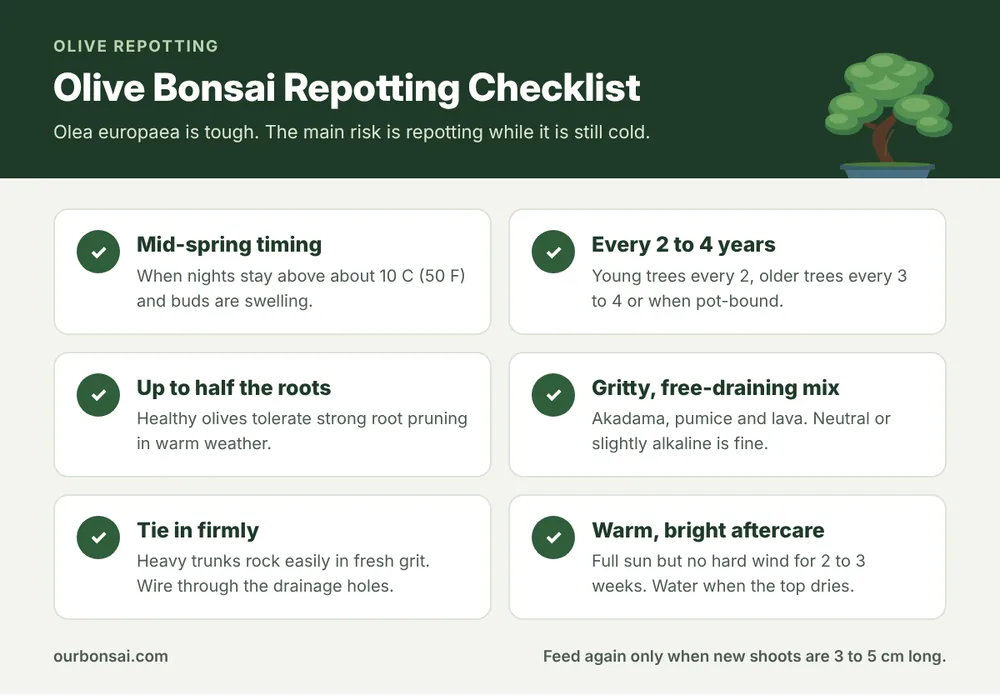
Olives need a mix that drains fast and keeps air around the roots. A common recipe is one third akadama, one third pumice and one third lava, sifted to 3 to 6 mm. In hot, dry summers you can raise the akadama to 40 percent. In wet climates, cut it to 20 percent and add more lava.
Unlike azaleas or pines, olives do not need acidic soil. They grow naturally in limestone areas. A 10 percent share of crushed limestone grit or calcined clay is fine, and so is hard tap water. Organic matter should stay low; a bit of fine bark is acceptable, but heavy compost leads to soggy roots. Our bonsai soil mix ratio guide explains how to shift the proportions.
How to repot olive bonsai, step by step
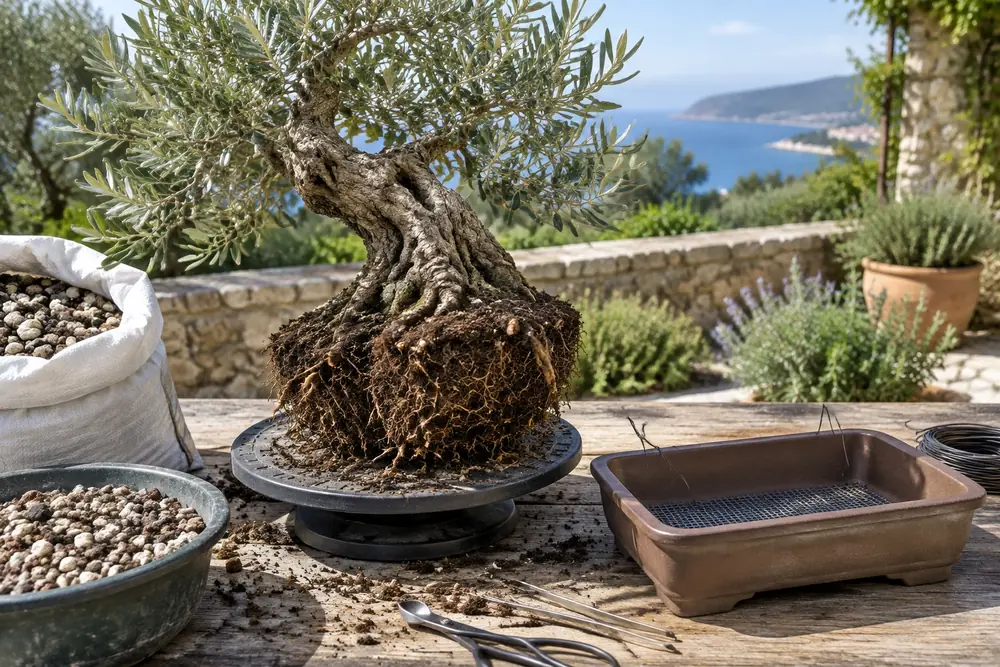
Before you start. Prepare the new pot with drainage mesh and two tie-down wires. Have your soil sifted and ready. A root hook, sharp root shears and a concave cutter for thick roots will cover most jobs. Our list of repotting tools shows what each one does.
- Remove the tree. Cut the old wires and lift. Olives often have a dense, woody root plate, so use a sickle or knife around the wall if needed.
- Rake out the soil. Work from the edges and bottom. With a healthy olive in warm weather, you can comb out most of the old soil.
- Cut thick roots first. Remove heavy downward roots under the trunk to help the tree sit lower in a shallower pot. Seal very large cuts if you like.
- Trim the rest. Shorten the remaining roots so they fit the new pot with about 2 cm to spare at the walls. Up to half the root mass can go on a strong tree; a weak tree should lose a quarter or less.
- Position and tie in. Set the tree on a mound of soil, check the front and angle, then wire it down until it cannot move. Read our notes on bonsai repotting wire if you are not sure which gauge to use.
- Fill and settle. Add soil and work it in with a chopstick until no air pockets remain under the trunk.
- Water well, twice, until it runs clear.
After the repot
| Time after repot | What to do |
|---|---|
| Days 1 to 7 | Bright, warm spot out of strong wind. Morning sun is fine. Water when the top 1 to 2 cm dries. |
| Weeks 2 to 3 | Back to full sun. Watch for new buds breaking along the branches. |
| Weeks 3 to 6 | Start a balanced fertilizer at half strength once shoots are 3 to 5 cm long. |
| Rest of the season | Normal care. Light pruning is fine; save heavy branch work for next year. |
Some leaf drop in the first fortnight is normal, especially after heavy root work. Olives often push a flush of new leaves right after. If leaves keep falling and the soil stays wet for days, check for rot; our guide to root rot in bonsai explains the signs.
Common mistakes
- Repotting too early in a cold spring. The single biggest cause of trouble.
- Moving the tree indoors right after repotting “to protect it.” Low indoor light slows root recovery. Keep it outside if the weather allows.
- Leaving nursery soil around the core. It stays wet while the new grit dries, and the core rots. Remove it over one or two repots.
- Overwatering after repotting. Fewer roots mean less water used. Water when the surface dries, not daily by habit.
- Feeding straight away. Fresh cuts burn easily. Wait for new shoots.
Frequently asked questions
Can I bare-root an olive bonsai?
A healthy olive in warm weather can usually take it, and some growers do it to replace compacted soil completely. It still adds stress. If the tree is weak or the weather is cool, leave some old soil around the core.
Can I repot an olive in summer?
Olives tolerate summer repotting better than most species if you avoid heat waves and keep the tree shaded for a week. Spring is still the safer choice.
How cold can a newly repotted olive get?
Keep it above freezing for at least a month. Established olives in the ground survive brief frosts down to about -7 C (19 F), but a freshly repotted tree in a shallow pot has no such margin.
Does an olive need a deep pot?
Not especially. Olives do well in medium-depth pots because their roots spread more than they dive, which suits classic rectangular and oval bonsai pots.
Final thoughts
Olives forgive a lot at repotting time, as long as you wait for warmth. Mid-spring, a gritty mineral mix, firm tie-down and a few weeks of sheltered sun are the whole recipe. The Wikipedia article on the olive covers the species’ natural range and tolerance of dry, limy soils, and our overview of evergreen bonsai trees compares olive with other evergreens that stay outdoors in mild climates.