Best Knob Cutter for Bonsai: 9 Top Picks Compared

As an Amazon Associate we earn from qualifying purchases. See our affiliate disclosure.
In this guide
- Our Top Picks at a Glance
- 1. Wazakura Knob Cutter 8.3 in (Best Overall)
- 2. KAKURI Knob Cutter 7 in with Sheath (Best Compact Japanese)
- 3. Wazakura Concave and Knob Cutter Set (Best Two-Cutter Set)
- 4. Joshua Roth Spherical Knob Cutter (Best Traditional Spherical Jaw)
- 5. TianBonsai MT-KC-205 Knob Cutter (Best Budget Pick)
- 6. tianbonsai Round Edge Cutter 180 mm (Best for Small Trees)
- 7. VOUIU 8 in Knob Cutter (Best Stainless Value)
- 8. RYUGA RS-09 Spherical Knob Cutter (Best for Smaller Hands)
- 9. M METERXITY 11 in Knob Cutter (Most Leverage)
- Also Worth a Look
- Knob Cutter vs Concave Cutter: Which Do You Need?
- How to Choose a Bonsai Knob Cutter
- How to Use a Knob Cutter
- Frequently Asked Questions
- Final Verdict
Quick answer: the best knob cutter for most bonsai growers is the Wazakura Knob Cutter (8.3 in). It is hand forged from S55C carbon steel in Sanjo, Japan, and the maker rates it for cuts up to 18 mm, which covers knobs, old stubs and roots on most trees. On a tight budget, the TianBonsai MT-KC-205 gives you a proper round-jaw cutter in hardened alloy steel with a tool bag. For shohin and other small trees, the KAKURI 7 in knob cutter is a compact Japanese option that comes with a sheath.
A knob cutter has round, cupped jaws. Instead of slicing straight across, it scoops out a small hollow, so the wound sits slightly below the bark and the callus can grow over it level with the trunk. It is the tool you reach for when a concave cutter cannot get the job done: removing trunk knobs, cleaning up old pruning stubs, reducing swollen branch collars and cutting thick roots.
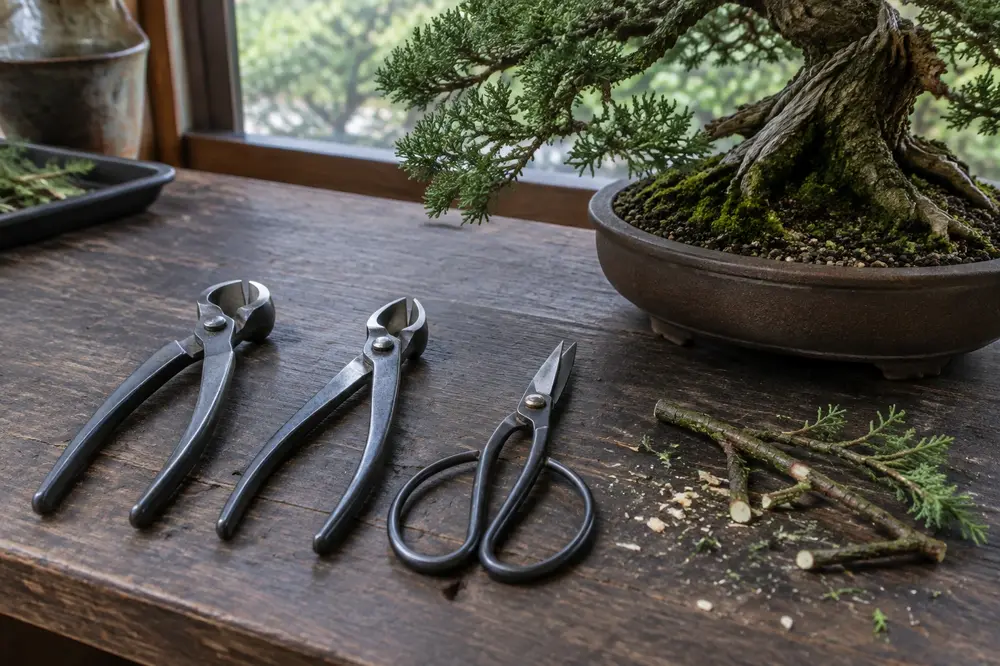
Below are nine knob cutters compared on the details their makers publish: steel type, length, weight and rated cutting size. We did not test these tools by hand. Product details were checked against Amazon listings on November 1, 2026, and prices change often, so check the current price on Amazon.
Our Top Picks at a Glance
| Knob cutter | Steel | Length | Max cut (maker) | Best for |
|---|---|---|---|---|
| Wazakura Knob Cutter 8.3 in | Japan, hand-forged S55C carbon | 210 mm | Up to 18 mm | Best overall |
| KAKURI Knob Cutter 7 in with sheath | Japan, carbon steel | About 173 mm | Not stated | Best compact Japanese |
| Wazakura Concave + Knob Cutter Set | Japan, carbon steel | 200 + 210 mm | Not stated | Best two-cutter set |
| Joshua Roth Spherical Knob Cutter | High-carbon steel | Not stated | Not stated | Best traditional spherical jaw |
| TianBonsai MT-KC-205 Knob Cutter | 4Cr13MoV alloy, HRC55 | 205 mm | Under 8 mm (wet wood) | Best budget pick |
| tianbonsai Round Edge Cutter 180 mm | 3Cr13 alloy, HRC50 | 180 mm | Under 5 mm (wet wood) | Best for small trees |
| VOUIU 8 in Knob Cutter | Stainless steel | 210 mm | Not stated | Best stainless value |
| RYUGA RS-09 Spherical Knob Cutter | Stainless steel | 179 mm | Not stated | Best for smaller hands |
| M METERXITY 11 in Knob Cutter | Stainless steel | 280 mm | Not stated | Most leverage |
1. Wazakura Knob Cutter 8.3 in (Best Overall)

| Steel | Hand-forged S55C carbon steel |
|---|---|
| Made in | Sanjo, Niigata, Japan |
| Size | 210 x 50 x 13 mm, 15 mm blades |
| Weight | 230 g (8.1 oz) |
| Rated cut | Knobs, roots and limbs up to 18 mm |
| Extras | Black gift box |
This is the knob cutter we would buy first. Wazakura makes it in Sanjo, a town known for blacksmiths since the 17th century, and the maker gives clear numbers: 210 mm long, 230 g, and rated for cuts up to 18 mm. That is the most generous rating in this list, and the long handles give you the leverage to use it.
The jaws make an almost spherical cut that sits just below the bark, which is what you want when removing a knob or an old stub. S55C carbon steel takes a keen edge and is easy to touch up with a fine stone, but it will rust if you put it away wet. Dry it after each session and oil the pivot.
If you already own a concave cutter, this is the one tool to add. If you own neither, look at the Wazakura two-cutter set (#3), which pairs this exact cutter with their concave cutter.
Pros
- Made in Japan, hand forged
- Highest rated capacity here (18 mm)
- Clear specs from the maker
- Easy to resharpen
Cons
- Carbon steel needs drying and oiling
- Listing showed limited stock when we checked
- Costs more than the stainless options
Best for: growers who want one knob cutter that handles most trunks and roots for years.
2. KAKURI Knob Cutter 7 in with Sheath (Best Compact Japanese)

| Steel | Japanese high-carbon steel |
|---|---|
| Made in | Japan |
| Size | About 6.8 x 2 x 0.4 in |
| Weight | About 7 oz |
| Extras | Protective sheath |
KAKURI is a Japanese tool maker, and this is their small knob cutter. At about 6.8 inches it is noticeably shorter than the usual 8 inch cutters, which makes it easier to steer around the base of small trunks, between surface roots and in the tight spots on shohin and mame bonsai.
The blade is Japanese carbon steel that the maker says can be restored on a whetstone, and the included sheath protects the edge in a tool bag. The trade-off is leverage: on thick knobs on large trees, a longer cutter will be easier on your hand.
Pros
- Made in Japan
- Short length fits small trees and tight spots
- Comes with a sheath
- Can be resharpened on a whetstone
Cons
- Less leverage for thick wood
- Maker does not state a maximum cut size
Best for: shohin and small indoor trees, and anyone who prefers a short tool.
3. Wazakura Concave and Knob Cutter Set (Best Two-Cutter Set)

| In the box | Concave branch cutter (200 mm, 190 g) and knob cutter (210 mm, 230 g) |
|---|---|
| Steel | Hand-forged high-carbon steel |
| Made in | Sanjo, Japan |
Most structural pruning on bonsai is a two-step job: the concave cutter takes the branch off flush, then the knob cutter cleans up anything left behind. This set gives you both cutters from the same maker, and the knob cutter is the same 210 mm model as pick #1.
If you are starting from scratch, this set is better value than buying the two cutters one at a time. For trimming shoots you will still need scissors. Our guide to the best Japanese bonsai tool kits covers sets that include them.
Pros
- Both essential branch cutters in one box
- Same Japanese knob cutter as our top pick
- Usually cheaper than buying both separately
Cons
- No scissors
- Carbon steel needs care to avoid rust
Best for: growers who need both cutters and want them to match.
4. Joshua Roth Spherical Knob Cutter (Best Traditional Spherical Jaw)

| Steel | High-carbon steel |
|---|---|
| Grade | Professional grade (per maker) |
| Jaw | Spherical |
Joshua Roth is a long-established US bonsai tool brand (see our Joshua Roth tools review), and this is its professional spherical knob cutter. Spherical jaws close into a near-round cup, so they bite deeper into a knob than the flatter “round edge” cutters further down this list. That makes them good at hollowing out stubborn knobs and old stubs in a few bites.
The Amazon listing is thin on specs: it gives no length, weight or cutting capacity, only that the high-carbon steel holds a sharp edge with proper care. If size matters to you, check the product photos and questions on the listing before buying. Joshua Roth also sells a lower-priced line, the Joshua Roth 1167 spherical knob cutter.
Pros
- Spherical jaws hollow out knobs quickly
- Professional-grade carbon steel
- Established bonsai brand
Cons
- Listing gives few specs
- Carbon steel needs oiling
- Listing showed limited stock when we checked
Best for: growers who want a deep, true spherical cut.
5. TianBonsai MT-KC-205 Knob Cutter (Best Budget Pick)

| Steel | 4Cr13MoV alloy steel |
|---|---|
| Hardness | HRC55, induction hardened edge |
| Length | 205 mm |
| Rated cut | Wet branches under 8 mm |
| Extras | Tool bag |
TianBonsai publishes more numbers than most budget brands, and they are useful ones. The edge is hardened to HRC55, the cutter is 205 mm long, and the maker rates it for wet branches under 8 mm. That is less than half the Wazakura rating, so treat it as a tool for small to medium knobs, not for big trunk work. More on the brand in our Tian Bonsai tools review.
4Cr13MoV is a stainless-type alloy, so it is more forgiving about rust than carbon steel. It is a sensible first knob cutter if you are not sure how often you will use one.
Pros
- Low cost for a real round-jaw cutter
- Hardened edge with stated HRC rating
- Rust-resistant alloy
- Comes with a tool bag
Cons
- Rated only for wood under 8 mm
- Not made in Japan
Best for: beginners and anyone who uses a knob cutter only now and then.
6. tianbonsai Round Edge Cutter 180 mm (Best for Small Trees)

| Steel | 3Cr13 alloy steel |
|---|---|
| Hardness | HRC50 |
| Length | 180 mm |
| Rated cut | Wet branches under 5 mm |
| Design | Combined straight edge and knob cutter |
This smaller tianbonsai tool is a hybrid: its round edge works as a knob cutter, and the maker says it also trims branches in crotches like a concave cutter. At 180 mm it is easy to handle on small trees.
Keep its limits in mind. It is rated for wet wood under 5 mm, and HRC50 steel is softer than the other tianbonsai cutter, so it is best for light clean-up work on small trees, not for thick knobs.
Pros
- One tool for knobs and small branch cuts
- Compact 180 mm size
- Low cost
Cons
- Small 5 mm rating
- Softer HRC50 steel dulls sooner
Best for: small indoor and shohin trees where cuts stay small.
7. VOUIU 8 in Knob Cutter (Best Stainless Value)

| Steel | Stainless steel |
|---|---|
| Length | 210 mm |
| Design | Offset cutting edge |
VOUIU makes a full range of mid-priced stainless bonsai tools (see our VOUIU tools review). This 210 mm knob cutter has an offset cutting edge, and stainless steel means you can leave it in the garden shed without finding rust spots next week.
Stainless steel does not take as fine an edge as good carbon steel, and the listing gives no cutting capacity. For occasional knob and stub removal on outdoor trees, the low upkeep is worth that trade.
Pros
- Stainless steel resists rust
- Standard 8 in size with good leverage
- Mid-range price
Cons
- No rated cutting capacity
- Edge not as fine as Japanese carbon steel
Best for: outdoor growers who want a low-maintenance knob cutter.
8. RYUGA RS-09 Spherical Knob Cutter (Best for Smaller Hands)

| Steel | Stainless steel |
|---|---|
| Length | 179 mm |
| Made in | China (per listing) |
| Jaw | Spherical |
RYUGA is a well-known bonsai tool brand (see our RYUGA tools review), and its RS-09 is a spherical knob cutter in stainless steel. At 179 mm it is shorter than standard cutters, and the maker describes it as suited to smaller hands.
You get a true spherical jaw without the rust worries of carbon steel. The listing does not give a cutting capacity, and its stock was limited when we checked.
Pros
- Spherical jaw in stainless steel
- Compact 179 mm size
- Recognized bonsai brand
Cons
- Less leverage than 8 in cutters
- Limited stock at time of checking
Best for: growers with smaller hands or small to medium trees.
9. M METERXITY 11 in Knob Cutter (Most Leverage)

| Steel | Stainless steel |
|---|---|
| Length | 280 mm (11 in) |
| Width | 55 mm |
At 280 mm, this is the longest cutter in the list by a wide margin. Longer handles mean more leverage, which helps on hard wood, thick roots during repotting, and large outdoor trees.
The extra length also makes it clumsy on small trees, so it is a second knob cutter for big work rather than an all-rounder. The listing gives no cutting capacity.
Pros
- Long 11 in handles for leverage
- Stainless steel resists rust
- Good for thick roots and large trees
Cons
- Too big for small bonsai
- No rated cutting capacity
Best for: large outdoor trees and heavy root work.
Also Worth a Look
- LEONTOOL 8 in concave and spherical knob cutter set: a budget two-cutter set in heat-treated stainless steel with a black oxide finish and a flannel bag.
- Wazakura concave branch cutter, 8 in: if you buy the Wazakura knob cutter on its own, this is its matching concave cutter (rated 8 to 13 mm).
- Joshua Roth 1167 spherical knob cutter: Joshua Roth’s more affordable spherical cutter.
Knob Cutter vs Concave Cutter: Which Do You Need?
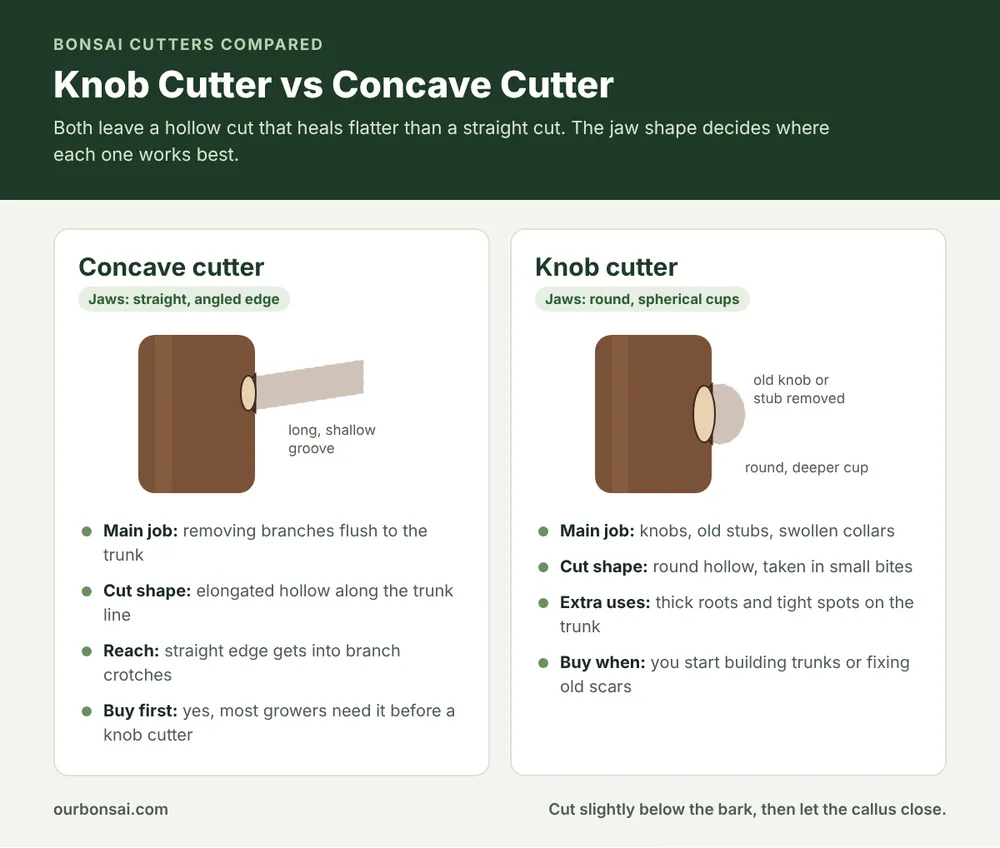
Both tools leave a hollow cut instead of a flat one, because a flat cut on a bonsai trunk usually heals into a visible bump. The difference is the jaw shape. A concave cutter has a straight, angled edge and makes an elongated cut along the trunk line, so it is the tool for removing branches. A knob cutter has round cups and takes small, scooping bites, so it is better for knobs, old stubs and thick roots.
If you only buy one, buy a concave cutter first. Add a knob cutter when you start reducing trunks, fixing old pruning scars or working on collected trees. Our list of tools every bonsai garden needs shows where each fits in.
How to Choose a Bonsai Knob Cutter
Spherical vs round-edge jaws
Spherical jaws (Joshua Roth, RYUGA, LEONTOOL) close into a deep cup and hollow out a knob quickly. Round-edge jaws (the tianbonsai models) are flatter and gentler, which suits small trees and light clean-up but takes more bites on large knobs.
Length and leverage
Standard knob cutters are about 200 to 210 mm (8 in). Shorter tools, such as the 7 in KAKURI or 179 mm RYUGA, reach into tight spots on small trees. Longer handles, like the 11 in METERXITY, give more force for thick wood and roots.
Carbon steel vs stainless steel
Carbon steel, used by Wazakura, KAKURI and Joshua Roth, takes the sharpest edge and is easy to resharpen, but it rusts if left wet. Stainless steel and alloys such as 4Cr13MoV need less care but are usually a little less sharp. If your tools live outdoors, stainless is the safer choice.
Check the rated cutting size
Few makers publish one, but when they do, take it seriously. Forcing a cutter through wood thicker than it is rated for can spring the jaws. For limbs beyond your cutter’s range, use a bonsai pruning saw first, then clean up with the knob cutter.
How to Use a Knob Cutter
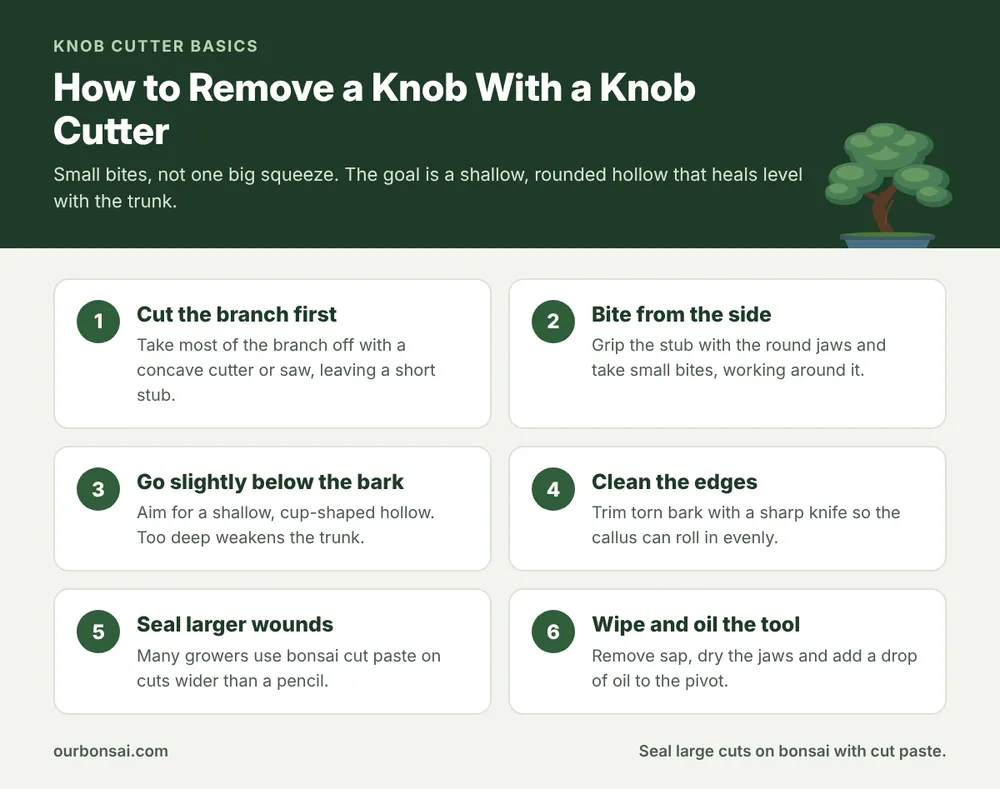
Do the heavy cut first with a concave cutter or saw, leaving a short stub. Then work around the stub with the knob cutter in small bites, from the side rather than straight on, until the wound sits slightly below the bark. Do not dig deep: a shallow, cup-shaped hollow is enough, and a deep pit weakens the trunk. For carving deeper hollows or deadwood, a carving tool is the right choice.
Many bonsai growers seal larger cuts with bonsai cut paste to keep the edges from drying out while the callus forms. Note that this is a bonsai-specific practice for appearance: for garden trees, Clemson Cooperative Extension advises against flush cuts and notes that wound dressings do not prevent decay. On bonsai the flush, hollow cut is a deliberate choice so the scar disappears into the trunk.
Frequently Asked Questions
What is a knob cutter used for in bonsai?
A knob cutter removes trunk knobs, old branch stubs and swollen branch collars with a round, hollow cut that heals level with the trunk. It is also handy for cutting thick roots during repotting.
Is a knob cutter the same as a concave cutter?
No. A concave cutter has a straight, angled edge for removing branches flush to the trunk. A knob cutter has round jaws for scooping out knobs and stubs. Many growers own both.
Do beginners need a knob cutter?
Not right away. Scissors and a concave cutter cover most early pruning. A knob cutter becomes useful when you start reducing trunks, fixing old scars or repotting trees with thick roots.
Can a knob cutter cut roots?
Yes. Its strong round jaws work well on thick roots during repotting. Clean the jaws afterward, since grit from the soil dulls the edge.
How thick a branch can a knob cutter cut?
It depends on the tool. The Wazakura knob cutter is rated up to 18 mm, while the TianBonsai MT-KC-205 is rated for wet wood under 8 mm. Use a saw for anything thicker than the maker’s rating.
How do I sharpen a knob cutter?
Use a fine whetstone or a small conical sharpening stone on the outside bevel only, following the curve of the jaw. Go lightly, then remove the burr on the inside. Carbon steel cutters are the easiest to resharpen.
Should I seal the cut after using a knob cutter?
On bonsai, many growers use cut paste on cuts wider than a pencil to help the callus roll in evenly. Small cuts usually heal fine without it.
Final Verdict
For most growers, the Wazakura Knob Cutter is the best knob cutter for bonsai: Japanese made, clearly specified and rated for cuts up to 18 mm. Get the Wazakura concave and knob cutter set if you need both cutters, the KAKURI 7 in cutter for small trees, and the TianBonsai MT-KC-205 if you want a capable cutter at a low price.
Building out the rest of your kit? See our guides to bonsai repotting tools and the Wazakura tool range, and for general care basics, this overview of bonsai cultivation and care.