Best Bonsai Gloves: Nitrile, Cut-Resistant and Thorn-Proof Picks


As an Amazon Associate we earn from qualifying purchases. See our affiliate disclosure.
In this guide
- Our Top Picks at a Glance
- Three Kinds of Glove for Three Kinds of Job
- 1. Brussel’s Bonsai Nitrile Gardening Gloves (Best Overall for Bonsai Work)
- 2. COOLJOB Bamboo Nitrile Gloves, 2 Pairs (Best Value Nitrile)
- 3. Schwer A4 AIR-SKIN Cut-Resistant Gloves (Best for Carving and Sharp Tools)
- 4. Schwer A7 Cut-Resistant Gloves, 2 Pairs (Best Heavy Cut Protection)
- 5. HANDLANDY Pigskin Rose Pruning Gauntlet (Best for Thorny Species)
- 6. SLARMOR Cowhide Gauntlet Gloves (Best Leather Gauntlet)
- 7. COOLJOB Thorn-Proof Padded Gloves (Best Padded Glove for Heavy Lifting)
- 8. OIZEN Cowhide Touchscreen Gloves (Best All-Round Leather Glove)
- Also Worth a Look
- How to Choose Bonsai Gloves
- Frequently Asked Questions
- Final Verdict
Quick answer: for everyday bonsai work, repotting, soil mixing, wiring and moving pots, the best gloves are thin nitrile-coated knit gloves, and Brussel’s Bonsai nitrile gloves are the ones to buy: puncture and chemical resistant, machine washable and sold in small, medium and large by a bonsai nursery that uses them. The COOLJOB bamboo nitrile two-pack is the value alternative. If you carve deadwood or use knives and saws, step up to a cut-resistant knit like the Schwer A4 AIR-SKIN. And for bougainvillea, pyracantha, hawthorn and other thorny species, you want a leather gauntlet such as the HANDLANDY pigskin rose gloves.
Ask a room of bonsai growers about gloves and half will say they never wear them. For fine pruning and wiring twigs that is right: you need to feel the branch, and gloves make you clumsy. But the other half of bonsai is dirty, sharp or spiky. Repotting means wet soil, root hooks and heavy pots; carving means chisels, knives and rotary tools next to your steadying hand; collecting and styling thorny species means blood; and fertiliser, lime sulphur and sprays should not be on your skin. For those jobs the right glove is not optional. We compared the eight gloves below from their Amazon listings on November 1, 2026.
Our Top Picks at a Glance
| Glove | Construction | Best for |
|---|---|---|
| Brussel’s Bonsai Nitrile Gardening Gloves | Nitrile-coated knit, puncture and chemical resistant, machine washable | Best overall for bonsai work |
| COOLJOB Bamboo Nitrile Gloves, 2 Pairs | Foam nitrile palm, bamboo rayon knit, touchscreen | Best value nitrile |
| Schwer A4 AIR-SKIN Cut-Resistant Gloves | 18-gauge knit, ANSI A4, sandy nitrile palm, fibreglass-free | Best for carving and sharp tools |
| Schwer A7 Cut-Resistant Gloves, 2 Pairs | ANSI A7, sandy nitrile, touchscreen, washable | Best heavy cut protection |
| HANDLANDY Pigskin Rose Pruning Gauntlet | Pigskin palm and back, elbow-length cuff, padded | Best for thorny species |
| SLARMOR Cowhide Gauntlet Gloves | Full-grain cowhide palm, elbow-length cowhide cuff | Best leather gauntlet |
| COOLJOB Thorn-Proof Padded Gloves | Faux suede palm, sewn cushion padding, mesh back, touchscreen | Best padded glove for heavy lifting |
| OIZEN Cowhide Touchscreen Gloves | Grain cowhide, foam padded palm, spandex back | Best all-round leather glove |
Three Kinds of Glove for Three Kinds of Job
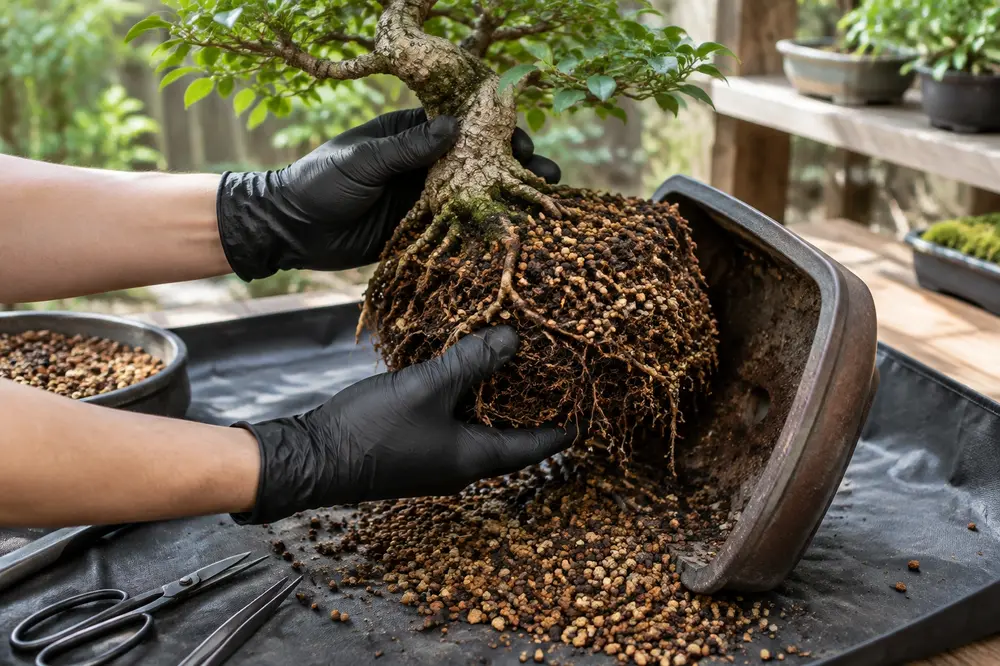
Nitrile-coated knit gloves are a stretchy fabric liner dipped in nitrile rubber on the palm. They are thin enough to feel a root, grippy when wet, resist punctures and chemicals, and go in the washing machine. They are the bonsai glove for nine jobs out of ten. Cut-resistant gloves look similar but are knitted from composite yarns rated by the ANSI scale from A1 to A9; A4 stops most tool slips and A7 handles blades and saws. They are for carving and for anyone who has ever caught a finger with a grafting knife. Leather gauntlets extend to the elbow in pigskin or cowhide and exist because a thorn goes straight through nitrile. Which you need depends on your trees: a collection of junipers and maples needs only nitrile; a bougainvillea or a citrus demands leather. Repotting technique is covered in our guide to how to repot a bonsai, and the tools in best repotting tools.
1. Brussel’s Bonsai Nitrile Gardening Gloves (Best Overall for Bonsai Work)
| Type | Nitrile-coated knit |
|---|---|
| Protection | Puncture, abrasion and chemical resistant |
| Back | Breathable nylon |
| Care | Machine washable |
| Sizes | Small, medium, large; separate listings |
Brussel's Bonsai is the largest bonsai nursery in the United States, and these are the gloves it sells for working on its own trees, which is a better endorsement than any marketing line. They are classic nitrile-touch gloves: a snug knit liner with a nitrile palm that grips wet pots and root balls, resists punctures from root hooks and wire ends, and shrugs off fertiliser. The nylon back breathes and the whole glove goes in the wash.
Buy the right size, because the fit is what gives you feel: the small and large have their own listings. Brussel's also offers to answer care questions within thirty days of purchase, a nice extra from a nursery whose trees feature in our live bonsai guide.
Pros
- Thin enough to feel roots
- Grips wet pots
- Chemical and puncture resistant
- Machine washable
- Sold by a bonsai nursery
Cons
- Not thorn-proof
- One pair per listing
Best for: repotting, soil work, wiring and general handling.
2. COOLJOB Bamboo Nitrile Gloves, 2 Pairs (Best Value Nitrile)
| Type | Foam nitrile palm on bamboo rayon knit |
|---|---|
| Liner | 68% bamboo rayon, 28% nylon, 4% spandex |
| Extras | Touchscreen fingertips, long cuff |
| Pack | 2 pairs, 4 sizes |
Two pairs for about the price of one, with a bamboo rayon liner that is softer and cooler than nylon and a foamed nitrile palm that grips as well as the Brussel's. The fingertips work a phone screen, which is handy for photographing a tree mid-repot, and the longer cuff keeps soil out. Four sizes.
Foam nitrile wears faster than smooth nitrile, which is why two pairs is the right way to buy them.
Pros
- Two pairs
- Soft, cool bamboo liner
- Touchscreen fingertips
- Four sizes
Cons
- Foam coating wears sooner
- Not thorn-proof
Best for: anyone who goes through gloves, or wants a spare pair in the tool roll.
3. Schwer A4 AIR-SKIN Cut-Resistant Gloves (Best for Carving and Sharp Tools)
| Cut rating | ANSI A4 |
|---|---|
| Knit | 18-gauge seamless, ultra-thin |
| Palm | Sandy nitrile |
| Extras | Reinforced thumb, touchscreen, fibreglass-free yarn |
Deadwood carving puts a gouge, a knife or a rotary bit a few centimetres from the hand holding the branch, and a slip goes into that hand. An A4-rated glove stops most of those slips. Schwer's AIR-SKIN is an 18-gauge knit, as thin as a dress glove, so you keep dexterity, with a sandy nitrile palm for grip and a reinforced thumb. The yarn is free of fibreglass, which matters because fibreglass-core gloves make some people itch.
Wear it on the steadying hand only if you like; the tool hand can stay bare. Our guide to the most essential carving tools covers what you will be holding.
Pros
- A4 cut protection in a very thin glove
- Grippy nitrile palm
- No fibreglass
- Touchscreen
Cons
- Not thorn-proof
- Sold as a single pair
Best for: carving, grafting, saw work and anyone who has cut themselves with a bonsai tool.
4. Schwer A7 Cut-Resistant Gloves, 2 Pairs (Best Heavy Cut Protection)
| Cut rating | ANSI A7 |
|---|---|
| Palm | Sandy nitrile |
| Extras | Touchscreen, washable |
| Pack | 2 pairs |
Where A4 covers ordinary slips, A7 is rated for medium to heavy cut hazards: power carving with die grinders, splitting trunks, working with saws on large collected material. The sandy nitrile palm grips in wet and greasy conditions, the gloves wash and reuse, and you get two pairs.
They are thicker than the AIR-SKIN, so keep them for the heavy jobs.
Pros
- A7 protection
- Two pairs
- Washable, grippy
Cons
- Thicker, less feel
- Overkill for pruning
Best for: power carving and heavy structural work.
5. HANDLANDY Pigskin Rose Pruning Gauntlet (Best for Thorny Species)
| Material | Pigskin leather palm and back |
|---|---|
| Cuff | Elbow-length synthetic leather gauntlet |
| Protection | Padded, puncture-resistant palm and fingertips |
| Note | Pigskin stays soft after wetting |
Bougainvillea, pyracantha, hawthorn, barberry, citrus and black locust all make fine bonsai and all draw blood. A gauntlet protects the forearm as well as the hand, which is where thorns catch when you reach into a canopy. HANDLANDY uses pigskin, the most breathable leather and one that dries soft after it gets wet, with a padded palm and a cuff to just below the elbow.
Leather costs you feel, so do the thorny work in these and switch to nitrile or bare hands for the fine cuts. For a thorny tree worth the trouble, see our bougainvillea bonsai styles.
Pros
- Elbow-length protection
- Breathable pigskin
- Padded palm and fingertips
- Good price
Cons
- Bulky for fine work
- Synthetic cuff
Best for: styling and repotting thorny species.
6. SLARMOR Cowhide Gauntlet Gloves (Best Leather Gauntlet)
| Material | 100% cowhide, full-grain palm |
|---|---|
| Cuff | Extended cowhide gauntlet to the elbow |
| Construction | Gunn cut, keystone thumb |
| Fit | Sizes for women and men |
An all-cowhide gauntlet, including the cuff, for people who want leather all the way up. Cowhide is tougher than pigskin and the full-grain palm will take years of thorns. The gunn cut and keystone thumb are glove-making details that keep the seams away from the working surfaces and let the thumb move freely.
Heavier and warmer than the HANDLANDY; better in cold weather, worse in summer.
Pros
- Cowhide throughout, including cuff
- Full-grain palm
- Well-cut pattern
Cons
- Warm in summer
- Stiff until broken in
Best for: collecting and working on thorny material, especially in cool weather.
7. COOLJOB Thorn-Proof Padded Gloves (Best Padded Glove for Heavy Lifting)
| Palm | Faux suede leather with sewn cushion padding |
|---|---|
| Back | 4-way stretch breathable mesh |
| Extras | Touchscreen fingers, velcro wrist |
| Note | Mesh back is not thorn-proof |
A short glove with a thickly padded palm, for the jobs that bruise rather than cut: carrying big ceramic pots, leaning on a branch bender, hammering in a stand, sawing a trunk. The faux suede palm resists most thorns, the mesh back keeps hands cool, and the fingertips work a phone. The maker is honest that the mesh back is not thorn-proof.
Pair it with a turntable and you will lift heavy trees far less often anyway.
Pros
- Thick palm padding
- Cool mesh back
- Touchscreen
- Velcro wrist
Cons
- Back not thorn-proof
- Padding reduces feel
Best for: moving heavy pots and leaning on tools.
8. OIZEN Cowhide Touchscreen Gloves (Best All-Round Leather Glove)
| Palm | Grain cowhide, foam padded, reinforced fingertips |
|---|---|
| Back | Double-layer stretch spandex |
| Extras | Touchscreen thumb and forefinger, hook-and-loop wrist |
| Sizes | S to L |
A short cowhide work glove with a stretchy spandex back, for people who want leather's toughness without a gauntlet. The padded palm and reinforced fingertips suit root work on collected trees, hauling pots and general yard work, and the touchscreen thumb and forefinger are a convenience. Sizes run from small to large.
A good second glove alongside a nitrile pair.
Pros
- Durable grain cowhide
- Flexible back
- Touchscreen
- Three sizes
Cons
- Not elbow-length
- Leather needs drying after wet work
Best for: general heavy work when you do not need forearm protection.
Also Worth a Look
- COOLJOB long-sleeve thorn-proof gloves: a faux suede gauntlet version of the padded glove above, if you prefer synthetic to leather.
- A pair of disposable nitrile gloves from the pharmacy is the right choice for applying lime sulphur or wood hardener to deadwood; throw them away afterwards.
How to Choose Bonsai Gloves
Decide what you are protecting against
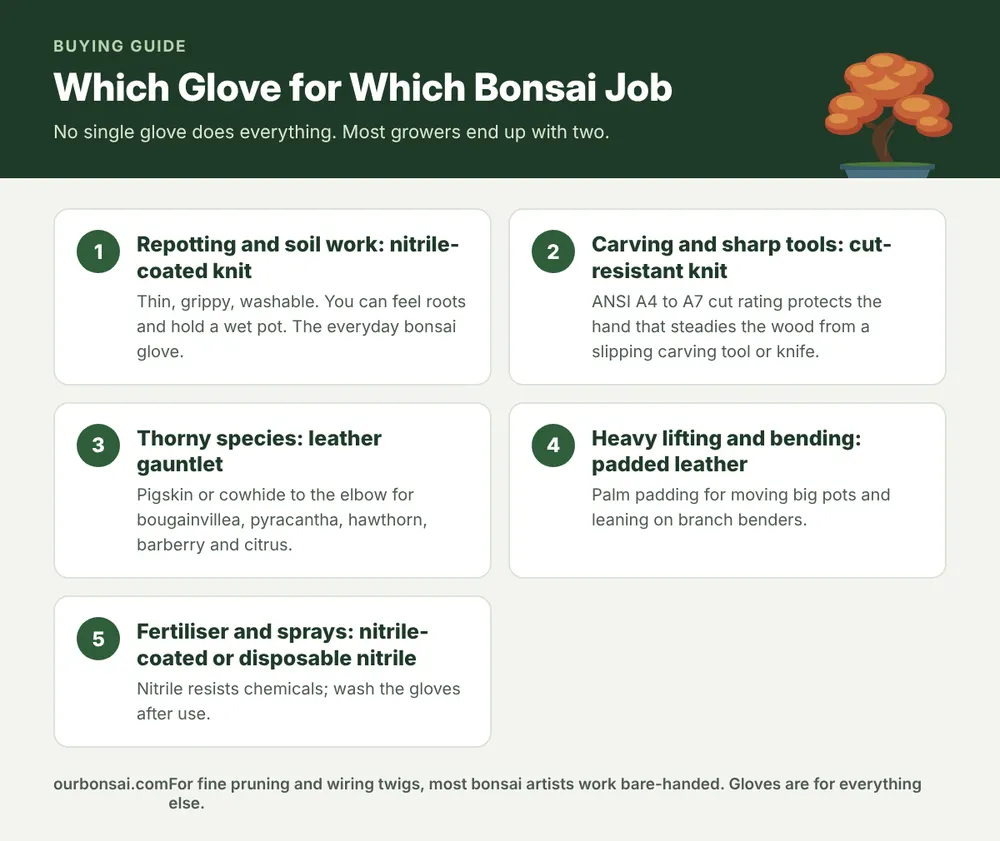
Dirt and chemicals: nitrile-coated knit. Blades: cut-resistant knit, A4 for hand tools and A7 for power carving. Thorns: leather, ideally a gauntlet. Bruises and weight: padded palms. Most growers need the first, and one of the others depending on their trees and whether they carve.
Buy them snug
A loose glove is a clumsy glove and a dangerous one near rotary tools. Nitrile and cut-resistant knits should fit like a second skin; measure your hand and use the maker's chart. Leather stretches a little with use.
Take them off for fine work
Pruning twigs, wiring fine branches, pinching buds and placing moss are bare-hand jobs. Gloves are for the heavy, wet, sharp and spiky parts, and for handling anything you would not want on your skin. For the pruning itself see our bonsai pruning guide.
Wash and dry them
Nitrile and cut-resistant gloves go in the washing machine; wash them after fertiliser or spray. Leather should be brushed clean and dried slowly away from heat, and conditioned occasionally.
Keep two pairs
A nitrile pair at the bench and a leather or cut-resistant pair in the tool roll covers nearly everything. The two-pair packs from COOLJOB and Schwer make that cheap.
Frequently Asked Questions
Do you need gloves for bonsai?
Not for fine pruning and wiring, which most growers do bare-handed. You do for repotting, soil mixing, thorny species, carving and handling fertiliser or sprays.
What are the best gloves for bonsai?
Thin nitrile-coated knit gloves for everyday work; Brussel's Bonsai nitrile gloves are our pick. Add a cut-resistant glove for carving and a leather gauntlet for thorny trees.
What gloves protect against bougainvillea and pyracantha thorns?
Leather gauntlets that reach the elbow, such as the HANDLANDY pigskin or SLARMOR cowhide gloves. Nitrile and knit gloves do not stop thorns.
Are cut-resistant gloves useful for bonsai?
Yes for carving deadwood, grafting and saw work. An ANSI A4 glove like the Schwer AIR-SKIN protects the steadying hand from slips while staying thin enough to work in.
Can I use ordinary gardening gloves for bonsai?
Nitrile-coated gardening gloves are exactly right. Thick cotton or rubber gloves are too clumsy for most bonsai jobs.
How do I clean bonsai gloves?
Nitrile and knit gloves can be machine washed. Brush leather clean and dry it slowly away from heat.
Should I wear gloves when applying lime sulphur?
Yes. Nitrile resists it well; disposable nitrile gloves are the simplest option, or wash coated gloves immediately afterwards.
Final Verdict
Buy a snug pair of Brussel’s Bonsai nitrile gloves or the COOLJOB bamboo two-pack for the bench. Add the Schwer A4 AIR-SKIN if you carve, and the HANDLANDY pigskin gauntlet if you grow anything with thorns. Then take them all off when it is time to prune a twig.