Best Soil for Wisteria Bonsai: Mix and Repotting Tips

The best soil for wisteria bonsai is a moisture-holding but free-draining mix, richer in akadama than most bonsai recipes: about 60 percent akadama, 20 percent pumice and 20 percent lava rock or fine pine bark, sifted to 2 to 6 mm, with a pH of roughly 6 to 7. Wisteria is one of the thirstiest trees in bonsai. In full summer sun a pot can need water twice a day, and during flowering many growers stand the pot in a shallow tray of water. That only works safely if the soil underneath drains well. Repot every 2 to 3 years, because wisteria flowers better when it is slightly pot-bound.
In this guide
A thirsty vine in a small pot
The two wisterias most often grown as bonsai are Japanese wisteria (Wisteria floribunda) and Chinese wisteria (Wisteria sinensis). Both are woody climbing vines in the pea family, hardy to around USDA zone 5. In the ground, they cover pergolas and walls and push enormous amounts of growth.
Fitting that vigor into a bonsai pot creates two soil challenges:
- Water demand. A wisteria in leaf and flower moves a lot of water. A shallow pot of gritty soil can dry out by noon, and a dry spell during bud formation means no flowers next year.
- Root vigor. The roots fill a pot quickly. Some crowding encourages flowering; too much means the soil can no longer hold water at all.
The mix has to buffer the first problem, and your repotting schedule has to manage the second.
The best soil for wisteria bonsai: recipe
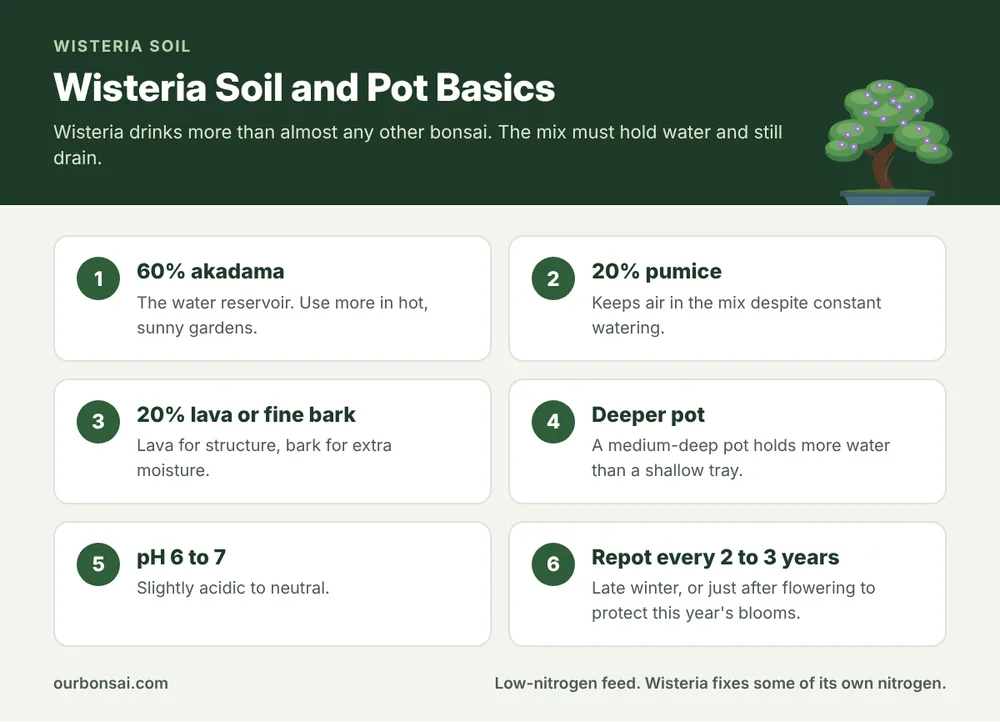
- Standard: 60 percent akadama, 20 percent pumice, 20 percent lava.
- Hot, dry climates: 60 percent akadama, 20 percent pumice, 20 percent fine pine bark.
- Cool, wet climates: 50 percent akadama, 30 percent pumice, 20 percent lava.
If you cannot find akadama, calcined clay granules (sold as soil conditioners) work as a substitute because they also hold water inside the grain. Avoid peat and bagged potting soil; they hold water but compact and rot the roots of a tree that is watered this often. Our article on bonsai soil mix ratios explains how each component shifts water retention.
To check your mix, water a dry pot until it drains, wait 10 minutes, and lift it. A good wisteria mix should make the pot feel clearly heavier, and the surface akadama should stay dark for several hours on a warm day. If the pot is light again and the surface pale by lunchtime in mild weather, add more akadama or bark. If water still stands on the surface a few seconds after you stop pouring, sift the mix again; there is too much dust.
Grain size follows pot size. Use 2 to 4 mm for small trees and shohin, and 3 to 6 mm for larger trees in deep pots. A thin layer of coarser grains (6 to 9 mm) at the very bottom helps water leave a deep pot quickly.
Pot choice matters as much as soil
Wisteria is often displayed in deeper pots than other deciduous trees, partly to show off hanging flowers and partly because a deeper pot holds more water. A round or square pot about as deep as the trunk is thick is a common choice. For cascade-style trees, a tall pot works well; see our notes on tall bonsai pots for cascade designs.
Watering in this mix
| Season | Typical watering | Notes |
|---|---|---|
| Spring, leafing out and flowering | Once or twice a day | Optional: stand the pot in 1 to 2 cm of water while in flower |
| Summer | Once or twice a day | Never let it dry out while next year’s buds form |
| Autumn | Every 1 to 3 days | Slow down as leaves yellow |
| Winter, dormant | When the surface dries, often every 7 to 14 days | Protect roots from hard frost |
The water tray trick is for the flowering period and hot spells only. Leaving the pot in standing water all year encourages rot, even in a good mix.
When to repot a wisteria
Repot young, developing trees every 2 years and older, flowering trees every 3 years or so. There are two accepted windows:
- Late winter to very early spring, before buds open. Root recovery is fastest, but you risk losing some of that year’s flowers.
- Right after flowering, in late spring. You keep the flowers, and the tree still has most of the growing season to recover.
Whichever you choose:
- Comb out the outer third of the root ball.
- Remove thick, coarse roots and up to about a third of the root mass.
- Repot into fresh mix in the same pot or one slightly larger.
- Water well and keep the tree in light shade for a week.
- Wait 3 to 4 weeks before feeding.
Avoid moving a mature flowering wisteria into a much bigger pot. With lots of new root space, it tends to put its energy into long vegetative shoots and stops flowering for a year or two.
Feeding and soil
Wisteria is a legume, and its roots host bacteria that fix nitrogen from the air. That means it needs less nitrogen than most bonsai. A high-nitrogen feed, or soil rich in compost, gives you meters of whippy shoots and few flowers. Use a low-nitrogen, higher-phosphorus and potassium feed from late spring through summer, and keep organic matter in the soil low.
Frequently asked questions
Why is my wisteria bonsai not flowering?
The most common causes are too young a tree (seed-grown wisteria can take many years to flower), too much nitrogen, too little sun, or drying out during summer when buds form. Grafted or cutting-grown plants flower sooner; see our review of a wisteria bonsai starter tree.
Can wisteria bonsai live indoors?
No. It needs a cold winter and full sun. Keep it outdoors and shelter the pot from freezes below about -10 C (14 F).
Is Black Dragon wisteria grown the same way?
Yes. ‘Black Dragon’ is a double-flowered form with very dark purple blooms, and its soil and watering needs are the same. Read more in our article on Black Dragon wisteria bonsai.
Can I use pure akadama?
Some growers do, especially in hot climates. Mixing in pumice keeps the soil open longer as the akadama breaks down.
Final thoughts
Wisteria needs more water in its soil than most bonsai and less nitrogen. A 60 percent akadama mix, a medium-deep pot, careful summer watering and a repot every 2 to 3 years will keep it healthy and flowering. For background on the genus, see the Wikipedia article on Wisteria, and for other hardy outdoor species, our list of outdoor bonsai trees.