Best Soil for Willow Leaf Ficus Bonsai: Mix and Repotting Tips


The best soil for willow leaf ficus bonsai is an open, granular mix that drains quickly but holds plenty of water: equal parts akadama, pumice and lava rock for trees that summer outdoors, or one part each of akadama, pumice and fine pine bark for trees kept indoors all year. Sift everything to 2 to 6 mm and aim for a slightly acidic to neutral pH of 6 to 7. Willow leaf ficus is a heavy drinker in warm weather, so a pot of this mix in full summer sun may need water every day, while the same tree indoors in winter might go 4 to 7 days between waterings.
In this guide
What makes willow leaf ficus different
Willow leaf ficus is usually sold as Ficus salicaria, a trade name; botanically it is generally treated as a narrow-leaved form of Ficus neriifolia, a fig from the Himalayan region and southern China. Its long, narrow leaves give it a fine, dense canopy that suits broom and banyan styles.
For soil, three traits matter:
- It grows hard in heat. Outdoors in summer it can push several flushes of growth and fill a pot with roots in one season.
- It throws aerial roots when humidity is high, and those roots fuse into the trunk.
- It is tough. It tolerates heavy root pruning, bare-rooting and the occasional dry pot better than many tropical species.
That makes it forgiving about soil chemistry. Structure is what matters: the mix has to keep its air spaces after months of heavy watering.
Best soil for willow leaf ficus bonsai: two recipes
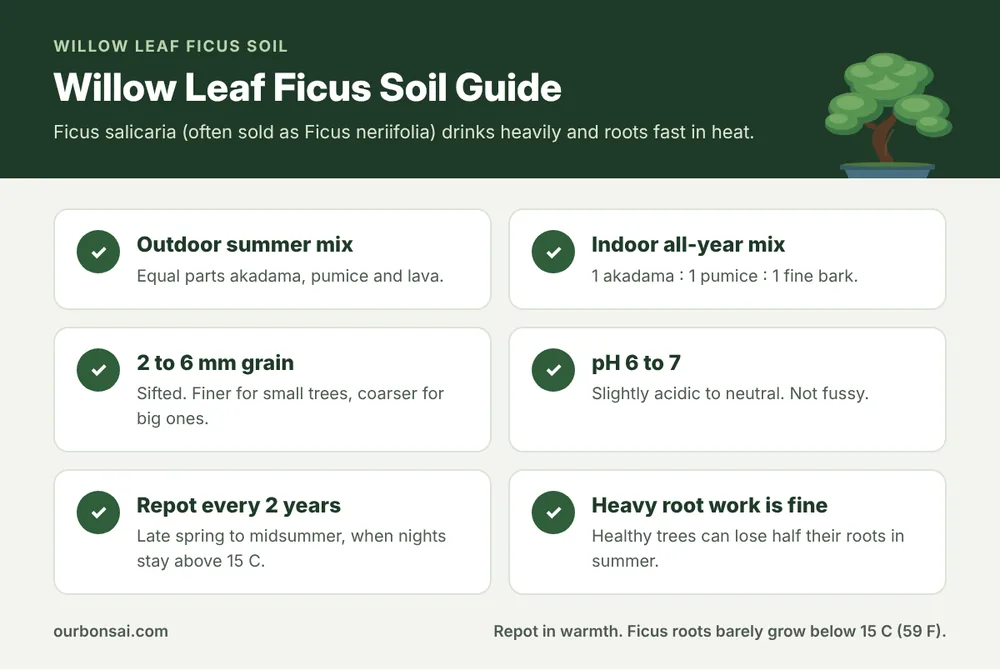
Outdoor summer, indoor winter (the most common setup). Use equal parts akadama, pumice and lava. Outdoors, sun and wind dry the pot fast, and the mineral mix lets you water heavily without drowning roots. When the tree comes inside for winter, water less often and the same mix still works.
Indoor all year, under lights or in a bright window. Swap the lava for fine pine bark: one part akadama, one part pumice, one part bark. Indoor pots dry more slowly, and the bark helps buffer the dry air without leaving the roots soggy.
Grain size. Match the grain to the pot. A small willow leaf ficus in a 15 cm pot does best with 2 to 4 mm grains. A large banyan-style tree in a 40 cm tray can take 4 to 6 mm. Coarser grains dry faster, which matters most outdoors in July. If you are not sure, start in the middle and watch how quickly the pot dries over a hot week.
| Ingredient | Role in a ficus mix | Notes |
|---|---|---|
| Akadama | Holds water and nutrients, encourages fine roots | Breaks down in 2 to 3 years |
| Pumice | Air and drainage | Stable, light |
| Lava rock | Drainage, weight, rough surface for roots | Good for outdoor trees |
| Fine pine bark | Moisture retention indoors | Sift to 3 to 6 mm |
| Calcined clay (e.g. Turface) | Akadama substitute | Holds water, does not break down |
| Potting soil | Not recommended | Too fine for a bonsai pot |
If you grow several ficus, the same mix works across the genus. Our ficus ginseng bonsai soil recipe is close to the indoor version above, and our general guide to bonsai soil mix ratios explains how to shift the balance.
How soil and watering work together
A common question is how often to water in this mix. There is no fixed rule, but a pattern helps:
- Water thoroughly, until water flows from the drainage holes.
- Wait until the top 1 cm feels dry, or until the akadama turns from dark to light brown.
- Water thoroughly again.
In this mix you cannot easily overwater a healthy, growing willow leaf ficus in summer. You can overwater a dormant-ish one indoors in December, so slow down in winter. A tree that wilts in summer despite daily watering is usually root-bound and needs repotting.
Repotting willow leaf ficus
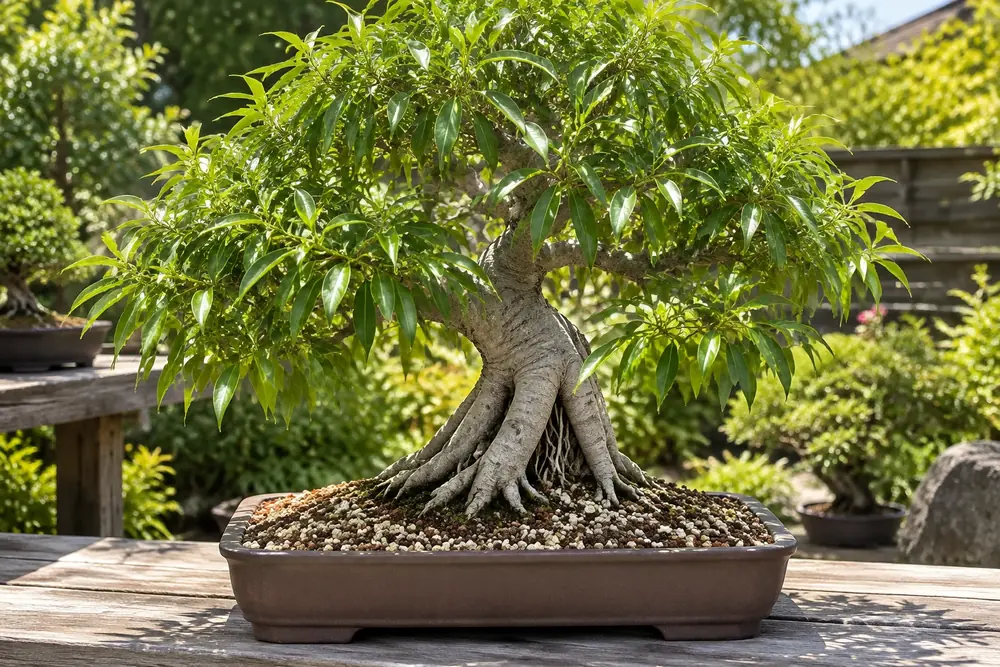
Repot every 2 years for a developing tree and every 2 to 3 years for a refined one. Ficus is tropical and roots best in warmth, so the window is late spring to midsummer, when nights stay above about 15 C (59 F). Our article on the best time to repot tropical bonsai goes into detail.
- Remove the tree and rake out the old soil. In summer, a healthy willow leaf ficus can be bare-rooted.
- Cut back thick roots and up to half of the root mass.
- Keep aerial roots that have reached the soil; they are part of the trunk’s future.
- Repot into fresh mix, tie in, water well.
- Keep it in bright shade for a week, then back to full sun.
- Resume feeding after 3 to 4 weeks.
Repotting is also a good time to check for pests at the root zone, such as root mealybugs, which show up as white, waxy patches on roots. See our guide to ficus bonsai pests and diseases for treatment.
Signs your soil needs changing
- Water sits on top for several seconds before draining.
- The surface stays wet for more than a week indoors.
- Leaves yellow and drop from the inside of the canopy while the soil is damp.
- Fine green algae or moss covers the surface and the pot smells sour.
Any of these mean the mix has broken down or was too fine to begin with. Repot at the next warm window, or sooner if roots are rotting.
Frequently asked questions
Can I use the same soil as for Golden Gate ficus?
Yes. Willow leaf and Golden Gate ficus have very similar needs. Our Golden Gate ficus bonsai care guide uses comparable mixes.
Is pure akadama good for willow leaf ficus?
It works, especially for indoor trees, but it breaks down faster under heavy watering. Mixing it with pumice keeps the pot open longer.
Does willow leaf ficus need acidic soil?
No. It tolerates slightly acidic to neutral soil and is not sensitive to hard tap water, though salt buildup should be flushed out now and then.
How do I encourage aerial roots?
Humidity and warmth. A humid summer outdoors or a plastic tent over the tree for a few weeks encourages them. Soil type has little effect.
Final thoughts
Willow leaf ficus is easy on soil as long as the mix stays granular. Use equal parts akadama, pumice and lava for an outdoor-summer tree, swap lava for bark if it lives indoors, and repot in summer heat every couple of years. For the botany of the species, see the Wikipedia article on Ficus neriifolia, and for a related fig often grown the same way, our banyan fig bonsai care guide.