Best Soil for Scots Pine Bonsai: Mix and Repotting Tips


The best soil for scots pine bonsai is a lean, airy mineral mix: roughly equal parts pumice, lava rock and akadama, sifted to 3 to 6 mm, with a slightly acidic pH between about 5 and 6.5. Scots pine (Pinus sylvestris) grows wild on sand, gravel and rock across Europe and northern Asia, so it handles dry spells far better than waterlogging. In this mix, a pot in full sun typically needs water every day or two in summer and once every 4 to 10 days in late autumn and winter. Young trees in development can use a coarser, faster-draining version; collected trees need a slower changeover from their native soil.
In this guide
What the tree is used to
Scots pine has one of the largest natural ranges of any conifer, from Scotland and Spain across Scandinavia and Russia to Siberia. It is extremely cold-hardy, to around USDA zone 3. In the wild it thrives on soils that most trees avoid: poor, sandy, acidic, fast-draining ground. Like all pines, it depends on mycorrhizal fungi that wrap its fine roots and help it pull nutrients from lean soil.
In a pot, that translates into three needs: lots of air, slightly acidic conditions, and a stable structure that does not collapse into mud. Every mix below aims at those.
Best soil for scots pine bonsai at three stages
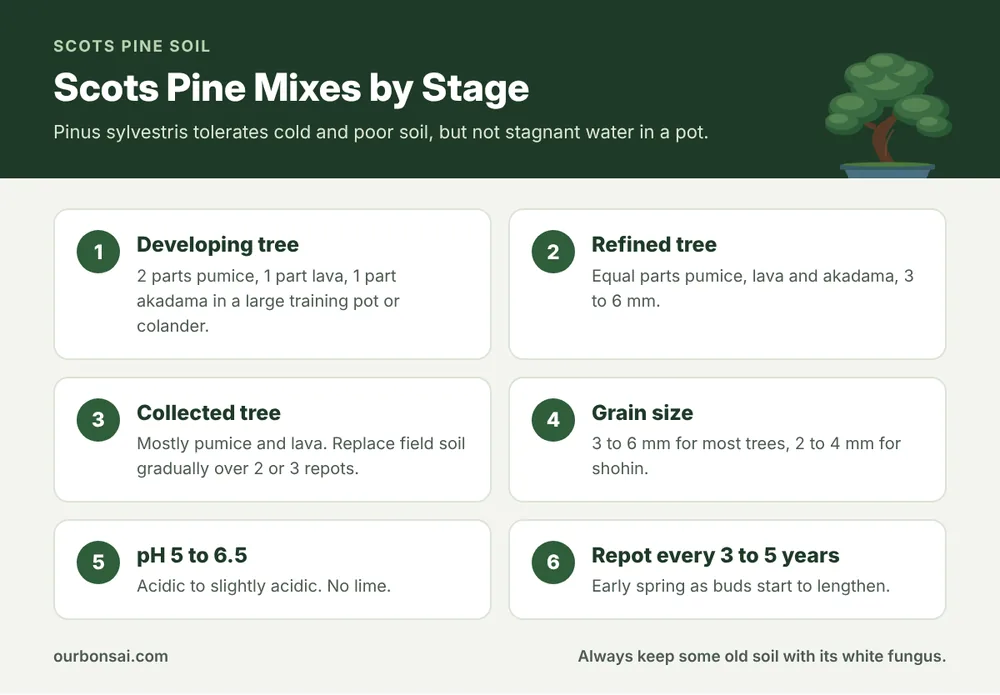
Developing trees. If you are growing a young Scots pine to thicken the trunk, speed matters more than looks. Use a coarse, very open mix: two parts pumice, one part lava, one part akadama, in a large training pot or even a plastic colander. Fast drainage lets you water and feed heavily, which drives growth.
Refined trees in bonsai pots. Once the tree is in a shallow display pot, switch to equal parts pumice, lava and akadama. The akadama helps fine root growth and shows you when the pot is drying.
Collected trees (yamadori). Mountain or field-collected Scots pines often arrive with a core of native soil. Do not remove it all at once. Pot the tree in a mostly pumice and lava mix around the old root ball, then replace a portion of the native soil at each repot over the next few years.
| Situation | Mix | Grain |
|---|---|---|
| Young tree, growing on | 2 pumice : 1 lava : 1 akadama | 4 to 8 mm |
| Bonsai pot, refined tree | 1 pumice : 1 lava : 1 akadama | 3 to 6 mm |
| Shohin (under 20 cm) | 1 pumice : 1 lava : 1 akadama | 2 to 4 mm |
| Collected tree, first potting | 2 pumice : 2 lava : 1 akadama | 4 to 8 mm |
| Very hot, dry summers | Add 10% fine bark to any of the above | Same |
If you cannot get akadama, swap it for more pumice and a little fine bark. Our article on bonsai soil mix ratios explains what each change does. Heron’s and similar pre-made blends also work if they are mostly inorganic; see our notes on Heron’s bonsai soil mix.
Grain size and pot depth
The deeper the pot, the coarser the soil can be. Water perches at the bottom of every pot, and in a deep pot that wet zone is a small part of the total. In a shallow pot, it can be half the soil. Use a slightly coarser drainage layer (6 to 9 mm) at the bottom of shallow pots, and keep the main mix free of dust.
A practical rule many growers follow: the largest grain in the mix should be no more than about a tenth of the pot depth. A 6 cm deep pot suits grains up to 6 mm; a 3 cm deep shohin pot suits 2 to 3 mm. Going much coarser than that in a shallow pot makes it dry out too fast in summer, and Scots pine needles will shorten and yellow at the tips if the roots repeatedly dry out completely. Going finer than 2 mm anywhere invites compaction.
When and how to repot
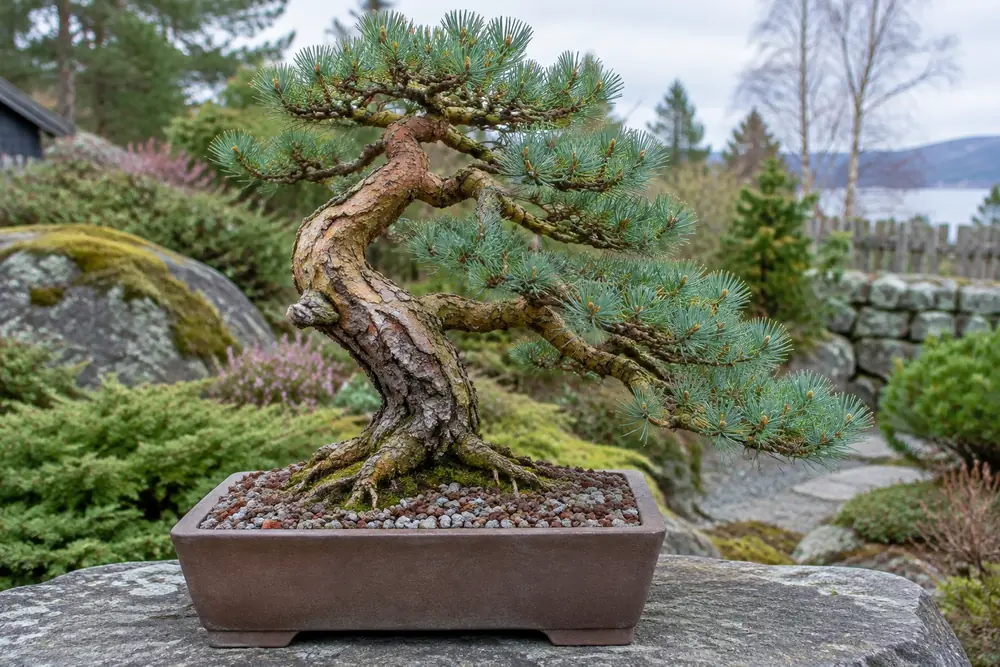
Repot young Scots pines every 2 to 3 years and older ones every 3 to 5 years. The best time is early spring, when buds begin to elongate but before the needles unfold. In much of North America and Europe that is late March to April.
- Comb out the outer third to half of the root ball.
- Keep a good share of the old soil that shows white fungal threads; it seeds the new mix.
- Cut circling roots and long downward roots, but avoid removing more than about a third of the roots in one session.
- Never bare-root a Scots pine.
- Tie the tree in firmly, water thoroughly and keep it out of wind for 2 to 3 weeks.
Some growers repot pines in late summer instead. It can work in mild climates, but spring is more reliable for most people.
Signs the soil is wrong
- Needles yellowing from the inside of the canopy, short new candles. Often roots too wet for too long.
- Water pooling on the surface. The mix has broken down, usually old akadama.
- Very long, weak candles and needles. Not a soil problem as such; usually too much nitrogen or too little sun. Scots pine needs full sun.
- Tree loose in the pot a year after repotting. Roots are not establishing. Check for rot. Our root rot in bonsai guide walks through it.
Frequently asked questions
Is Scots pine soil different from Japanese black pine soil?
Only slightly. Black pine tolerates a little more water and is often grown in mixes with more akadama. Our article on the best soil for Japanese black pine bonsai compares the details.
Can I use sand for Scots pine?
Coarse sharp grit, yes, in small amounts. Fine sand fills air gaps and should be avoided.
Does a Scots pine need protection in winter?
The tree is very hardy, but roots in a pot are exposed. Protect pots from long freezes below about -10 C (14 F) by sinking them into the ground or moving them to a cold frame.
How often should I water?
When the top centimeter is dry. Pines like a slight drying between waterings. In summer that can be daily; in winter, much less.
Wrap-up
Scots pine is tough, but in a pot it depends on you for drainage. Start with equal parts pumice, lava and akadama, go coarser for development and slower for collected trees, and repot in early spring every few years with some old soil kept. More on the species is on the Wikipedia page for Pinus sylvestris, and our list of outdoor bonsai trees puts it in context with other hardy species.