Best Raffia for Bonsai Bending: What to Buy and How to Use It

As an Amazon Associate we earn from qualifying purchases. See our affiliate disclosure.
In this guide
- Our Top Picks at a Glance
- Natural Raffia, Not Paper Raffia
- 1. Tinyroots Bonsai Raffia (Best Overall)
- 2. Sukh Natural Raffia, 3 Bundles (Best Value for a Few Trees)
- 3. Sukh Natural Raffia, 9 Bundles (Best for a Season of Styling)
- 4. Woanger Natural Raffia, 18 x 50 g (Best Bulk Buy)
- 5. Woanger Natural Raffia, 24 x 50 g (Best for Large Trees)
- 6. IHDYPPEW All-Natural Raffia, 30 x 50 g (Best for Clubs and Workshops)
- Also Worth a Look
- How to Use Raffia on a Bonsai Branch
- Frequently Asked Questions
- Final Verdict
Quick answer: any clean, natural raffia works for bonsai; what matters is that it is real palm fibre, not paper, and that you soak it before you wrap. The Tinyroots bonsai raffia is the only product sold specifically for bonsai, in long 3-foot strands that are convenient for wrapping, and it is the easy choice for a first bag. If you bend branches regularly you will get through it fast, and natural craft raffia is the same fibre for far less per gram: the Sukh 3-bundle pack covers a few trees, the Woanger 18-bundle pack covers a season, and the IHDYPPEW 30-bundle box will supply a club workshop.
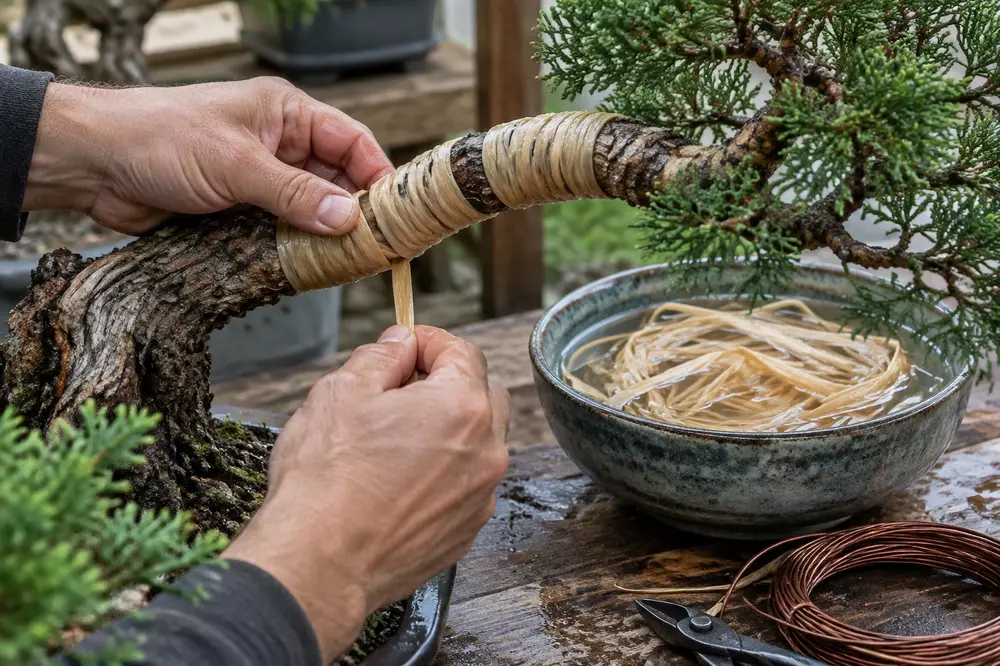
Raffia is the fibre stripped from the leaves of the raffia palm, and it has one job in bonsai: to let you bend a branch much further than wire alone would allow. Wrapped wet and pulled tight, it compresses the bark and the outer wood so that when the branch is bent the fibres inside crack a little and the surface does not split open. It also pads the branch from the heavy wire or branch bender on top, and it holds moisture against the wound while it heals. It is cheap, it is traditional, and most of the raffia on Amazon is sold for gift wrapping rather than trees, which is fine as long as you know what to avoid.
Our Top Picks at a Glance
| Raffia | Quantity | Best for |
|---|---|---|
| Tinyroots Bonsai Raffia | About 40 strands, 3 ft each, sold for bonsai | Best overall |
| Sukh Natural Raffia, 3 Bundles | Undyed natural raffia, about 120 g | Best value for a few trees |
| Sukh Natural Raffia, 9 Bundles | Natural raffia, 9 thick bundles | Best for a season of styling |
| Woanger Natural Raffia, 18 x 50 g | Natural raffia, 900 g total | Best bulk buy |
| Woanger Natural Raffia, 24 x 50 g | Natural raffia, 1.2 kg total | Best for large trees |
| IHDYPPEW All-Natural Raffia, 30 x 50 g | Natural raffia, 1.5 kg total | Best for clubs and workshops |
Natural Raffia, Not Paper Raffia
Search for raffia and half the results are paper raffia: crinkled paper twine on a spool, sold as ribbon. It is useless for bonsai. It has no wet strength, it will not stretch and shrink, and it turns to pulp against a damp branch. You want natural raffia, the pale, flat, slightly translucent fibre sold in bundles or hanks, usually described as natural or undyed. Dyed natural raffia works but can stain pale bark, so stick to the natural colour. Strand length matters a little: longer strands mean fewer joins on a big branch, which is the point of the Tinyroots bag, but craft bundles typically run two to three feet and are fine. Raffia is one half of a bending kit; the other is heavy wire or a branch bender, covered in our guides to bonsai wire and bending thick branches.
1. Tinyroots Bonsai Raffia (Best Overall)
| Quantity | About 40 strands, roughly 3 ft each |
|---|---|
| Fibre | Natural raffia |
| Sold for | Bonsai branch protection and bending |
| Seller | Tinyroots, the Bonsai Outlet house brand |
Tinyroots is the house brand of Bonsai Outlet, one of the biggest US bonsai retailers, and this is raffia selected and bagged for bonsai: around forty strands of about three feet, long enough to wrap a substantial branch without joining. The listing describes exactly the uses we would: protecting bark under wire and branch benders, reducing wire scars as the branch thickens, and tethering a branch down to the trunk to pull it into position.
You pay a premium over craft raffia for the convenience and the long strands. For a grower bending one or two branches a year it is the right bag; the same brand makes the soil in our Tinyroots soil review.
Pros
- Long 3 ft strands
- Selected for bonsai
- Clear instructions on the listing
- Trusted bonsai brand
Cons
- Most expensive per gram
- Small quantity for heavy users
Best for: a first bag, and anyone who bends branches occasionally.
2. Sukh Natural Raffia, 3 Bundles (Best Value for a Few Trees)
| Quantity | 3 thick bundles, about 120 g total |
|---|---|
| Fibre | Undyed natural raffia |
| Packaging | Vacuum sealed; fluffs up when opened |
| Texture | Smooth, splinter-free strands |
Craft raffia at its simplest: three fat bundles of undyed natural fibre, vacuum packed, about 120 g in total. The maker describes smooth, splinter-free strands that bend and twist without breaking, which is the quality you want for a tight wrap. One bundle will do a medium branch generously, so this pack is good for several bends.
Open the pack over a bin; it expands dramatically.
Pros
- Natural, undyed
- Enough for several branches
- Very low price
Cons
- Strands shorter than the Tinyroots
- Sold as craft, so no bonsai guidance
Best for: hobbyists with a handful of trees to style.
3. Sukh Natural Raffia, 9 Bundles (Best for a Season of Styling)
| Quantity | 9 thick bundles |
|---|---|
| Fibre | Natural raffia |
| Packaging | Vacuum sealed |
| Texture | Smooth, no burrs, elastic |
The same raffia as the 3-bundle pack, three times over. If you have a collection of conifers heading into a styling season, with several trunks and primary branches to move, this is the sensible quantity. The maker makes a point of elasticity, strands that bend and twist without snapping, and smooth surfaces without burrs, both of which matter when you are pulling the wrap tight over bark.
Pair it with a roll of 4 mm aluminium or 2 mm copper and you are set for the year.
Pros
- Three times the quantity for not much more
- Natural, elastic strands
- Vacuum packed stays dry
Cons
- More than a one-tree grower needs
Best for: a season of work on several trees.
4. Woanger Natural Raffia, 18 x 50 g (Best Bulk Buy)
| Quantity | 18 bundles x 50 g, 900 g total |
|---|---|
| Fibre | Natural raffia, straw texture |
| Texture | Smooth surface, good elasticity |
Eighteen 50 g bundles, nearly a kilogram of natural raffia, for people who wrap a lot: anyone developing collected junipers or pines, where every primary branch gets wrapped before it is set. Buying in bulk also means you stop being stingy with the wrap, which is the commonest mistake; a thin wrap does not protect the bark.
Store it dry and it keeps indefinitely.
Pros
- Almost a kilogram
- Low price per bundle
- Natural colour
Cons
- Far more than a beginner needs
- Craft packaging
Best for: serious hobbyists with many trees in development.
5. Woanger Natural Raffia, 24 x 50 g (Best for Large Trees)
| Quantity | 24 bundles x 50 g, 1.2 kg total |
|---|---|
| Fibre | Natural raffia |
| Texture | Smooth, elastic strands |
The 24-bundle version of the same raffia. Big trunks eat raffia: wrapping a trunk the thickness of a wrist to make a serious bend can take two or three bundles once you overlap properly, and you may need to wrap it twice if the first attempt is not tight. At this quantity the cost per bend becomes trivial.
Split it with a bonsai friend if it is too much.
Pros
- 1.2 kg
- Cheapest per gram of the Woanger packs
- Keeps indefinitely dry
Cons
- Bulky to store
Best for: trunk bends on large material.
6. IHDYPPEW All-Natural Raffia, 30 x 50 g (Best for Clubs and Workshops)
| Quantity | 30 bundles x 50 g, about 1.5 kg |
|---|---|
| Fibre | Natural raffia palm fibre |
| Texture | Smooth, flexible, strong |
A club-sized box: thirty 50 g bundles of natural raffia, a kilo and a half. For a bonsai society running a styling workshop, or a teacher with students bending material every weekend, this is the economical way to keep everyone supplied. The maker describes it as natural raffia palm fibre, smooth and flexible.
Stock was limited when we checked. For one grower it is a lifetime supply.
Pros
- Largest quantity here
- Natural palm fibre
- Very low cost per bundle
Cons
- Limited stock
- Far too much for one person
Best for: clubs, teachers and workshop organisers.
Also Worth a Look
- Tbest stainless steel bonsai branch bender: a screw-driven bender with three hook sizes for the bends that need more than wire. Always wrap in raffia first.
- Grow A Bonsai Tree 4 mm aluminium wire: the heavy wire that goes over the raffia on a wrapped branch.
- Avoid paper raffia ribbon, however it is labelled. It has no wet strength and will fall apart on the branch.
How to Use Raffia on a Bonsai Branch
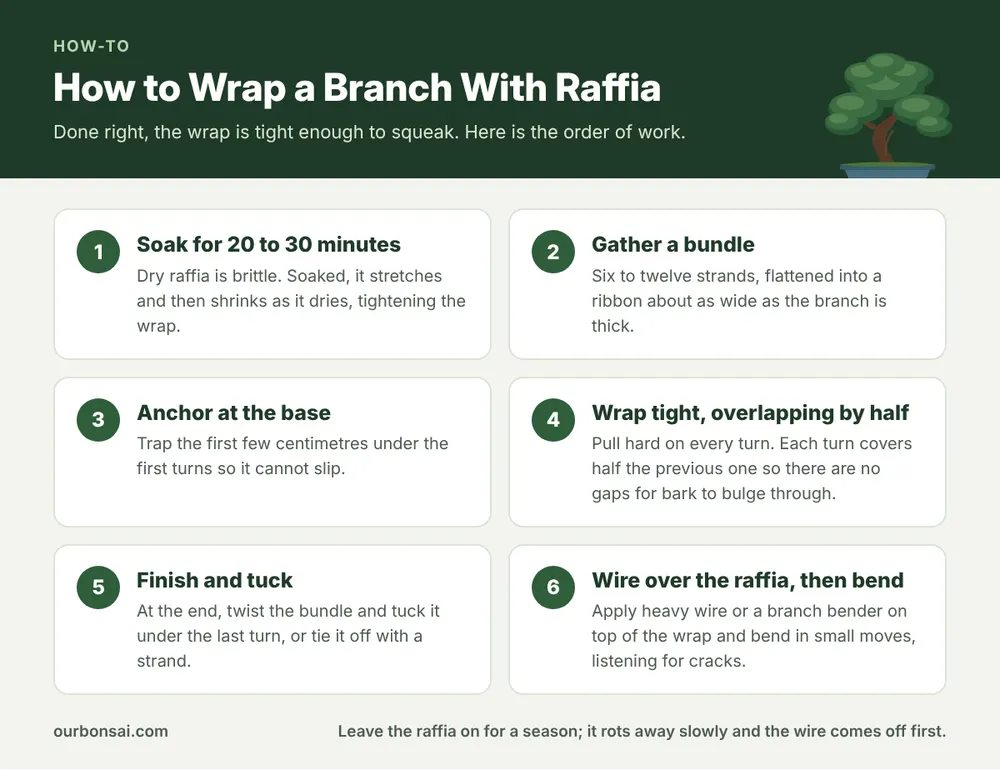
Soak it
Put the strands you need in a bucket of water for twenty to thirty minutes. Wet raffia stretches as you pull it and shrinks as it dries, so the wrap gets tighter on its own. Dry raffia snaps and will not conform to the bark.
Make a ribbon
Take six to twelve strands and flatten them side by side into a band roughly as wide as the branch is thick. Thicker branches want wider bands and more layers.
Wrap tight, overlap by half
Trap the starting end under the first two turns, then wrap towards the tip pulling hard on every turn, each turn covering half of the one before. No gaps, no slack. A good wrap looks like a bandage and feels like wood. Finish by twisting the bundle and tucking it under the last turn.
Wire or bend on top
Apply your heavy wire or a branch bender over the raffia, never under it, then bend in small movements, pausing to let the fibres settle and listening for cracking. For how far and how fast, read our branch wiring guide and guy wire guide; raffia makes a hard bend possible, not safe, and the branch still needs aftercare.
Leave it on
Raffia stays on for a growing season or more and rots away gradually. Remove the wire first, when it starts to bite (how to spot wire bite), and unwrap the raffia later once the branch has set, or let it weather off. Do not re-use it.
When not to bother
Thin, flexible branches that bend easily with wire alone do not need raffia. It is for primary branches and trunks, for brittle species, and for any bend that frightens you.
Frequently Asked Questions
What is raffia used for in bonsai?
Soaked raffia is wrapped tightly round a branch or trunk before a heavy bend. It compresses the bark so the surface does not split, pads the branch from wire or benders, and keeps the wound moist while it heals.
What kind of raffia is best for bonsai?
Natural, undyed raffia palm fibre in long strands. Tinyroots sells bonsai-specific raffia; natural craft raffia from Sukh, Woanger and others is the same fibre in bulk. Avoid paper raffia.
Do you soak raffia before wrapping a bonsai?
Yes, for twenty to thirty minutes. Wet raffia stretches as you wrap and shrinks as it dries, tightening the wrap. Dry raffia is brittle.
How long should raffia stay on a bonsai branch?
A growing season or more. It rots slowly. Remove the wire first when it begins to bite, and unwrap the raffia once the branch has set.
Can I use paper raffia for bonsai?
No. Paper raffia has no wet strength, will not stretch and shrink, and disintegrates against a damp branch.
How much raffia do I need for a bonsai branch?
A ribbon of six to twelve strands overlapping by half along the length of the bend. A medium branch uses a good part of one craft bundle; a thick trunk may take two or three.
Does raffia stop a branch from breaking?
It greatly reduces the risk of the bark splitting and holds the wood together if fibres crack inside, but it does not make any bend safe. Bend slowly, in stages, and give the tree aftercare.
Final Verdict
Buy the Tinyroots bonsai raffia for your first bends, then switch to natural craft raffia when you get through it: the Sukh 3-bundle pack for a few trees, the Woanger 18-bundle pack for a season, the IHDYPPEW box for a club. Soak it, wrap it tight, wire over the top, and bend slowly.