Best Soil for Zelkova Bonsai: Mix and Repotting Tips

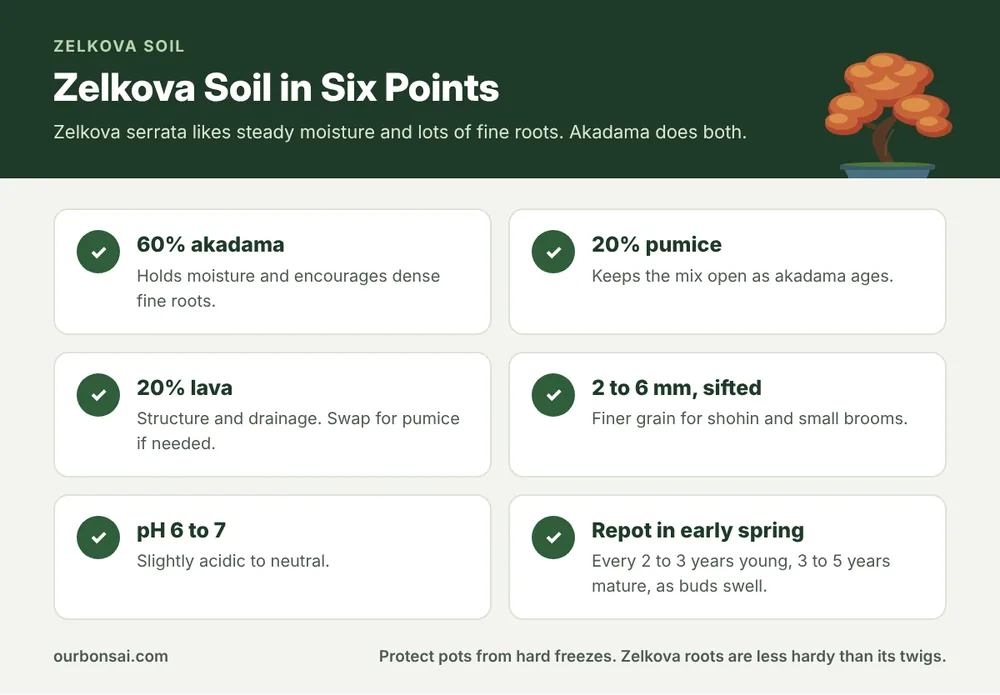
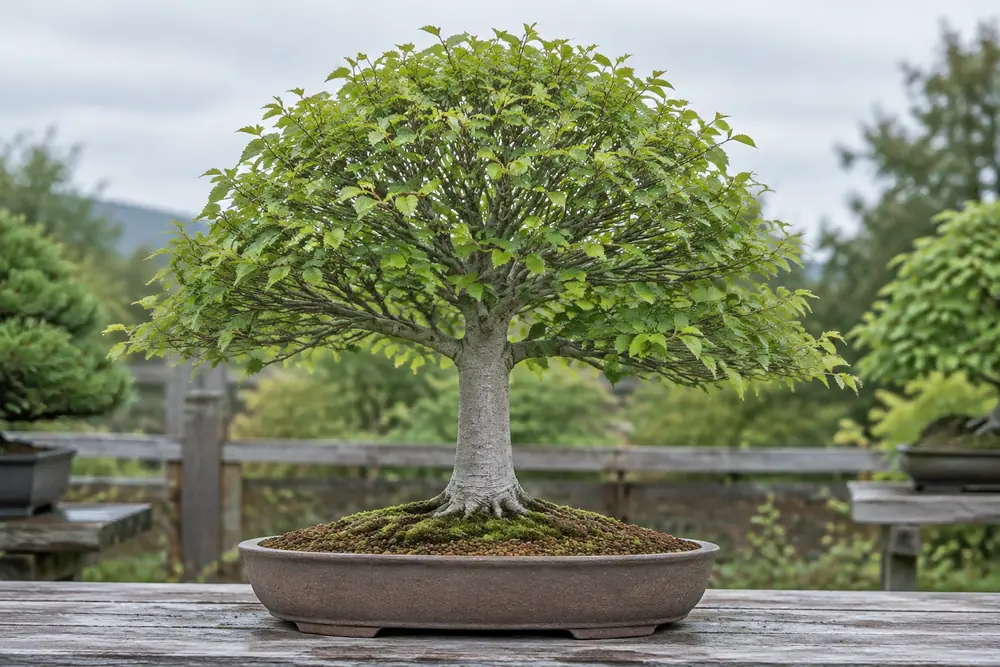
The best soil for zelkova bonsai is an akadama-rich mix that stays evenly moist but drains freely: about 60 percent akadama, 20 percent pumice and 20 percent lava rock, sifted to 2 to 6 mm, with a pH of roughly 6 to 7. Japanese zelkova (Zelkova serrata) is grown mostly in the broom style, with hundreds of fine twigs, and that kind of top growth depends on a dense mass of fine roots underneath. Akadama encourages exactly that. Repot young trees every 2 to 3 years and mature trees every 3 to 5 years, in early spring as the buds swell.
In this guide
Zelkova at a glance
- Native range: Japan, Korea, eastern China and Taiwan.
- Hardiness: roughly USDA zones 5 to 8 in the ground; pots need frost protection below about -10 C (14 F).
- Growth habit: deciduous tree in the elm family with a straight trunk, smooth gray bark that flakes with age, and small serrated leaves that turn yellow, orange or red in autumn.
- Bonsai use: the classic broom style (hokidachi), as well as upright and group plantings.
Zelkova is often confused with Chinese elm (Ulmus parvifolia), and some sellers label Chinese elms as “zelkova.” They are relatives with similar needs, but true zelkova has more strongly toothed leaves and a more upright, vase-like growth habit.
Why the best soil for zelkova bonsai is akadama-heavy
Zelkova likes consistent moisture. It does not want to sit in water, but it reacts to drying out by dropping leaves or scorching at the edges, and in a broom tree that can mean losing fine twigs that took years to build.
Akadama holds water inside each grain while leaving air between them. It also produces very fine, branching roots, which in turn support fine, branching twigs. The pumice and lava keep the mix open as the akadama slowly breaks down over 2 to 3 years.
For different conditions:
- Hot, sunny summers: 70 percent akadama, 30 percent pumice.
- Wet, mild climates: 50 percent akadama, 25 percent pumice, 25 percent lava.
- No akadama available: 50 percent calcined clay, 30 percent pumice, 20 percent fine bark.
You can see how these ratios affect drainage and retention in our guide to bonsai soil mix ratios.
One practical detail about akadama: buy the hard grade if you can. Hard (double-line or “hard-fired”) akadama holds its shape for longer, especially through freeze and thaw cycles, so the pot stays open closer to the 3 year mark. Soft akadama can turn to paste in a single wet winter. Whatever you buy, sift it before use and again if the bag has been knocked around in transport, because the dust that forms in the bag clogs the pot.
Why not just use bagged potting soil? It holds water, but it holds it everywhere, including the spaces roots need for air. Zelkova in that kind of soil grows a few thick roots instead of many fine ones, and the twig structure above suffers. Our comparison of bonsai soil and regular soil explains the difference in more detail.
Soil and the broom style
A broom zelkova is built by repeated pruning: shoots are cut back to two buds again and again until the canopy is a dense, rounded fan of fine twigs. That only works if the tree has energy to keep budding back, and energy comes from the roots.
Three soil habits make a real difference:
- Keep the mix fresh. Once akadama turns to mud, roots die back and the twigs above them follow. Repot before that happens.
- Spread the surface roots evenly. A broom tree looks best with a wide, even root flare all the way around.
- Avoid coarse soil in shallow pots. Very coarse grit dries too fast and causes leaf scorch in summer.
| Tree stage | Pot | Mix | Grain |
|---|---|---|---|
| Young tree, growing trunk | Large training pot or ground | 50% akadama, 50% pumice and lava | 4 to 8 mm |
| Developing broom | Medium training pot | 60% akadama, 20% pumice, 20% lava | 3 to 6 mm |
| Refined broom | Shallow oval display pot | 60 to 70% akadama, rest pumice | 2 to 4 mm |
Repotting a zelkova
Repot in early spring when buds swell, before the leaves open. Young trees need it every 2 to 3 years, mature trees every 3 to 5.
- Lift the tree and rake out the outer half of the root ball.
- Remove thick or downward-growing roots under the trunk.
- Spread the remaining surface roots outward in a radial pattern.
- Trim up to about a third of the root mass on a healthy tree.
- Repot into fresh mix, tie in, water thoroughly.
- Keep the tree sheltered from frost and wind for 3 to 4 weeks.
Wait until the new leaves have hardened before feeding. Then follow the normal pruning schedule for deciduous trees, described in our guide on when to prune deciduous bonsai.
Signs of a soil problem
- Leaves scorched brown at the edges in summer while the soil is dry by afternoon: mix too coarse or pot too shallow. Add more akadama.
- Yellowing leaves and soft dieback of fine twigs with soil that stays wet: mix has broken down, or drainage holes are blocked.
- Weak budding after pruning: often an old, compacted root ball. Repot the next spring.
- White crust on the soil: fertilizer salts. Flush with plenty of rainwater.
Frequently asked questions
Can I use the same soil for zelkova and Chinese elm?
Yes. Both do well in akadama-rich mixes. Our article on the best soil for Chinese elm bonsai uses very similar ratios.
Is zelkova an indoor bonsai?
No. It is a hardy deciduous tree that needs a cold winter dormancy. Grow it outdoors and protect the pot in hard freezes.
How often should I water a zelkova in this soil?
When the surface starts to dry. In summer that may be daily or even twice a day for small pots; in winter, much less.
Should I use moss on the surface?
A thin layer of moss helps keep the top layer from drying out and looks good on a broom tree. Keep it thin so you can still judge moisture.
Final thoughts
Zelkova rewards a moist, akadama-rich mix with dense fine roots and dense fine twigs. Keep the soil fresh with a repot every few springs, spread the roots evenly, and avoid letting a shallow pot dry out in summer. For more on the species, see the Wikipedia article on Zelkova serrata, and for related trees grown the same way, our overview of deciduous bonsai tree types.