How to Repot Trident Maple Bonsai and Build Better Roots

If you want to know how to repot trident maple bonsai, here is the core of it: repot in early spring as the buds swell and show color, before the leaves open, every 1 to 2 years for a developing tree and every 2 to 3 years for a mature one. Trident maples have very vigorous roots, so a healthy tree can lose up to about half its root mass. Use an akadama-rich mix (about 50 percent akadama, 25 percent pumice, 25 percent lava), spread the remaining roots out radially to improve the surface flare, and keep the newly repotted tree above freezing for 3 to 4 weeks.
In this guide
Why trident maple roots are different
The trident maple (Acer buergerianum) comes from eastern China and Taiwan and has been grown in Japan for centuries. It is hardy in the ground to roughly USDA zone 5, has three-lobed leaves and good autumn color, and is one of the most popular deciduous bonsai species in the world.
Its roots are its defining feature for bonsai growers. They grow fast, thicken quickly and fuse together where they touch. That has two consequences:
- A trident fills a pot quickly and becomes root-bound sooner than most maples. Leaving it too long leads to a tangled, thick mat that is hard to sort out.
- Roots can be shaped. Regular repotting is the main way to build a wide, even root flare (nebari), and tridents respond better to that work than almost any other species.
Timing: when the buds swell
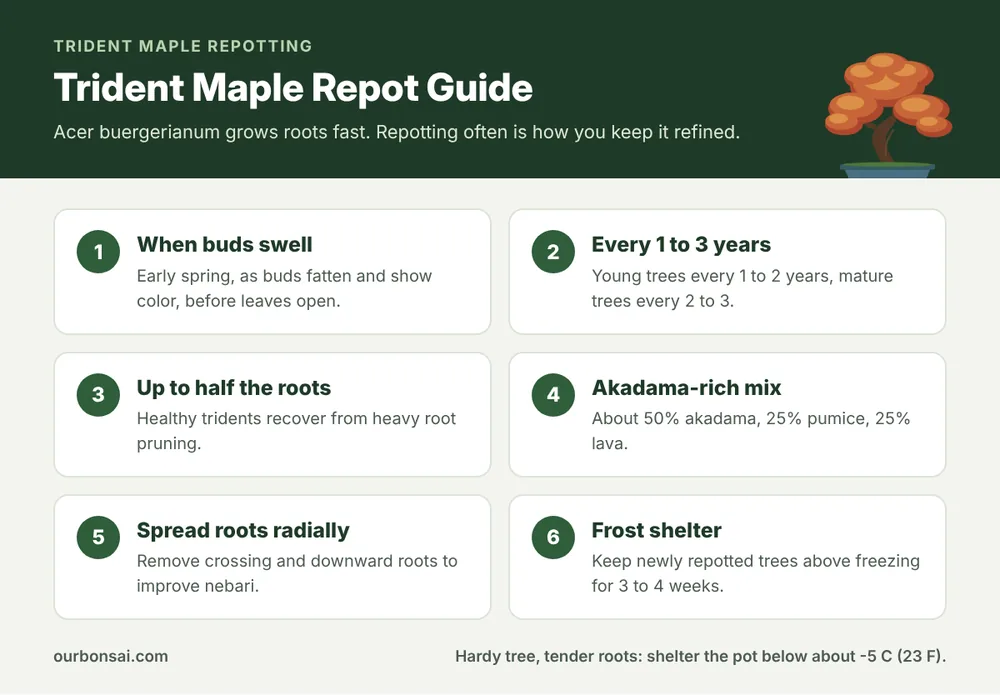
The ideal moment is when buds are swelling and starting to show pink or green at the tips but the leaves have not yet unfolded. In most temperate climates that is between late February and early April. At this stage the tree has stored energy ready to push roots, and there are no leaves yet losing water.
Repotting in autumn is possible in mild climates, and some growers do it, but it leaves cut roots sitting in cold wet soil all winter. Our article on repotting bonsai in autumn explains when that can make sense.
One caution: tridents are hardy trees, but their roots are less cold-tolerant than the branches. A pot of fresh, wet soil can freeze solid on a clear night in March. Keep the newly repotted tree in a cold frame, garage or greenhouse whenever frost is forecast.
Soil mix
Tridents like moisture and are heavy drinkers in summer. An akadama-rich mix suits them:
- 50 percent akadama
- 25 percent pumice
- 25 percent lava rock
Sift to 2 to 6 mm. In very hot, dry summers some growers use 60 to 70 percent akadama. In wet climates, cut it to 40 percent. Our bonsai soil mix ratio guide explains how these changes affect drainage.
How to repot trident maple bonsai, step by step
- Prepare the pot with mesh over the holes and two tie-down wires. Have your soil sifted and close by. A root hook, sharp root scissors and a concave cutter are the main tools; see our repotting tools guide.
- Remove the tree. On a root-bound trident, you may need a sickle or thin saw around the inside wall.
- Rake out the soil. Work from the bottom and the edges. Healthy tridents tolerate removing most of the old soil.
- Cut the thick downward roots directly under the trunk so the tree can sit flat and low.
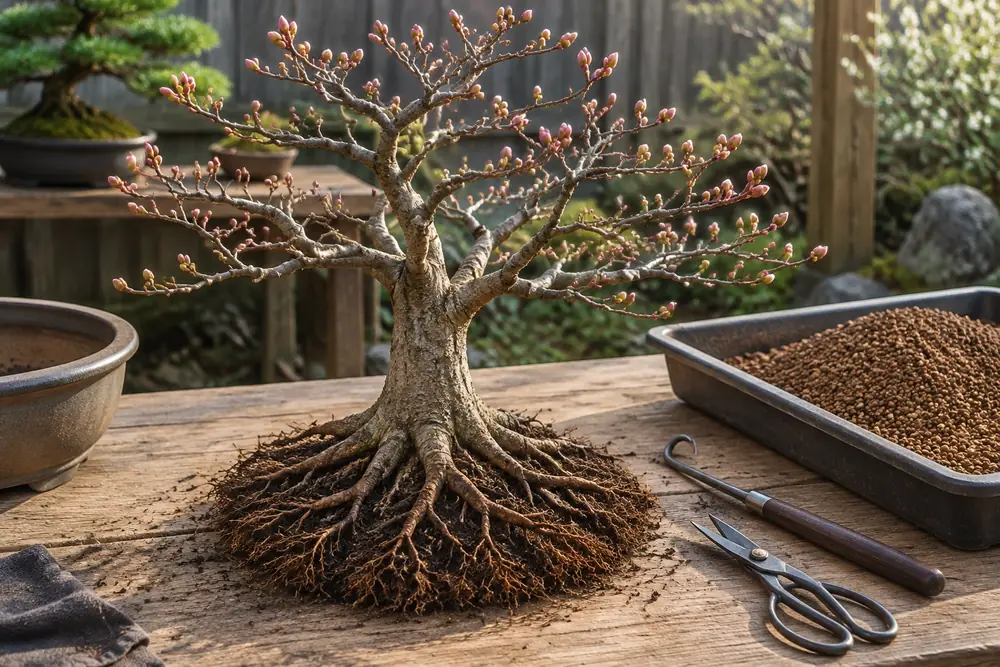
- Sort the surface roots. Remove roots that cross, circle or grow straight up. Keep the ones that radiate outward like spokes.
- Trim the rest so they fit the pot with a couple of centimeters to spare at the walls. Up to half the root mass can go on a strong tree.
- Position the tree, spread the roots evenly, tie it in firmly with wire (our page on bonsai repotting wire covers gauges), and work soil into every gap with a chopstick.
- Water thoroughly until the water runs clear.
Using each repot to build nebari
A wide, even root flare is one of the things that makes a trident maple look old. Every repot is an opportunity to improve it.
- Spread roots like the spokes of a wheel. Lay surface roots out radially and pin them with soil or a little wire.
- Cut thick roots back to a fine side root. This produces more, finer roots near the trunk.
- Fill gaps. Where a side of the trunk has no surface roots, you can encourage new ones by scoring the bark lightly at soil level, or by thread-grafting a young root.
- Try the tile method on young trees. Some growers plant the tree on a flat tile buried in the soil, which forces roots to grow sideways instead of down.
Over several repots, a trident can go from one-sided roots to a convincing 360-degree flare.
Aftercare
- Keep the tree sheltered from frost and strong wind for 3 to 4 weeks.
- Water when the surface is starting to dry. Leaves open quickly on a healthy trident, and water use increases once they do.
- Start feeding once leaves have hardened off, usually about 4 weeks after repotting.
- Let it grow freely for the first month before trimming shoots. For the pruning schedule afterwards, see when to prune deciduous bonsai.
When things go wrong
| Symptom | Likely cause | What to do |
|---|---|---|
| Buds stall for weeks | Cold or too much root removed | Keep frost-free, be patient, do not feed |
| Leaves open then wilt | Too few roots for the foliage, or wind | Shade and shelter, mist foliage |
| Branch dieback | Roots on that side were cut hard | Avoid removing all roots under one branch |
| Tree rocks in the pot | Loose tie-down | Re-tighten wire |
Frequently asked questions
Can I bare-root a trident maple?
Yes, healthy tridents tolerate it well at the right time of year. It is commonly done to replace old soil completely or to correct roots.
How often should I repot a trident maple?
Young trees every 1 to 2 years, mature trees every 2 to 3. The vigor of the roots is the reason they need it more often than most maples.
Can I repot a trident maple in summer?
Not for routine work. Emergency repotting (such as a broken pot) can be done with minimal root disturbance and shade afterwards.
Should I seal root cuts?
It is not necessary for most root cuts. Large cuts on the underside of the trunk can be sealed with cut paste if you like.
Final thoughts
Trident maple is the species that teaches root work best. Repot as buds swell, cut boldly on a healthy tree, spread the roots radially and protect the pot from frost afterwards. Over a few years, the root flare will show the difference. For background on the species, see the Wikipedia article on Acer buergerianum, and for a ready-made example, our trident maple bonsai review.