Bonsai Humidity: How Much Do Trees Need?


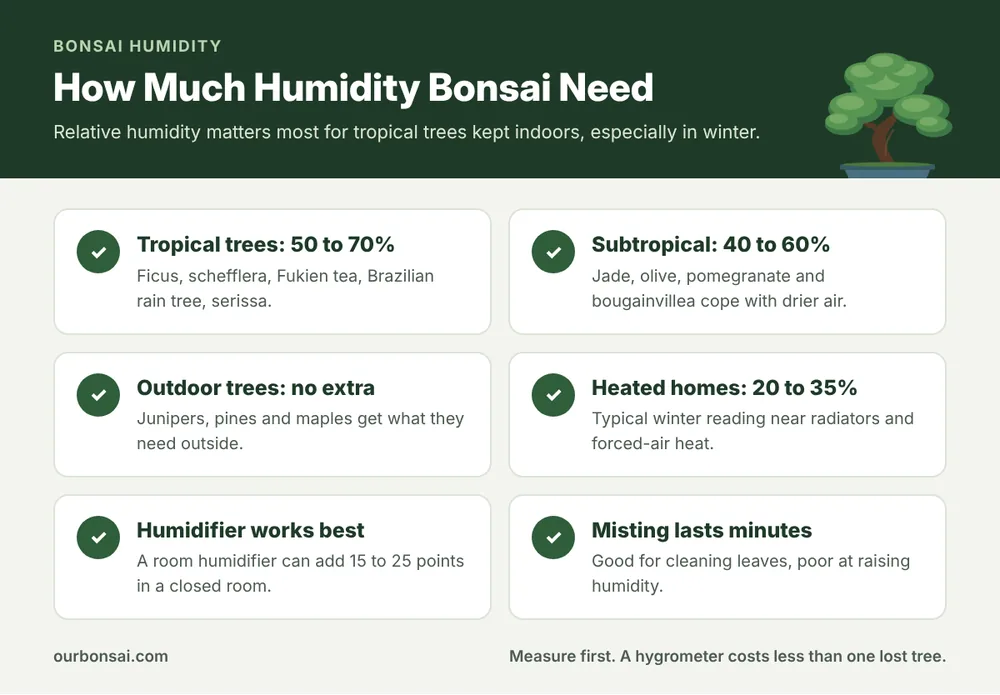
Bonsai humidity needs depend on the tree. Tropical species kept indoors, such as ficus, Fukien tea, schefflera and Brazilian rain tree, do best at about 50 to 70 percent relative humidity, while subtropical trees like jade and olive are comfortable at 40 to 60 percent. Outdoor temperate trees such as junipers, pines and maples need nothing extra. The problem is that a heated home in winter often sits at 20 to 35 percent, and lower still near radiators or forced-air vents. Of the common fixes, a room humidifier raises humidity the most, a humidity tray helps a little, and misting by hand barely moves the number for more than a few minutes.
In this guide
Why humidity matters for indoor bonsai
Leaves lose water through tiny pores called stomata. The drier the air, the faster they lose it. A tree with a full pot of roots can usually keep up. A bonsai cannot always, because it has a small root system in a shallow pot.
When the air is very dry, tropical bonsai respond in a few predictable ways:
- leaf tips and edges turn brown and crisp,
- older leaves yellow and drop,
- new leaves come out smaller and sometimes distorted,
- aerial roots on ficus and schefflera stop forming or dry up,
- spider mites, which love dry air, multiply quickly.
Many people read those signs as a watering problem and water more. That rarely helps, and it can push the roots into rot. Our guide on watering indoor bonsai in winter covers the balance.
How much bonsai humidity different trees need
| Tree type | Examples | Ideal humidity | Tolerance |
|---|---|---|---|
| Tropical rainforest species | Ficus, schefflera, Brazilian rain tree, Fukien tea | 50 to 70% | Struggle below 35% for long periods |
| Subtropical and dry-climate species | Jade, olive, pomegranate, bougainvillea, sago palm | 40 to 60% | Cope with 30 to 40% |
| Temperate outdoor species | Juniper, pine, maple, elm | Outdoor air | Do not need humidity help; should not be indoors |
Jade is a succulent and is happy in dry indoor air. Fukien tea, on the other hand, is one of the most humidity-sensitive trees commonly sold as indoor bonsai. If you are choosing an indoor tree for a dry apartment, our list of popular indoor bonsai trees notes which species tolerate it best.
Measure before you fix
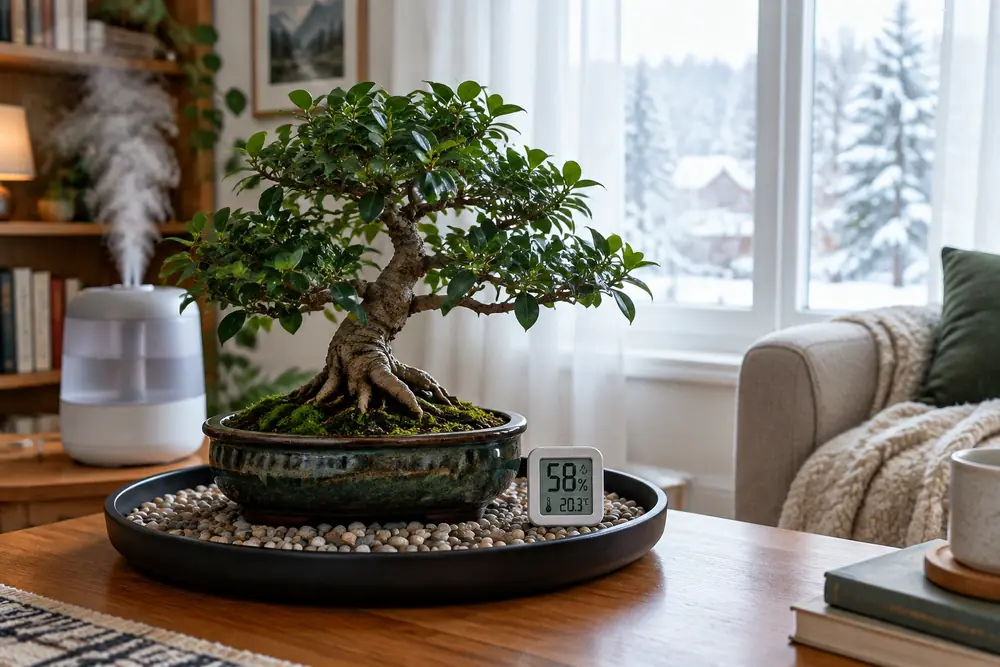
Relative humidity is easy to measure with a small digital hygrometer, which usually costs less than a bag of bonsai soil. Place it at the height of the tree, not across the room. Check it in the morning and evening for a few days, especially when the heating is on.
You might find that the window where your ficus sits is at 45 percent while the shelf above the radiator is at 22 percent. That one reading can explain a lot of leaf drop.
What raises humidity, ranked by effect
1. A room humidifier. The most effective option. A small cool-mist or evaporative unit in a closed room can raise humidity by 15 to 25 percentage points. Clean it regularly to avoid mold, and use distilled or filtered water if your tap water is hard, or you will get white dust on the leaves.
2. Grouping plants together. Several plants close together create a slightly more humid pocket of air. The effect is real but modest, a few percentage points.
3. A humidity tray. A shallow tray filled with gravel and water, with the pot resting on the gravel above the waterline. As the water evaporates it adds moisture right around the tree. The gain is small and local, but it costs nothing to run and also catches drainage water. We compared options in our review of bonsai humidity trays.
4. An indoor greenhouse cabinet or clear enclosure. Glass cabinets with a small fan and a light can hold 60 to 80 percent. They need ventilation, or mold and leaf diseases follow.
5. Misting. Spraying leaves raises humidity for a few minutes. It is useful for cleaning dust off leaves and for encouraging aerial roots in a humid setup, but it does not solve dry air on its own.
Things that make humidity worse
- Radiators, heating vents and fireplaces. Move trees at least a meter away and out of the direct airflow.
- Air conditioning in summer. It dries the air as well as cooling it.
- Cold glass at night. A windowsill can be both cold and dry. Pull the tree back from the glass on freezing nights.
- Open, drafty rooms. Constant air movement strips moisture from leaves faster.
Can humidity be too high?
Yes, if there is no air movement. In a closed cabinet or a bathroom with no ventilation, very high humidity encourages powdery mildew, leaf spot and fungus gnats in the soil. Above about 80 percent with still air, look for white powder or dark spots on leaves. A small fan running on low and a gap in the cabinet door usually solve it. Our article on powdery mildew on bonsai trees explains the signs.
Humidity and pests
Spider mites thrive in warm, dry air, and they are one of the most common pests on indoor bonsai in winter. Raising humidity is one of the best ways to slow them down. If you see fine webbing under leaves or tiny pale speckles, read our guide to spider mites on bonsai trees before the population builds up.
Frequently asked questions
Do outdoor bonsai need humidity trays?
No. Outdoor air is usually humid enough, and trays add little outside. The main use outdoors is to catch drainage water on a balcony.
Should I mist my bonsai every day?
You can, but do not rely on it for humidity. Misting is most useful in the morning, so leaves dry before evening, which reduces the risk of fungal spots.
What humidity is too low for a ficus?
Ficus tolerates more than most tropicals, but below about 30 percent for weeks it usually drops leaves. Aim for 45 percent or higher.
Will a bathroom work for my bonsai?
Only if it has a bright window. Most bathrooms are too dark, and the humidity spikes and drops sharply around showers.
Final thoughts
Humidity is a quiet factor that explains many winter problems with indoor bonsai. Measure it, keep tropical trees away from heat sources, and use a humidifier if your home is very dry. Trays and grouping help at the edges. For background on what relative humidity actually measures, see the Wikipedia article on relative humidity, and for the full picture of indoor care, our guide on how to take care of a bonsai tree inside.