How to Choose a Healthy Bonsai When Buying


Knowing how to choose a healthy bonsai comes down to a few quick checks: make sure the species suits where you will keep it (indoor or outdoor), look for dense, evenly colored foliage with signs of new growth, turn over several leaves to check for pests, gently wiggle the trunk to confirm the roots are anchored, and check that the pot has drainage holes and the soil is not glued over or rock hard. A healthy tree also smells earthy, not sour, and has no wire cutting deep into the bark. Most of these checks take under two minutes and catch the problems that make store-bought bonsai fail in their first months.
In this guide
Check 1: Is it the right tree for your home?
This matters more than anything on the shelf. Many shops sell junipers, Japanese maples and other outdoor species labeled as “indoor bonsai.” In a house, without cold winters and direct sun, they slowly decline and usually die within a year or two. Our article on keeping a Japanese juniper bonsai indoors explains why.
- Keeping it indoors? Choose a tropical or subtropical species: ficus, schefflera, jade, Fukien tea, serissa, Brazilian rain tree. See our list of popular indoor bonsai trees.
- Keeping it outdoors? Juniper, pine, maple, elm and many others, chosen for your climate.
If you are new to bonsai, our guide to easy-care bonsai trees narrows the options.
How to choose a healthy bonsai: the 10 checks
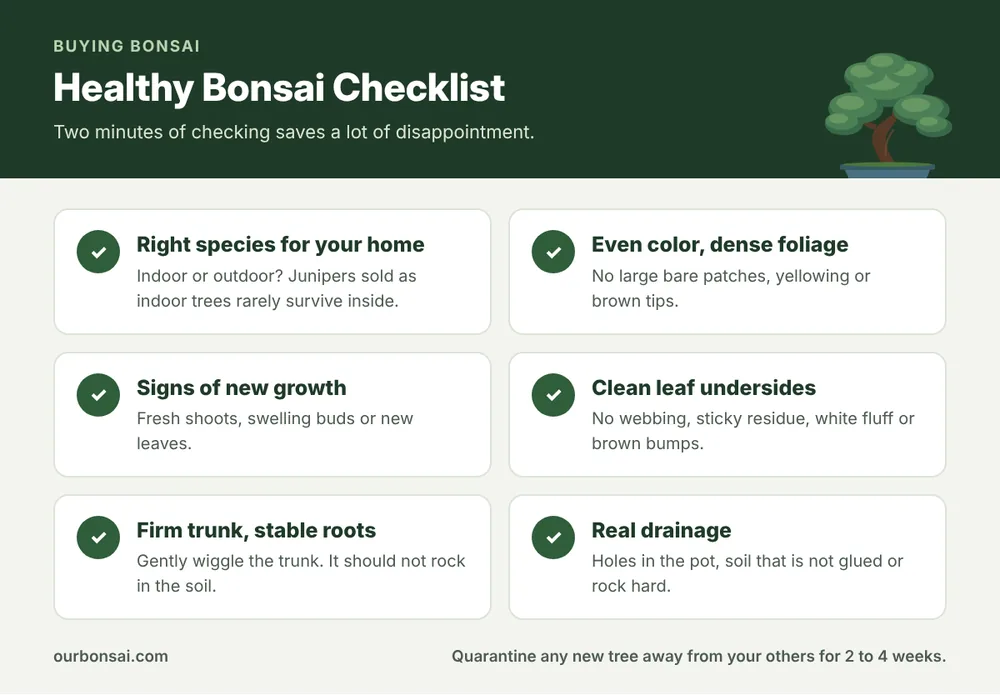
2. Foliage color and density
Healthy leaves or needles have even color for the species. Watch for:
- yellow leaves spread through the canopy (overwatering, root problems or low light),
- brown, crispy tips (drying out or salt buildup),
- patchy, thin areas where branches have dropped their leaves,
- on junipers, brown or gray inner foliage that crumbles when touched.
A few yellow leaves at the inside of a ficus are normal. Large areas are not.
3. Signs of active growth
New shoots, swelling buds or a flush of fresh, lighter-green leaves mean the roots are working. A tree with no new growth during the growing season may be struggling below the soil.
4. Pests
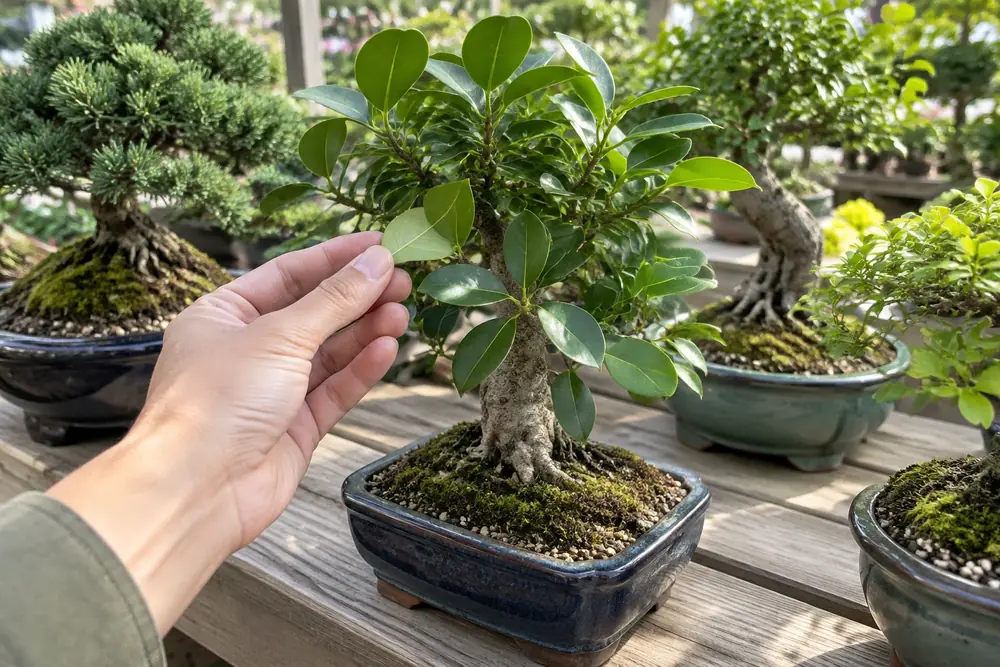
Turn over several leaves and look along stems and in leaf joints. Look for:
- fine webbing or tiny moving dots (spider mites),
- sticky, shiny residue on leaves or the table beneath (aphids or scale),
- white cottony clumps (mealybugs),
- small brown or gray bumps stuck to bark (scale).
Our guide to tiny bugs on bonsai leaves helps identify what you see.
5. The wiggle test
Hold the trunk gently near the base and move it slightly. It should feel anchored in the soil. If the tree rocks or lifts easily, the roots may be rotted, or the tree may have been recently stuck into the pot with few roots. Skip it.
6. Trunk and bark
Look for cracks, soft or sunken areas, peeling bark that reveals dark, wet wood beneath, or fungal growth. Gently press the bark at the base; it should be firm.
7. Soil and drainage
- Check for drainage holes in the pot.
- Avoid trees with a layer of gravel glued to the soil surface. Glue blocks water and air, and many mass-market bonsai are sold this way. If you buy one anyway, remove the glued layer the same day.
- Press the soil with a finger. Rock-hard, compacted soil that repels water is a warning sign. So is soil that is soggy and smells sour.
8. Wire
Wire is normal on bonsai, but it should not be cutting into the bark. Deep wire scars or wire buried in swollen bark mean the tree has been neglected for a while.
9. Roots at the surface
Brush aside a little soil at the base. You want to see roots spreading outward from the trunk. Roots that circle the trunk, or a trunk sitting on top of the soil with no visible roots, suggest problems.
10. Where it has been kept
A tree kept in a dark corner of a supermarket for weeks, or left in a hot car park, may look fine but has used up its reserves. Ask how long the tree has been in stock and how it has been watered. Specialist nurseries usually keep trees outdoors or in proper light.
A quick comparison
| Healthy sign | Warning sign |
|---|---|
| Dense, evenly colored foliage | Yellow or brown patches throughout |
| New shoots or buds in season | No growth for months |
| Trunk anchored, does not wobble | Trunk moves or lifts in the soil |
| Granular, moist soil | Glued gravel, rock-hard or sour soil |
| Clean leaf undersides | Webbing, stickiness, white fluff |
| Drainage holes | No holes or blocked holes |
| Wire sitting loosely | Wire cutting into bark |
Buying online
You cannot inspect a tree before it arrives, so:
- buy from sellers who show photos of the actual tree, not a stock image,
- read reviews that mention condition on arrival,
- check the species and whether it is indoor or outdoor,
- open the box immediately, remove packaging and run the checks above,
- photograph any damage for a return claim.
Our review of a small live bonsai tree shows what a typical online purchase looks like when it arrives.
After you buy
Keep a new tree away from your others for 2 to 4 weeks in case it carries pests. Our guide on how long to quarantine a new bonsai explains what to watch for. Do not repot or prune hard straight away unless the soil is clearly waterlogged; let the tree adjust to your conditions first.
Frequently asked questions
Is a cheap bonsai always unhealthy?
No. Many inexpensive trees are healthy and make good starter plants. Price matters less than the checks above.
What time of year is best to buy a bonsai?
Spring and early summer, when trees are actively growing and problems are easier to see. Outdoor trees bought in winter may be dormant, which makes health harder to judge.
Should I buy a tree with a few yellow leaves?
A few on the inside of a ficus or other tropical tree is normal. Widespread yellowing, especially with wet soil, is a warning sign.
Is a tree with no wire better?
Not necessarily. Wire shows the tree is being styled. What matters is that it is not cutting into the bark.
Final thoughts
Choose the right species for your home first, then check foliage, new growth, pests, roots, soil and wire before you pay. Those few minutes rule out most trees that would struggle. For an overview of the general care any new tree will need, see the Wikipedia article on bonsai cultivation and care, and if you are buying for someone else, our ideas for bonsai gifts.