Best Soil for Golden Gate Ficus Bonsai: Mix and Repotting Tips

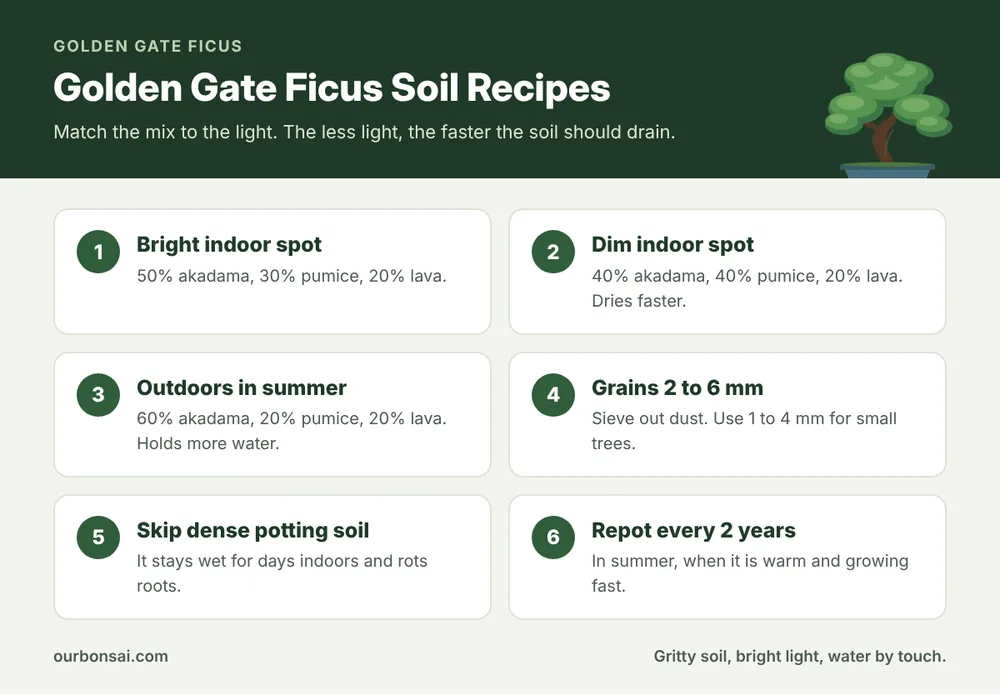
The best soil for golden gate ficus bonsai is a gritty but water-holding mix of about 50 percent akadama, 30 percent pumice and 20 percent lava rock, sieved to 2 to 6 mm. Golden Gate ficus usually spends most of the year indoors, where light is weaker and the soil dries more slowly than outside, so a dense potting mix stays wet for days and invites root rot. Adjust the mix to the light: more pumice for a dim spot, more akadama for a tree that summers outdoors in full sun. Repot every 2 years in summer, when it is warm and growing quickly.
In this guide
Why the indoor setting changes the soil
Golden Gate ficus is a fig cultivar with thick, glossy, oval leaves, usually sold as Ficus retusa or Ficus microcarpa. Like other figs, it is tough, fast-growing and tolerant of root work. Its weakness is soggy roots in low light.
On a summer patio, a ficus uses a lot of water. On a winter windowsill, it uses very little. The same soil that dries out in a day outside can stay damp for a week indoors. That is why the right mix depends on where your tree lives most of the year, not on the species alone.
Best soil for golden gate ficus bonsai, by location
| Where it lives | Akadama | Pumice | Lava | Why |
|---|---|---|---|---|
| Bright indoor spot or under a grow light | 50% | 30% | 20% | Balanced water and air |
| Dim indoor spot, humid home | 40% | 40% | 20% | Dries faster in low light |
| Outdoors in summer, indoors in winter | 50% | 30% | 20% | Good all-round choice |
| Outdoors all year in a warm climate | 60% | 20% | 20% | Holds more water in heat |
| Very dry heated home, small pot | 50% | 30% | 10% plus 10% fine bark | A little extra moisture |
Sieve every ingredient to remove dust, which clogs drainage. Our bonsai soil mix ratio guide explains each one, and good potting soil for bonsai covers bagged options.
Organic vs inorganic mixes
Many ficus sold in shops come in a peat or compost-based mix. It holds a lot of water, which helps the nursery, but it breaks down quickly and compacts in a shallow pot. Over a year or two, water starts to sit on the surface and roots at the bottom of the pot die.
Inorganic mixes based on akadama, pumice and lava keep their structure for 2 to 3 years, let air reach the roots, and make watering more predictable. A little fine bark is fine if your home is very dry, but avoid making organic matter the main part of the mix.
Top dressing and surface roots
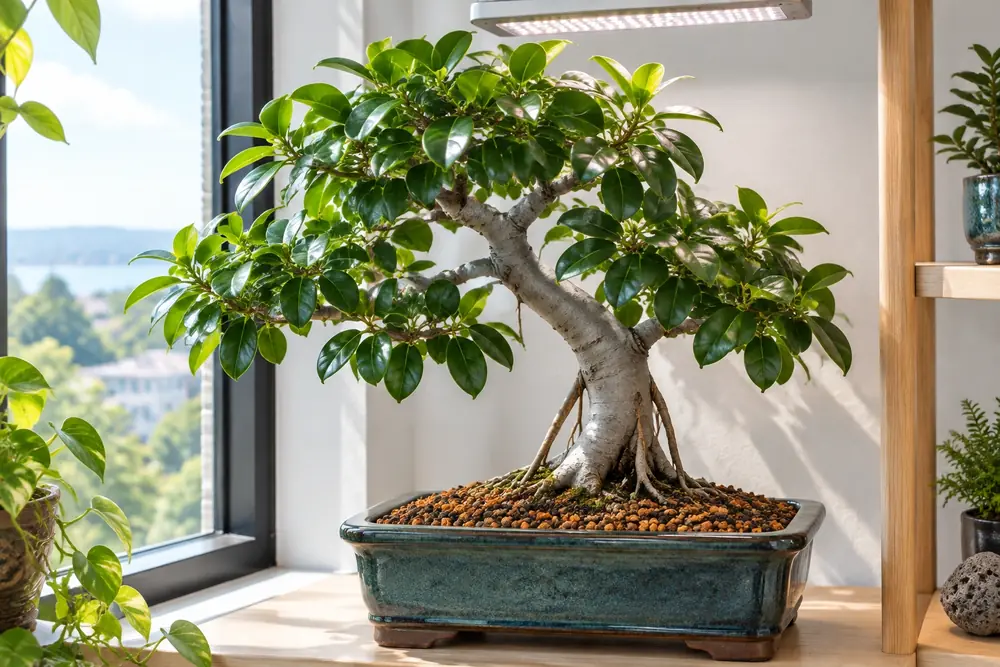
Golden Gate ficus often grows small aerial roots along its trunk and branches and develops thick surface roots that sprawl across the soil. A thin top dressing of finer, sieved akadama (1 to 3 mm) or a layer of live moss over the main mix keeps the surface looking neat and protects shallow roots from drying out between waterings. Keep the layer thin, no more than 5 mm, so it does not hold water against the trunk. If you want aerial roots to reach the soil and thicken, a slightly moister surface helps them root in once they touch down. Remove any thick moss that spreads up the trunk, because constantly damp bark at the soil line can start to rot.
Fertilizer and gritty soil
Inorganic soils hold fewer nutrients than compost, so regular feeding matters. During active growth, give a balanced liquid fertilizer every 2 weeks, or organic pellets monthly. In winter, feed only if the tree is still growing under good light, and at half strength.
How to tell if your soil is wrong
- Too wet: leaves yellow and drop, especially lower inner leaves; soil smells sour; fungus gnats appear. Our guide to fungus gnats on bonsai trees explains why gnats follow wet soil.
- Too dry: leaves wilt or curl, leaf edges brown, the pot feels light within a day.
- Broken down: water pools on the surface, roots circle the pot.
Repotting Golden Gate ficus
- When: late spring to summer, when nights stay above about 15 C (59 F).
- How often: every 2 years while developing, every 3 years when mature.
- How much root: up to half on a vigorous tree.
Steps:
- Prepare the pot with mesh and tie-in wires, and sieve the soil.
- Remove the tree, comb out the old soil from the outside in, and remove as much of any dense nursery soil as the tree tolerates.
- Cut thick downward roots and shorten long ones.
- Keep any aerial roots that have reached the soil.
- Pot up, tie in firmly and work the new soil into all the gaps.
- Water thoroughly, keep in bright shade for a week, then return to full light.
- Feed after 3 to 4 weeks.
Watering in a gritty mix
Water when the top 1 to 2 cm is dry, then soak until water runs out of the holes. Indoors in winter, that may be every 4 to 7 days; outdoors in summer, every day. Empty the saucer after watering. A humidity tray helps with dry indoor air without wetting the soil. Our Golden Gate ficus bonsai care guide covers light and feeding in more detail.
Frequently asked questions
Can I use regular potting soil for Golden Gate ficus bonsai?
It will survive in it for a while, but potting soil compacts and stays wet in a bonsai pot, especially indoors. A gritty bonsai mix is healthier.
Is akadama necessary for ficus?
No. Pumice and lava alone, with a little fine bark, also work. Akadama makes the mix hold a bit more water and nutrients.
How often should I repot a Golden Gate ficus?
Every 2 years while young, every 3 years when mature, in summer.
Why is my ficus soil always wet?
The mix is too fine or too organic, the pot lacks drainage, or the tree is in too little light. Fix the light and switch to a gritty mix at the next repot.
Final thoughts
Choose the soil for the place your tree actually lives. A gritty akadama, pumice and lava mix, tuned to your light, keeps a Golden Gate ficus healthy indoors and out. For a look at typical nursery trees, see our Brussels Golden Gate ficus bonsai review, and for the species group, the Wikipedia article on Ficus microcarpa.