When and How to Repot Japanese Maple Bonsai

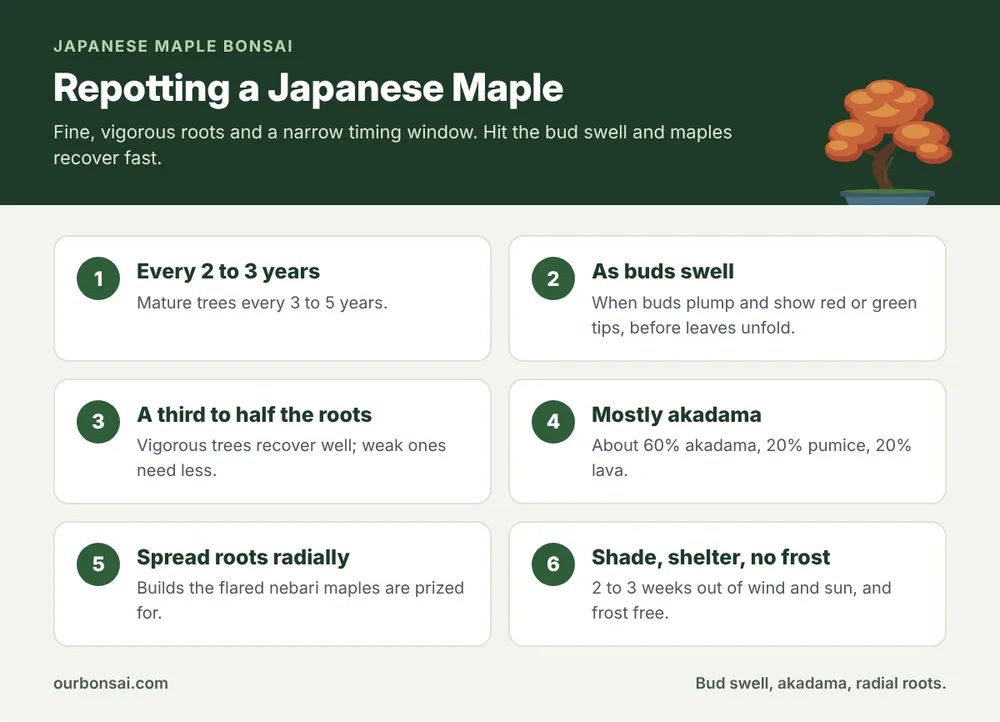
Here is how to repot japanese maple bonsai: repot every 2 to 3 years while the tree is young and every 3 to 5 years once mature, in early spring as the buds swell and show red or green tips, before the leaves unfold. Japanese maple (Acer palmatum) has fine, vigorous roots, so a healthy tree can lose a third to half of its root mass. Use a mostly akadama mix, about 60 percent akadama with 20 percent pumice and 20 percent lava, spread the roots outward like spokes to build a flared base, and keep the tree sheltered from wind, strong sun and frost for 2 to 3 weeks afterward.
In this guide
Why timing matters for maples
Maples wake early. Their roots start growing in late winter, and the buds swell soon after. When the buds are fat and just showing color at the tips, the tree is about to push a burst of root and leaf growth. Repot at that moment and new roots fill the fresh soil within weeks.
Repot too early, while the tree is fully dormant and the soil is cold, and cut roots sit idle in wet soil. Repot too late, once the leaves are open, and the tree has to supply water to soft new leaves with a reduced root system. Expect scorched or wilting leaves if you miss the window by a couple of weeks.
Some growers also repot maples in autumn after leaf fall in mild climates. Our article on repotting bonsai in autumn covers that approach, but early spring remains the standard.
Signs it is time
| Sign | Meaning |
|---|---|
| Water sits on the surface | Soil has broken down |
| Roots circle the pot or push the tree up | Pot is full |
| Leaves smaller and weaker than last year | Roots congested |
| Tree dries out within hours in summer | Too many roots, too little soil |
Soil for Japanese maple
Maples like evenly moist soil and suffer quickly if they dry out in summer. An akadama-heavy mix suits them:
- Standard: 60 percent akadama, 20 percent pumice, 20 percent lava.
- Hot summers: 70 percent akadama, 15 pumice, 15 lava.
- Cool, wet climate: 50 percent akadama, 25 pumice, 25 lava.
Sieve out dust before use. Maples are happy in slightly acidic soil, which akadama provides. Our bonsai soil mix ratio guide explains each component.
How to repot japanese maple bonsai, step by step
- Prepare everything before you lift the tree: pot with mesh and tie-in wires, sieved soil, root hook, scissors and a small saw.
- Remove the tree. Cut old wires and run a knife round the inside of the pot.
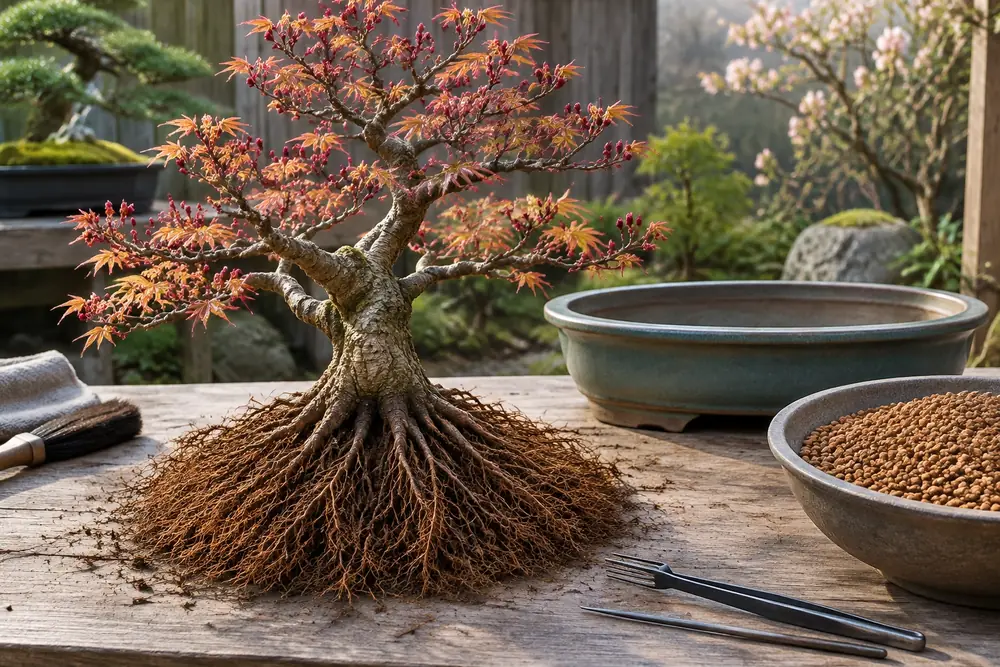
- Comb out the roots from the outside in and from the bottom up. Maple roots are fine and tolerate firm combing.
- Cut thick downward roots under the trunk. They make the tree sit high and do little for the nebari.
- Shorten the remaining roots so they fit the pot with space to grow. Remove a third to half of the root mass on a healthy tree.
- Spread surface roots radially. Lay the strongest roots out evenly in all directions. Over a few repots, this creates the wide, flared base maples are known for.
- Pot up, tie in firmly, and work soil into all the gaps with a chopstick.
- Water thoroughly until it runs clear.
Our list of the best bonsai repotting tools covers root hooks and saws.
Aftercare
- Shelter for 2 to 3 weeks. Out of wind and direct midday sun. Wind is especially damaging to opening maple leaves, which are thin and soft for their first few weeks.
- Protect from frost. Freshly repotted maples are sensitive to late frost. Use a cold frame or unheated garage on frosty nights.
- Water when the surface begins to dry. Do not let fresh akadama dry out, but do not keep it soaking either.
- No fertilizer for 4 weeks. Then start at half strength.
- Leave pruning until the first leaves have hardened.
- Watch the first flush. Slightly smaller leaves after a repot are normal and even welcome on a refined tree.
Grafted maples need extra care
Many Japanese maple cultivars, especially red-leaved and lace-leaf forms like ‘Deshojo’, ‘Bloodgood’ or dissectum types, are grafted onto a seedling rootstock of the green species. At repotting time, check where the graft sits. It usually shows as a change in bark color or a slight bulge low on the trunk. Keep the graft above the soil line, because burying it can lead to the scion rooting on its own or to rot at the union. Also look for shoots coming from below the graft. These are rootstock suckers with plain green leaves, and they should be cut off flush, since they are often more vigorous than the cultivar and can take over.
Grafted trees sometimes have a clumsy base where the graft union swells more than the rootstock. Repotting cannot fix that directly, but steady radial root spreading over the years helps the lower trunk thicken and makes the union less noticeable.
Common mistakes
- Missing the bud-swell window. Leaves already open means a harder recovery.
- Repotting and defoliating in the same season. Choose one.
- Leaving thick downward roots. They make radial nebari impossible.
- Putting a freshly repotted maple in full sun and wind. Leaves scorch.
- Bringing it indoors. Japanese maple is an outdoor tree that needs a cold winter. See our notes on Japanese maple bonsai indoors for why.
Frequently asked questions
How much root can I remove from a Japanese maple?
A third to half on a healthy, vigorous tree. Weak or old trees should lose less.
When is the best time to repot a Japanese maple bonsai?
Early spring, when the buds swell and show colored tips, before the leaves unfold.
Can I repot a Japanese maple in summer?
Not routinely. In an emergency, do a minimal slip-pot into a slightly larger pot without root pruning, and keep it shaded.
Why are my maple leaves scorching after repotting?
Usually wind, strong sun or the soil drying out while roots are recovering. Shelter the tree and water carefully.
Final thoughts
Japanese maple is one of the most rewarding trees to repot well: hit the bud-swell window, use an akadama-rich mix, cut the downward roots and spread the rest. For other maples, our Brussels trident maple bonsai review shows a close relative, and the Wikipedia article on Acer palmatum covers the species and its many cultivars.