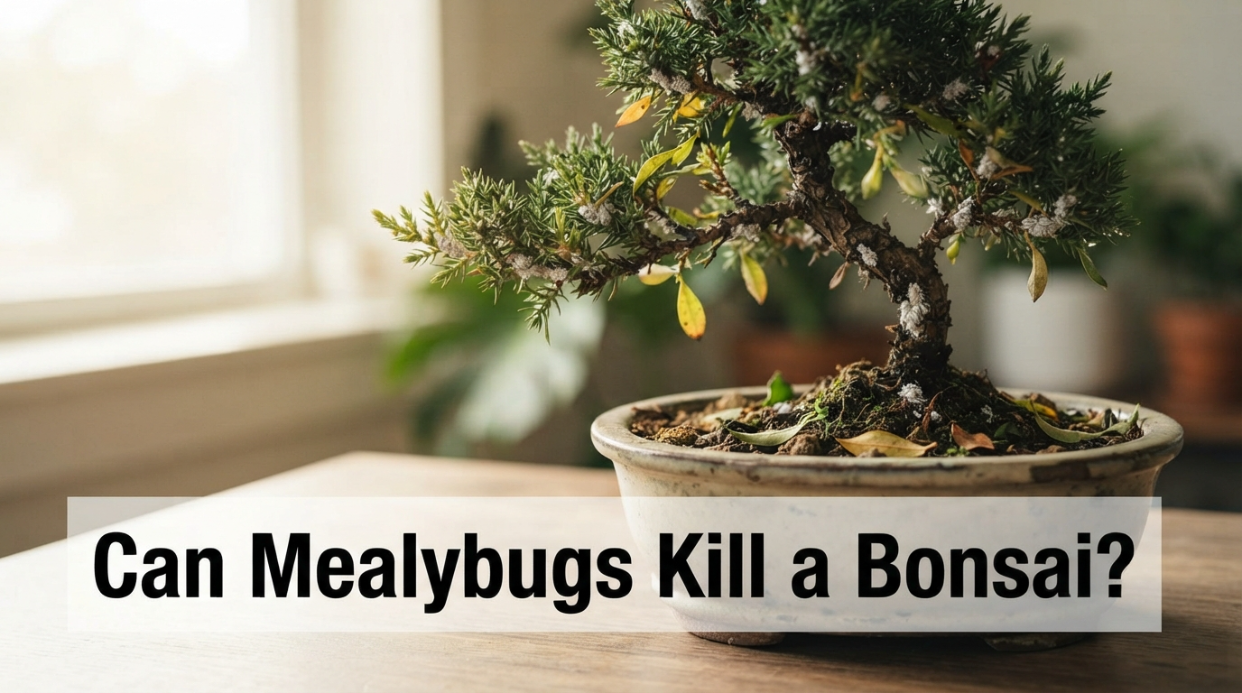
Can Mealybugs Kill a Bonsai?
Quick Answer
Yes, mealybugs can kill a bonsai when an infestation becomes severe or continues long enough to seriously weaken the tree. These sap-feeding pests can cause yellowing, stunted growth, leaf drop, twig decline, and eventually plant death, especially when the bonsai is already stressed; the UC IPM mealybug guidance explains why heavy populations are so damaging.
Signs Your Bonsai May Be at Risk
- White cottony clusters: Check leaf joints, branch forks, tender shoots, bark crevices, and the trunk base.
- Sticky honeydew: Leaves, branches, the pot, or the surface below the bonsai may feel sticky.
- Yellow or dropping leaves: Heavy feeding can reduce vigor and cause premature foliage loss.
- Weak new growth: Shoots may become stunted, distorted, or unusually slow.
- Hidden root pests: White wax around the soil, drainage holes, or roots may indicate root-feeding mealybugs.
What to Do First
- Isolate the bonsai, confirm that the white material contains living insects, remove visible pests, and inspect the tree repeatedly before escalating treatment.
Finding mealybugs on a bonsai is serious, but it doesn’t automatically mean the tree will die. When someone asks me, “Can mealybugs kill a bonsai?”, I look first at infestation size, tree vigor, and how long the pests have been feeding.
In This Guide
- What Are Mealybugs, and Can They Kill a Bonsai?
- How Do You Know Mealybugs Are Hurting Your Bonsai?
- Why Can Mealybugs Become Serious on Bonsai?
- What Should You Do If Your Bonsai Has Mealybugs?
- Which Mealybug Treatment Is Safest for Bonsai?
- How Do You Prevent Mealybugs From Coming Back?
- Frequently Asked Questions
What Are Mealybugs, and Can They Kill a Bonsai?
Mealybugs can eventually kill a bonsai if their population becomes large enough. Heavy infestations remove plant fluids, weaken growth, and can contribute to severe decline.
Definition: A mealybug is a small, soft-bodied, sap-feeding insect covered with a powdery or cotton-like wax that helps protect its body.
Most mealybugs are only a few millimeters long. They often settle in sheltered parts of the tree where they’re easy to overlook.
- Leaf axils: The point where a leaf or leaf stalk meets a shoot.
- Branch forks: Tight joints provide protection from water and sprays.
- New growth: Tender shoots provide convenient feeding sites.
- Bark crevices: Rough bark can hide small colonies.
- Root zone: Some mealybugs live below the soil surface and feed on roots.
The insects insert piercing mouthparts into plant tissue and remove fluids. High populations can lead to yellowing, distorted growth, premature leaf loss, branch decline, and plant death.
Iowa State University Extension’s mealybug guidance also notes that infestations rarely disappear after one treatment because hidden insects remain difficult to reach.
Does every mealybug infestation threaten the tree?
No. A few pests found early are much less dangerous than colonies covering several shoots or hiding throughout the root ball.
I would judge urgency using three factors:
- Population: A handful of visible insects is different from colonies across the canopy.
- Tree condition: A vigorous tree usually has more reserve than a weak or recently stressed bonsai.
- Duration: Persistent feeding gives the pests more time to reduce vigor.
A healthy bonsai with an early infestation has a good chance of recovery. The danger rises when pest pressure combines with watering, root, light, or temperature stress.
How Do You Know Mealybugs Are Hurting Your Bonsai?
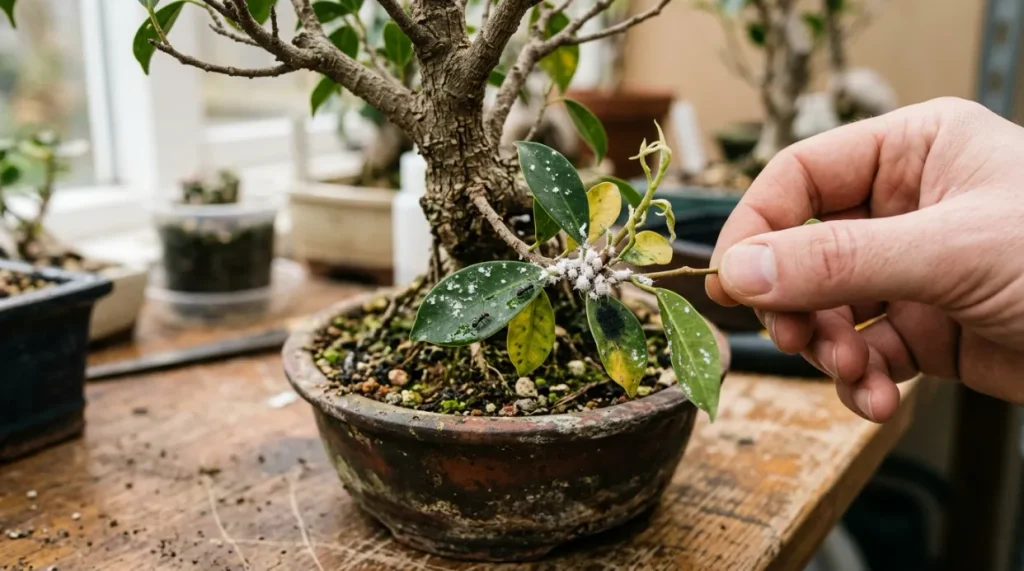
The clearest warning is a combination of visible mealybugs and declining growth. White fluff alone isn’t enough because mineral residue, scale insects, and other pests can sometimes look similar.
Start by inspecting the insect itself. Adult female mealybugs are generally oval, segmented, and coated in white wax.
Look for these early signs
- White waxy insects: Search leaf joints, undersides, shoots, and branch forks.
- Cotton-like material: Egg masses and wax can collect in protected areas.
- Honeydew: Sap-feeding mealybugs often leave clear, sticky residue.
- Ant activity: Ants may visit the honeydew and sometimes protect sap-feeding insects.
- Slow growth: New shoots may become weak or stunted.
Bonsai Empire’s pest and disease overview lists mealybugs among the common pests that can weaken bonsai through sap feeding.
Signs the infestation is becoming severe
As the population increases, symptoms become harder to dismiss. At that point, don’t focus only on the insects you can see.
- Widespread yellowing
- Premature leaf drop
- Distorted or stunted shoots
- Wilting despite appropriate watering
- Heavy honeydew deposits
- Black sooty mold growing on honeydew
- Weak twigs or branch dieback
Sooty mold doesn’t normally feed directly on the bonsai. It grows on the sugary honeydew left by sap-feeding insects.
That distinction matters. Removing the mold without controlling the mealybugs leaves the real problem in place.
Why Can Mealybugs Become Serious on Bonsai?
Bonsai aren’t automatically more attractive to mealybugs than ordinary plants. However, their compact form and limited root volume can make existing stress more important.
A tree dealing with root trouble, low light, excessive heat, or poor watering has fewer resources available for recovery. Add sustained sap loss, and its condition can decline faster.
Compact canopies give pests hiding places
Dense branching creates many protected joints and bark gaps. Mealybugs can remain hidden even when the most obvious cottony patches have been removed.
- Inspect both sides of every leaf.
- Follow branches back toward the trunk.
- Check branch crotches and pruning scars.
- Look beneath the pot rim.
- Examine drainage holes and the soil line.
Indoor bonsai may need closer monitoring
Warm indoor conditions can allow pest activity to continue when outdoor seasonal conditions would normally change. Indoor plants also receive less help from natural predators.
Tropical and subtropical bonsai kept indoors therefore deserve routine inspection. Ficus and other commonly grown indoor woody plants can host mealybugs.
Root mealybugs are easier to miss
Some mealybug species live around roots rather than on foliage. Their white wax may appear near drainage holes, along the pot edge, or around roots during repotting.
Weak growth alone does not prove a root infestation. Watering mistakes, damaged roots, compacted substrate, and poor light can produce similar symptoms.
What Should You Do If Your Bonsai Has Mealybugs?
Act quickly, but don’t immediately reach for the strongest pesticide available. A careful sequence helps reduce pests while limiting unnecessary stress on the bonsai.
- Isolate the tree. Move it away from other bonsai and houseplants.
- Confirm the pest. Use bright light and a hand lens if necessary.
- Inspect the whole bonsai. Check foliage, shoots, bark, trunk base, pot, and soil surface.
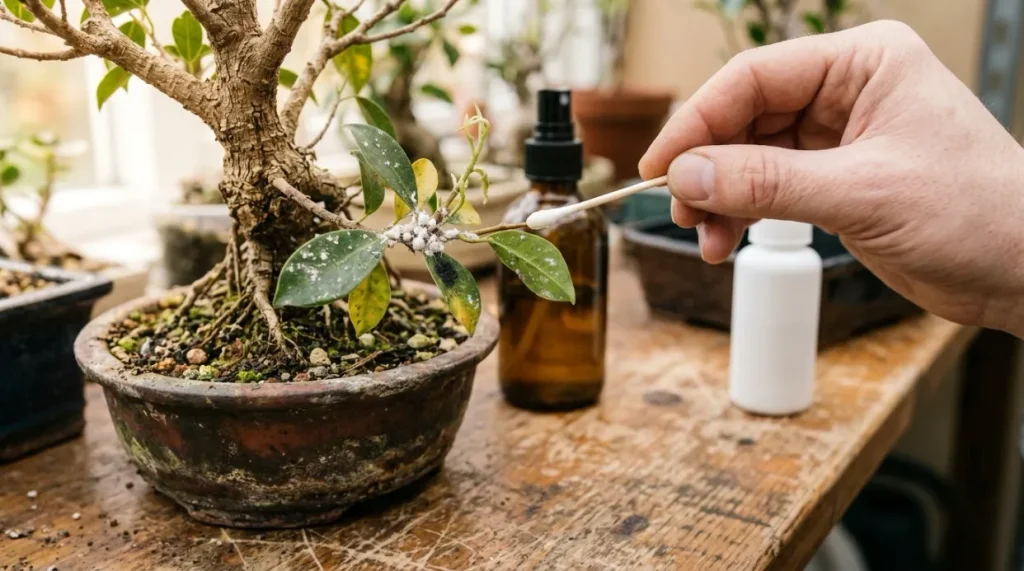
- Remove exposed insects. Use tweezers, a cotton swab, or another gentle method.
- Clean the surrounding area. Wipe benches, trays, windowsills, and tools.
- Monitor repeatedly. Hidden insects and newly mobile young can appear after the tree looks clean.
A controlled stream of water can also remove exposed pests from sturdy foliage. Protect loose bonsai substrate so it isn’t washed from the shallow pot.
University of Minnesota Extension recommends starting indoor pest management with identification and nonchemical approaches where practical.
Should you prune infested branches?
Removing a heavily infested, expendable twig can reduce pest numbers. It isn’t necessary for every infestation, and unnecessary pruning adds another source of stress.
Pro tip: Cutting live branches is irreversible. On valuable or heavily styled bonsai, check with an experienced grower or local bonsai club before removing important branches.
What if you suspect mealybugs in the roots?
Don’t perform an aggressive emergency repot solely because the tree looks weak. Confirm the evidence and consider whether root work is appropriate for the species and season.
- Look for white wax near drainage holes.
- Inspect material visible around the pot edge.
- Watch for recurring aboveground infestations.
- Consider other causes of poor growth first.
Pro tip: Root pruning can seriously weaken an already stressed bonsai. Seek species-specific advice before disturbing the root ball outside the normal repotting window.
Section Takeaway: Isolate first, identify carefully, and reduce the visible population before escalating treatment. Avoid combining pest stress with unnecessary pruning or root work.
Which Mealybug Treatment Is Safest for Bonsai?
There isn’t one treatment that’s safest for every bonsai species. Start with the least disruptive method capable of controlling the infestation.
As of 2026, extension recommendations still emphasize physical removal, targeted treatment, and repeated monitoring. Mealybugs are difficult because their waxy coating and hidden feeding sites reduce contact with sprays.
| Method | Best Use | Main Benefit | Important Caution |
|---|---|---|---|
| Manual removal | Small visible colonies | Minimal whole-tree exposure | Hidden insects can remain |
| Water spray | Exposed pests on sturdy foliage | Physically dislodges insects | Protect bonsai soil from erosion |
| Isopropyl alcohol | Targeted spot treatment | Useful on individual mealybugs | Use 70% or less and test a small area 1–2 days first |
| Insecticidal soap | Larger exposed populations | Contact treatment for soft-bodied pests | Use a labeled product and follow directions |
| Horticultural oil | Persistent exposed infestations | Can suppress pests reached by the spray | Species and temperature sensitivity matter |
Can rubbing alcohol damage a bonsai?
Yes. Alcohol can injure sensitive foliage, especially when used too strongly or applied broadly without testing.
UC IPM advises using 70% or less isopropyl alcohol for targeted treatment and testing a small area one to two days beforehand. A more diluted solution may be appropriate for sensitive plants.
What about insecticidal soap or horticultural oil?
Both can suppress mealybugs when the product reaches the insect. Coverage matters because wax and sheltered hiding places protect untreated individuals.
- Choose a product labeled for your plant and growing location.
- Follow the manufacturer’s dilution and application directions.
- Test sensitive foliage before treating the entire tree.
- Avoid homemade detergent mixtures that may burn leaves.
- Repeat only as the product label allows.
Should you use a systemic pesticide?
Some systemic insecticides are labeled for mealybugs on certain ornamental plants, but they aren’t my first choice for a small, manageable infestation. Their suitability depends on the plant, growing location, label, and possible exposure of pollinators.
Never increase pesticide concentration because the first application seems ineffective. With mealybugs, poor coverage and hidden insects are often bigger problems than product strength.
Section Takeaway: Use the least disruptive effective option first. Whatever treatment you choose, correct identification, careful application, and follow-up inspection matter more than one aggressive spray.
How Do You Prevent Mealybugs From Coming Back?
Prevention depends on finding new infestations before they become established. I consider routine inspection more valuable than preventive spraying.
A practical habit is to examine susceptible bonsai every week. During treatment, inspect more often so you can catch newly visible insects quickly.
Quarantine new plants
New nursery plants and houseplants are common routes for introducing pests. Keep new arrivals separate before placing them beside an established bonsai collection.
- Inspect leaf undersides and branch joints.
- Check the pot rim and drainage holes.
- Look for sticky residue or white wax.
- Keep suspect plants away from clean ones.
- Wash hands and clean tools after handling infested material.
A 7–10 day initial quarantine can reveal obvious pests, although longer isolation is sensible when a plant shows suspicious symptoms or requires treatment.
Avoid excessive nitrogen
Heavy nitrogen feeding encourages lush, tender growth. UC IPM notes that excessive nitrogen combined with regular irrigation can favor mealybug reproduction.
Feed according to the species, season, and fertilizer directions instead. More fertilizer isn’t a pest-control strategy.
Keep checking after the bonsai looks clean
The biggest mistake is stopping after the visible cotton disappears. Young insects and hidden colonies may still remain.
- Recheck branch forks.
- Inspect emerging shoots.
- Look beneath leaves.
- Watch for renewed honeydew.
- Check neighboring plants too.
If insects keep returning despite careful aboveground control, reassess the root zone and nearby plants. Repeated reinfestation usually means a source is still being missed.
Frequently Asked Questions
Can a few mealybugs kill a bonsai?
A few mealybugs usually won’t kill an otherwise healthy bonsai immediately. The concern is allowing them to reproduce and spread unnoticed. Remove visible insects, isolate the tree, and continue inspecting it so a small problem doesn’t become a damaging colony.
How quickly can mealybugs kill a bonsai?
There is no fixed timeline because damage depends on pest numbers, tree species, plant size, and existing stress. Death is generally associated with heavy or prolonged feeding rather than a few insects appearing for several days.
Can a bonsai recover after a bad mealybug infestation?
Yes, many bonsai can recover if enough healthy roots, branches, and foliage remain. Control the infestation first, then provide appropriate water, light, temperature, and normal care without overfertilizing the weakened tree.
Will rubbing alcohol kill mealybugs on bonsai?
Targeted isopropyl alcohol can kill individual mealybugs. Extension guidance recommends 70% or less and testing a small area one to two days beforehand because some plants may develop leaf burn or other damage.
Can mealybugs live in bonsai soil?
Yes. Certain mealybugs live around plant roots and may leave white wax around roots, pot edges, or drainage holes. Because several root problems cause similar aboveground symptoms, confirm the pest before undertaking disruptive root work.
Should I throw away a bonsai with mealybugs?
Not automatically. Early and moderate infestations are often manageable. Disposal becomes more reasonable when a low-value tree is heavily damaged, treatment repeatedly fails, and keeping it creates a serious risk to a larger plant collection.
Should I separate an infested bonsai from my other trees?
Yes. Isolate the affected bonsai as soon as you confirm or strongly suspect mealybugs. Also inspect neighboring plants, clean shared surfaces and tools, and prevent branches from touching while you monitor the infestation.
Can mealybugs kill a bonsai? They can, but severe damage is far less likely when you catch the pests early. Isolation, positive identification, careful removal, appropriate treatment, and repeated inspection give the tree its best chance to recover.
If your bonsai is already dropping leaves or losing branches, treat the infestation while checking its water, light, roots, and overall vigor. Pest control works best when the tree’s other care needs are also correct.