Scale Insects on Bonsai Leaves: Treatment Guide
Quick Answer
Scale insects on bonsai leaves and branches are sap-feeding pests that often look like brown, tan, gray, white, or waxy bumps. Isolate the bonsai, confirm that the bumps are living scale, remove reachable insects carefully, then target remaining pests with a plant-labeled horticultural oil or insecticidal soap when appropriate; the UC IPM scale insect guide provides useful identification and management guidance.
Signs to check first
- Fixed bumps: Scale often stays firmly attached to leaves, twigs, branches, or bark.
- Sticky honeydew: Soft scale may leave foliage, pots, or benches tacky.
- Sooty mold: Black growth can develop on honeydew rather than directly from the insect.
- Weak foliage: Yellowing, premature leaf drop, reduced growth, or twig decline can occur.
- Tiny crawlers: Newly hatched scale can move before settling and developing stronger protection.
Best first move
- Separate the bonsai from other plants, inspect it with magnification, and identify the pest before spraying the whole tree.
Scale insects on bonsai leaves can be frustrating because they rarely look like ordinary insects. A colony may resemble natural bark texture, dried sap, or tiny shells until the tree starts losing vigor.
In this guide, I’ll show you how to identify scale, distinguish it from similar bonsai pests, treat an infestation safely, and reduce the chance of it returning.
In This Guide
What Are Scale Insects on Bonsai?
Scale insects are small sap-feeding insects that settle on plant tissue and feed through piercing mouthparts. Many become almost motionless after their young crawler stage.
Definition: A scale insect is a sap-feeding insect in the superfamily Coccoidea whose later life stages often develop a waxy, shell-like, or shielded appearance while attached to leaves, twigs, branches, or stems.
The word “scale” covers many species. Their color, shape, preferred host, life cycle, and treatment timing can differ.
Two broad groups matter most when diagnosing a bonsai:
- Soft scales: Often produce sugary honeydew and may have rounded or waxy bodies.
- Armored scales: Develop a protective covering and generally do not produce honeydew.
A bonsai does not attract scale simply because it is miniature. The same insects can attack suitable full-size trees, shrubs, houseplants, and container plants.
Small bonsai can still suffer noticeable damage because each leaf and branch contributes heavily to the finished canopy. A dense crown can also hide colonies in places that casual inspections miss.
How Do You Identify Scale Insects on Bonsai Leaves?
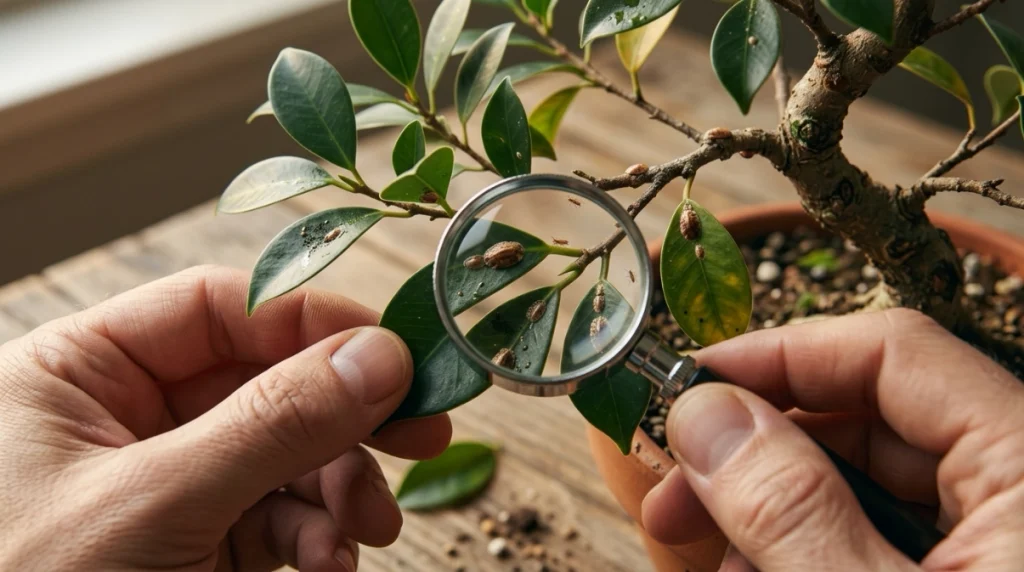
Look for attached bumps that differ from the normal color or texture of the leaf and branch. Then check the surrounding tissue for honeydew, discoloration, weak growth, or sooty mold.
Inspect more than the top of the leaves
Scale commonly hides where the tree offers protection. A quick glance from above can miss most of an infestation.
- Check upper and lower leaf surfaces.
- Inspect petioles and leaf joints.
- Look along new twigs and older branches.
- Examine branch crotches and bark crevices.
- Check the trunk near dense foliage.
- Inspect areas where leaves overlap.
A 10× hand lens can make identification much easier. Good side lighting also helps raised insects stand out from flat leaf spots.
Try a careful confirmation test
A suspicious bump deserves closer inspection before treatment. Compare several unaffected branches so you know what normal bark and buds look like.
On a small infestation, a confirmed scale may sometimes lift away with gentle pressure from a soft tool or cotton swab. Do not aggressively scrape young bark or tender foliage.
Another clue is the crawler stage. These newly hatched scale insects are small, mobile, and often easier to control than protected adults.
The University of Minnesota Extension scale guide suggests monitoring for crawlers with close inspection, white paper, or double-sided tape placed near infested areas.
Do not confuse scale with other bonsai pests
- Mealybugs: Usually have a white, cottony or waxy appearance.
- Aphids: Usually remain visibly insect-shaped and gather around tender growth.
- Spider mites: Cause fine stippling and sometimes delicate webbing rather than fixed shell-like bumps.
- Whiteflies: Winged adults may fly when foliage is disturbed.
- Natural bark: Repeats consistently with the tree’s normal texture and does not form an active colony.
Section Takeaway: Diagnose the insect before treating the tree. Fixed bumps plus plant damage, honeydew, crawlers, or living tissue beneath a covering create a much stronger scale diagnosis than color alone.
What Damage Do Scale Insects Cause?
Scale insects remove plant fluids while feeding. Large or persistent populations can weaken foliage, slow growth, and contribute to twig or branch decline.
Possible symptoms include:
- Yellow or pale leaves
- Premature leaf drop
- Weak new shoots
- Reduced overall vigor
- Sticky leaf or branch surfaces
- Black sooty mold
- Stunted foliage
- Twig or branch dieback in severe cases
Honeydew can reveal soft scale
Some soft scales excrete honeydew while feeding. This sugary liquid can make leaves, branches, pots, shelves, or benches feel sticky.
Sooty mold fungi may then grow on that honeydew. The black coating is therefore a secondary sign rather than the scale insect itself.
Ant activity can also increase around honeydew-producing insects. Repeated ants climbing the same bonsai deserve a closer inspection of leaves and twigs.
Do not diagnose scale from yellow leaves alone
Yellowing foliage has many possible causes. Watering problems, damaged roots, light stress, fertilizer injury, seasonal changes, and other pests can produce overlapping symptoms.
Always look for the insect or another strong diagnostic clue. Treating an unidentified problem with pesticide can add stress without fixing the cause.
Soft Scale vs. Armored Scale: What Is the Difference?
Soft and armored scales share a sap-feeding lifestyle, but they differ in appearance and biology. Recognizing the group can explain why one infestation produces sticky honeydew while another does not.
| Feature | Soft Scale | Armored Scale |
|---|---|---|
| Typical covering | Body may appear waxy, rounded, or smooth | Protective detachable cover or shield |
| Honeydew | Common in many species | Generally absent |
| Sooty mold | Can occur where honeydew accumulates | Less useful as a diagnostic clue |
| Young stage | Mobile crawler before settling | Mobile crawler before developing protection |
| Control challenge | Hidden individuals and overlapping life stages | Protective covering reduces exposure to contact sprays |
Exact identification to species is not always necessary for a small home collection. It becomes more useful when the infestation persists despite correctly timed treatment.
Host species can also narrow the possibilities. Pines, junipers, maples, elms, ficus, azaleas, and other bonsai hosts do not necessarily attract the same scale species.
How Do You Treat Scale Insects on Bonsai?
Start with isolation and physical removal, then target surviving scale at its most vulnerable life stage. Avoid jumping immediately to the strongest pesticide available.
1. Isolate the infested bonsai
Move the tree away from healthy bonsai and houseplants. Keep the quarantine spot appropriate for the species’ light, temperature, and airflow needs.
Check neighboring plants as well. Crawlers or infested plant material can allow a small problem to spread through a collection.
2. Remove accessible scale carefully
For a light infestation, physical removal can immediately reduce the population. Use a soft brush, cotton swab, or another gentle method that does not damage bark or leaves.
The Bonsai Empire pest and disease guide also describes physical removal followed by an appropriate soap or horticultural oil as a common scale-management approach.
- Work slowly around tender leaves.
- Support fine branches while cleaning them.
- Dispose of heavily infested dead material.
- Clean tools before using them on another bonsai.
Pro tip: Avoid cutting live branches merely to remove a few insects. For irreversible pruning on valuable material, get guidance from an experienced grower or local bonsai club first.
3. Target the crawler stage
Crawlers are newly hatched, mobile scale insects. They have not yet developed the stronger protection associated with later stages.
This makes crawler timing one of the most useful ideas in scale control. The exact hatch period varies with scale species, host plant, climate, and season.
Check infested branches at least weekly during likely hatch periods. Magnification, white paper, or sticky tape can help reveal movement.
4. Consider insecticidal soap
A commercially formulated insecticidal soap labeled for your plant and target pest can help control exposed young stages. Coverage matters because these products generally work through direct contact.
Do not substitute random household dish detergent for a formulated horticultural product. Household cleaners can contain ingredients or concentrations that injure plant tissue.
Test any spray on a small section first when the label allows. Watch for discoloration or leaf injury before treating a valuable bonsai completely.
5. Consider horticultural oil
Horticultural oils can control scale by coating exposed insects and interfering with respiration. They can be useful against several scale stages when applied correctly.
Colorado State University Extension’s horticultural oil guidance notes that oils are widely used for scales, aphids, mites, and other pests.
Plant sensitivity still matters. Drought-stressed plants and certain sensitive species may be more vulnerable to oil injury.
- Use only products labeled for the plant and situation.
- Follow the specified dilution exactly.
- Avoid applying during unsuitable heat or sun conditions listed on the label.
- Cover the pest thoroughly where the product depends on contact.
- Do not exceed the label’s application frequency.
6. Expect to monitor after treatment
One application may not eliminate every stage. Eggs, protected adults, or insects missed by spray coverage can remain.
Reinspect the tree regularly and follow the product label regarding repeat applications. The goal is to break the life cycle, not simply make the visible adults disappear.
Section Takeaway: The safest treatment sequence is isolate, identify, physically reduce the colony, target vulnerable crawlers, and monitor repeatedly. Correct timing and thorough coverage usually matter more than using a harsher product.
How Do You Keep Scale From Coming Back?
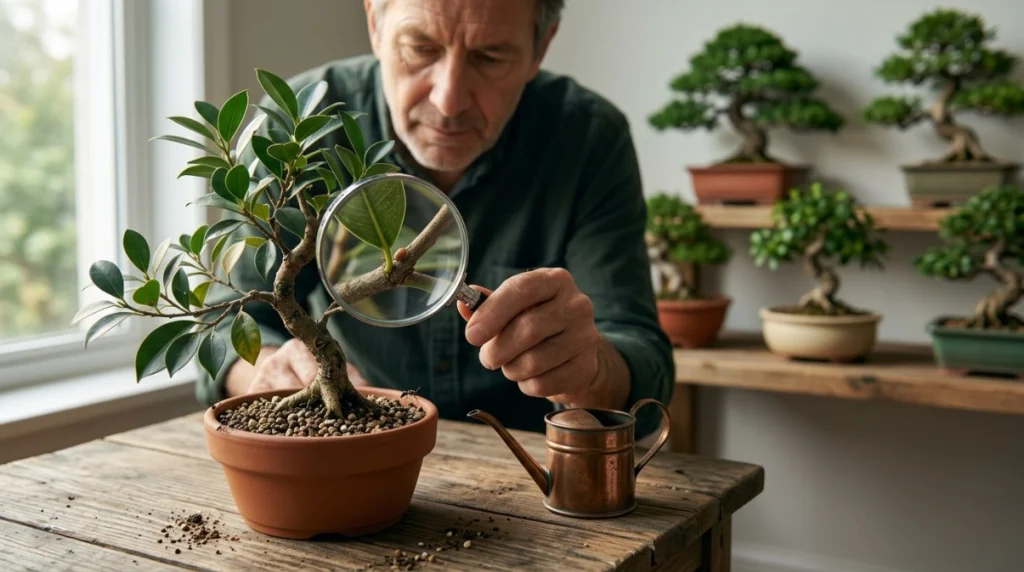
Regular inspection is the best long-term defense. Scale becomes much harder to manage after several generations establish across dense branches.
Inspect new trees before joining the collection
Check every new bonsai, pre-bonsai, accent plant, and houseplant before placing it beside established trees. Pay special attention to stems, leaf undersides, bark crevices, and branch joints.
Quarantine gives hidden pests time to become visible. It also prevents an unidentified problem from immediately reaching every nearby plant.
Keep the bonsai growing steadily
Scale prevention does not require forcing maximum growth. It requires avoiding unnecessary stress that leaves the tree struggling to recover from pest damage.
- Water according to actual soil moisture.
- Maintain suitable light for the species.
- Use a free-draining bonsai substrate appropriate for the tree.
- Feed according to growth stage and species needs.
- Provide reasonable airflow without exposing sensitive foliage to damaging wind.
Watch for recurring clues
Sticky leaves, new ants, weak shoots, strange bumps, and sudden sooty mold are reasons to inspect immediately. Do not wait until the next scheduled maintenance session.
As of 2026, integrated pest management remains the most sensible approach for a home bonsai collection. Confirm the pest, use the least disruptive effective control, preserve beneficial insects where practical, and monitor the result.
My rule for diagnosis is simple: change as little as possible until the evidence points somewhere specific. A weak bonsai rarely benefits from simultaneous changes to watering, fertilizer, light, and pesticide use.
Frequently Asked Questions
Can scale insects kill a bonsai?
Yes, a severe or persistent scale infestation can weaken a bonsai enough to cause leaf loss, poor growth, twig dieback, or further decline. A healthy tree may tolerate a small population temporarily, but scale should still be monitored and controlled before numbers build.
What do scale insects look like on bonsai leaves?
They often look like small brown, tan, gray, white, or waxy bumps attached to leaves, stems, or branches. Their shape varies by species, so supporting clues such as honeydew, crawlers, yellowing, or living tissue beneath a covering help confirm the diagnosis.
Does neem oil kill scale insects on bonsai?
Some horticultural oil products derived from neem can affect scale when the product is labeled for that use and contacts susceptible stages. “Neem” products vary, so read the exact label instead of assuming every neem formulation works the same way.
Can I scrape scale insects off a bonsai?
You can gently remove accessible scale from a lightly infested bonsai, but avoid aggressive scraping that damages leaves or bark. Physical removal works best as part of a broader plan that includes monitoring for crawlers and treating remaining insects when necessary.
Why are there ants on my scale-infested bonsai?
Many soft scales produce sugary honeydew that attracts ants. Repeated ant traffic can therefore be a clue that honeydew-producing insects are feeding somewhere on the tree, although ants alone do not prove that scale is present.
How often should I check the bonsai after treatment?
Check it at least weekly while you are trying to break an active scale infestation, and inspect more often if crawlers are appearing. Continue monitoring after visible adults disappear because eggs or hidden stages may survive the first treatment.
Should I repot a bonsai because it has scale insects?
Usually not. Leaf and branch scale does not automatically require root disturbance, and unnecessary repotting can add stress to an already weakened tree. Repot only when root or soil conditions independently justify it and the timing suits the bonsai species.
Final Takeaway
Scale insects on bonsai leaves are easiest to manage when you catch them early and identify them correctly. Look for fixed bumps, honeydew, sooty mold, crawlers, yellowing foliage, and weakened growth rather than relying on one symptom.
Start with isolation and careful physical removal. If treatment is needed, use a plant-labeled insecticidal soap or horticultural oil appropriately and focus on vulnerable crawler stages.
Most importantly, keep checking the tree after it looks clean. A few minutes of regular inspection can stop the next generation before it becomes another full infestation.