Root Pruning Bonsai: When and How to Do It Safely

This post contains affiliate links. As an Amazon Associate, OurBonsai earns from qualifying purchases at no extra cost to you. Read our disclosure.
In this guide
Root pruning bonsai is what keeps a tree alive in a small pot for decades. In nature, roots keep spreading. In a bonsai pot they run out of room, circle around the edge and fill the space until water can no longer soak in. Trimming the roots every few years, usually during repotting, makes room for fresh soil and encourages a dense mat of fine feeder roots close to the trunk. That fine root system is what lets the tree take up water and food efficiently and stay healthy.
This guide covers when to root prune, how much root you can safely remove, how to do it step by step, and how to care for the tree afterwards.
Why bonsai need root pruning
- Space for fresh soil. Old soil breaks down, compacts and drains poorly. Root pruning makes room to replace it.
- Fine feeder roots. Cutting thick roots encourages lots of fine roots to grow from the cut ends, close to the trunk.
- A shallow root system. Removing downward-growing roots lets the tree live in a shallow pot.
- Better nebari. Pruning helps develop an even spread of surface roots, the “nebari” that makes a bonsai look old and stable.
- Prevents pot-bound decline. A root-bound tree dries out fast and cannot absorb water properly.
The Wikipedia overview of bonsai cultivation and care describes root reduction as a core part of keeping trees small and healthy in containers.
When to do root pruning on a bonsai
| Tree type | Best time | How often |
|---|---|---|
| Deciduous (maple, elm, hornbeam) | Early spring, as buds swell | Every 2 to 3 years young, 3 to 5 mature |
| Conifers (pine, juniper) | Early to mid spring | Every 3 to 5 years |
| Tropical (ficus, Fukien tea, jade) | Late spring to early summer | Every 2 to 3 years |
| Flowering (azalea) | Right after flowering | Every 2 to 3 years |
The reason for early spring is simple: the tree is about to grow and has full energy reserves, so it rebuilds roots quickly. Tropical trees prefer warmth, so they wait for late spring or early summer. Our guide to the best time to repot tropical bonsai goes deeper on indoor species, and repotting bonsai in autumn explains when an autumn repot can work.
Signs your bonsai needs root pruning: water sits on top of the soil, roots poke out of the drainage holes, the tree dries out much faster than it used to, or you can lift the whole root ball out in one solid lump of roots.
How much root can you remove?
On a healthy, vigorous tree, removing up to about a third of the root mass is safe. Strong deciduous trees such as trident maple and Chinese elm can take more. Pines, junipers and any weak tree should lose less, around a quarter. Never root prune a tree that is sick, freshly collected or recovering from a hard top pruning.
A good rule: the more foliage you leave on the tree, the more roots it needs to support it. Do not root prune hard and prune the branches hard in the same season.
What you need
- Sharp root scissors or old pruning scissors kept for roots.
- A root hook or chopstick to comb out the soil. Our guide to the best bonsai repotting tools has good options, or browse bonsai root hooks.
- Fresh bonsai soil. See our bonsai soil mix ratio guide.
- Mesh and wire to secure the tree in the pot. Our bonsai repotting wire guide explains sizes.
- A spray bottle to keep the roots damp while you work.
How to do root pruning bonsai step by step
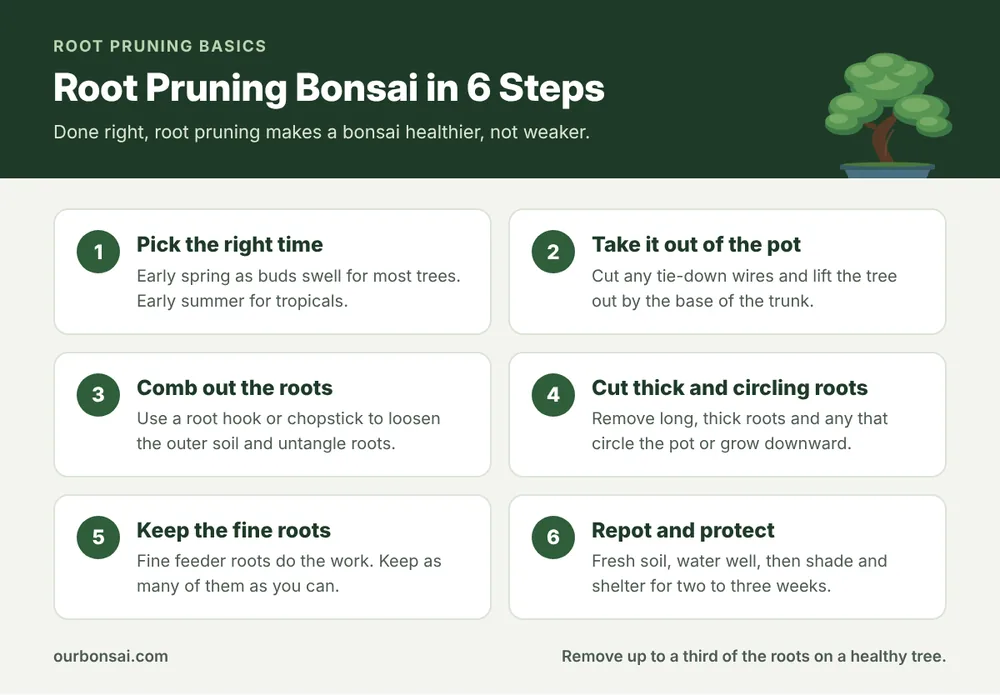
Step 1: Remove the tree from the pot
Cut any wires holding the tree in place. Run a knife around the inside of the pot if roots cling to the walls, then lift the tree out by the base of the trunk.
Step 2: Comb out the roots
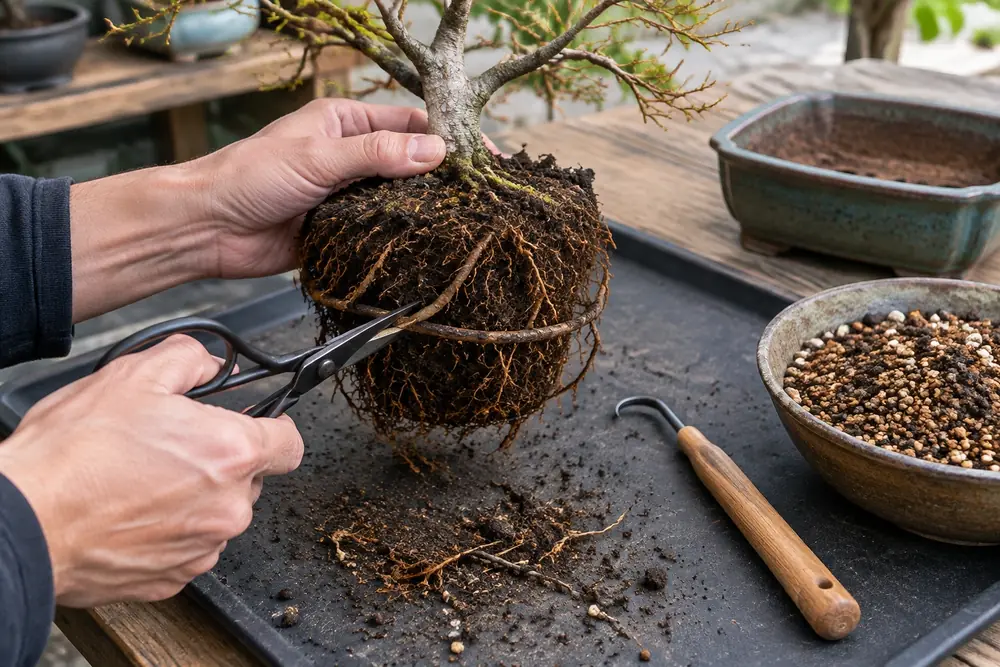
Starting at the outside and bottom, use a root hook to loosen the old soil and untangle the roots. Work from the top surface outward too, so you can see the surface roots. Keep the roots moist with a spray bottle; fine roots die quickly in dry air.
Step 3: Cut the long and circling roots
Trim long roots that circle the pot back to inside the root ball. Remove thick roots growing straight down under the trunk, which often prevent the tree sitting low in a shallow pot. Cut cleanly with sharp scissors, never tear.
Step 4: Keep the fine roots
Fine, hair-like feeder roots are the ones that absorb water. Keep as many of them as you can and cut the thick, woody ones instead.
Step 5: Check for rot
Healthy roots are firm and light-colored inside. Black, soft or smelly roots are rotting and should be cut back to healthy tissue. Our guide to root rot in bonsai explains what to look for.
Step 6: Repot
Place a layer of fresh soil in the pot, set the tree in position, tie it in with wire so it cannot rock, and work fresh soil in among the roots with a chopstick. Water until the water runs clear from the drainage holes.
Aftercare after root pruning
- Shade and shelter for two to three weeks. No hot afternoon sun or strong wind.
- Water carefully. Keep the soil evenly moist but not soggy. A tree with fewer roots uses less water.
- No fertilizer for about four weeks while the cut roots heal and new roots form.
- No wiring or heavy pruning the same season.
- Protect from frost if you repotted outdoor trees early in spring.
Common root pruning mistakes
- Pruning roots in midsummer heat or in autumn on trees that need spring repotting.
- Letting the roots dry out while you work.
- Removing most of the fine roots and keeping the thick ones.
- Not tying the tree in, so it rocks and tears new roots.
- Root pruning a weak or sick tree.
FAQ: root pruning bonsai
Can I root prune a bonsai without repotting?
Usually root pruning happens during repotting, because you need to take the tree out of the pot. Some growers trim roots poking out of drainage holes, but real root pruning needs the tree out of the pot.
Will root pruning kill my bonsai?
Not if you do it at the right time on a healthy tree and remove no more than about a third. Done right, it makes the tree stronger.
How long does a bonsai take to recover from root pruning?
New roots start within two to three weeks in spring. Most trees are growing normally within a month or two.
Do I need to prune the branches after root pruning?
Not necessarily. On a tree that lost a lot of roots, a light trim of the top helps balance it, but avoid heavy pruning the same season.
Final thoughts
Root pruning bonsai sounds drastic, but it is one of the healthiest things you can do for a tree in a small pot. Do it in early spring for most trees, early summer for tropicals, remove up to a third of the roots, keep the fine ones and protect the tree for a few weeks after. Your tree will reward you with stronger growth and a better root base for years.