How Often to Water Ficus Bonsai (Indoor & Outdoor Guide)


This post contains affiliate links. As an Amazon Associate, OurBonsai earns from qualifying purchases at no extra cost to you. Read our disclosure.
In this guide
- Why ficus bonsai watering is different
- How often to water ficus bonsai by season
- What changes how often your ficus needs water
- How to check if a ficus bonsai needs water
- How to water a ficus bonsai the right way
- Ficus watering indoors vs outdoors
- Signs of overwatering and underwatering
- FAQ: how often to water ficus bonsai
- Final thoughts
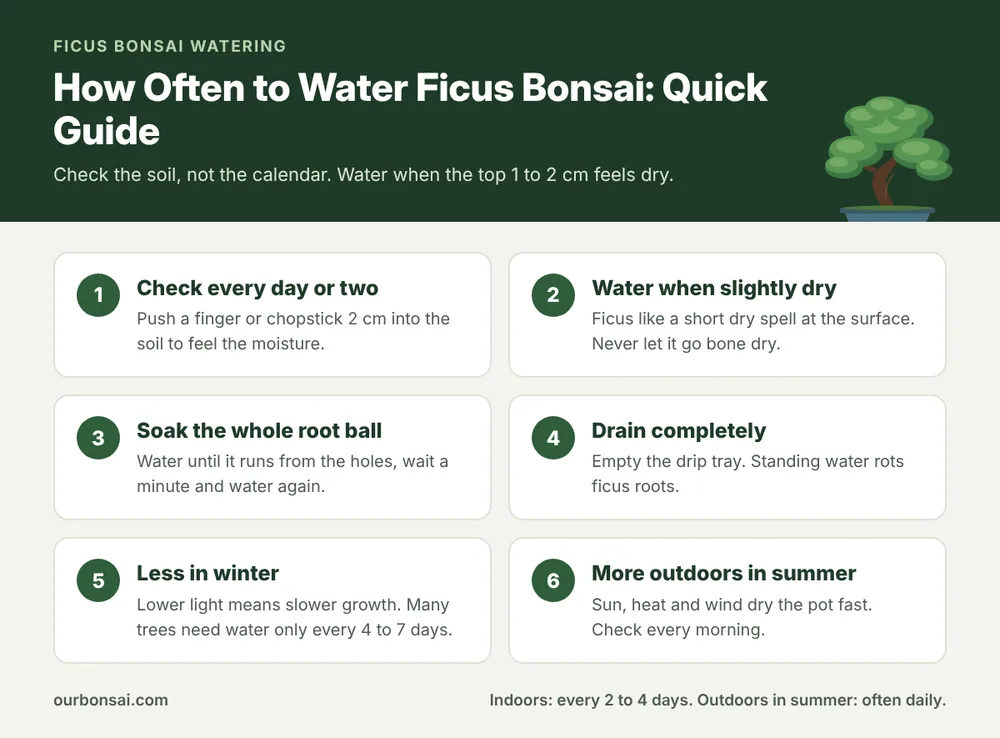
If you are wondering how often to water ficus bonsai, the practical answer is: check it every day or two and water when the top 1 to 2 cm of soil feels dry. For most indoor ficus that works out to every two to four days in spring and summer, and every four to seven days in winter. A ficus outdoors in summer sun may need water every day. The exact number of days depends on your pot, soil, light and temperature, which is why the soil check matters more than any schedule.
Ficus are some of the most forgiving bonsai trees, which is why they are so popular indoors. They tolerate the odd missed watering better than most species. What they do not tolerate for long is soil that stays wet. This guide shows how to get it right in every season.
Why ficus bonsai watering is different
Bonsai ficus, mostly Ficus retusa, Ficus microcarpa (including ginseng ficus) and Ficus benjamina, have thick, waxy leaves that hold water well. Their roots are vigorous and recover quickly. That combination means a ficus can handle a short dry spell, and in fact prefers to dry slightly between waterings. The Wikipedia page on Ficus microcarpa describes it as a tough tropical fig that grows in many conditions, and that toughness shows in a pot.
The weak point is the roots sitting in wet soil. Ficus sold in dense, peaty soil with a saucer underneath often get overwatered, and root rot follows. Free-draining soil is the most important thing you can do for easy watering; see our guide to good potting soil for bonsai.
How often to water ficus bonsai by season
| Situation | Typical frequency | What to watch |
|---|---|---|
| Indoors, spring and summer | Every 2 to 4 days | Faster in a bright, warm window |
| Indoors, autumn and winter | Every 4 to 7 days | Heating dries the top, but growth is slow |
| Outdoors, summer | Daily, sometimes twice | Small pots in full sun dry in hours |
| Under grow lights all year | Every 2 to 4 days | Steady growth means steady water use |
| Just repotted | Keep evenly moist for 2 to 3 weeks | Fewer roots, so do not overdo it |
Treat the table as a starting point. A large pot with deep soil in a cool room may go a week between waterings; a small pot on a sunny windowsill may need water every other day.
What changes how often your ficus needs water
- Pot size. A shallow 6 inch pot holds very little water and may dry in a day in summer. A deep 12 inch training pot can stay moist for a week.
- Soil. Gritty bonsai soil with akadama, pumice and lava drains fast and needs more frequent watering, but it almost never causes rot. Peaty soil holds water much longer and is the main cause of overwatering.
- Light and temperature. A tree in a bright, warm window grows and drinks more than one in a cool, dim corner.
- Root mass. A pot-bound ficus, with roots filling every space, dries out much faster and may need repotting.
- Season and growth. A ficus pushing new shoots uses far more water than one resting in winter.
Every time one of these changes, for example after repotting or moving the tree, go back to checking the soil daily until you learn the new rhythm.
How to check if a ficus bonsai needs water
- Finger test. Push a finger 1 to 2 cm into the soil. If it feels dry at that depth, water. If it is still cool and damp, wait.
- Chopstick test. Push a wooden chopstick into the soil and leave it for ten minutes. If it comes out dark and damp, wait; if it is dry and clean, water.
- Weight test. Lift the pot just after watering, then again a day or two later. With practice you can feel when it is light and ready for water.
- Moisture meter. Helpful for beginners in deep pots. Our guide to the best soil moisture meter for indoor plants covers good ones.
How to water a ficus bonsai the right way
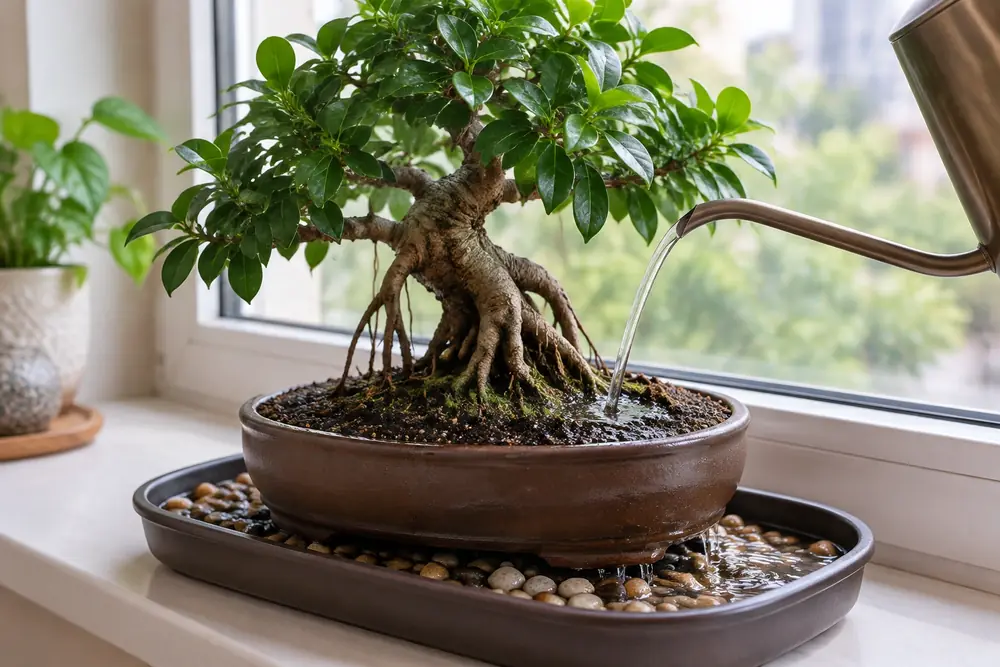
- Water slowly at the soil. Use a watering can with a fine rose or a long spout so the soil is not washed away. Our pick of the best Japanese watering can for bonsai has some good options, or browse bonsai watering cans.
- Water until it drains. Keep going until water runs freely from the drainage holes.
- Water twice. Wait a minute and water again. The first pass wets the soil; the second soaks it evenly.
- Drain completely. Empty the drip tray after ten minutes. Never leave the pot standing in water.
- Use room-temperature water. Very cold water can shock tropical roots.
Small, very dry trees can also be soaked: set the pot in a bowl of water up to the rim for ten minutes, then let it drain fully. This is a good rescue for soil that has dried so much it repels water.
Ficus watering indoors vs outdoors
Indoors, the main risks are overwatering in winter, when the tree grows slowly, and dry air from heating, which dries the leaves while the soil is still wet. Keep the tree in bright light, check the soil before each watering, and use a humidity tray instead of watering more. Our guide to watering indoor bonsai in winter explains the heating season in detail.
Outdoors in summer, a ficus grows fast and drinks a lot. Check every morning, and on very hot days check again in the late afternoon. Our article on watering bonsai in summer has tips for heat waves. Bring the tree inside before nights fall below about 55°F (13°C).
Signs of overwatering and underwatering
| Overwatering | Underwatering |
|---|---|
| Leaves yellow and drop while still soft | Leaves curl, go crispy and drop |
| Soil stays dark and damp for days | Soil pulls away from the pot edge |
| Sour or musty smell | Pot feels very light |
| White mold or fungus gnats on the soil | Wrinkled bark or root bulb |
If you suspect overwatering, let the soil dry, empty the tray and check the roots for rot. For a tree that has dried out, soak it as described above and keep it out of direct sun for a day or two.
FAQ: how often to water ficus bonsai
Should I water my ficus bonsai every day?
Not usually indoors. Check every day or two, but water only when the top of the soil feels dry. Outdoors in hot summer weather, daily watering is often needed.
Can I water a ficus bonsai with tap water?
Yes, ficus tolerate most tap water. If your water is very hard, rain water or filtered water now and then helps prevent white crust on the soil.
Should I mist my ficus bonsai?
Misting cleans the leaves and gives a short humidity boost, but it does not replace watering the soil. A humidity tray is more effective.
Why is my ficus soil always wet?
Usually dense soil, a pot without enough drainage, or too little light. Repot into a gritty mix and move the tree to a brighter spot.
Final thoughts
Now you know how often to water ficus bonsai: check every day or two, water thoroughly when the top 1 to 2 cm is dry, drain completely, and water less in winter. Get the soil and light right and a ficus becomes one of the easiest bonsai you can own.