Cherry Blossom Bonsai Winter Care: Dormancy and Frost Protection

This post contains affiliate links. As an Amazon Associate, OurBonsai earns from qualifying purchases at no extra cost to you. Read our disclosure.
In this guide
- Why your cherry blossom bonsai needs a cold winter
- How cold can a cherry bonsai handle?
- Cherry blossom bonsai winter care checklist
- Where to keep a cherry blossom bonsai in winter
- Watering in winter
- Why you should not prune a cherry in winter
- Protecting the flower buds from late frost
- Waking your cherry bonsai up in spring
- Watch for pests and disease before winter
- Indoor “cherry blossom bonsai”: a note
- Feeding before and after winter
- Common cherry blossom winter mistakes
- FAQ: cherry blossom bonsai winter care
- Final thoughts
Good cherry blossom bonsai winter care is the secret to a tree covered in flowers each spring. Flowering cherries (Prunus serrulata and related Prunus species) are deciduous trees from temperate East Asia. They need a cold winter rest, called dormancy, before they can bloom. Keep them too warm and they may leaf out weakly with few or no flowers. Let the roots freeze solid in a small pot and you risk losing the tree. The goal is cold enough, but not too cold.
This guide explains why winter cold matters, how much frost a cherry bonsai can handle, where to keep it, and how to water, protect and wake it up in spring.
Why your cherry blossom bonsai needs a cold winter
Like apples, plums and many other fruit trees, flowering cherries need a certain amount of cold before their buds will open. Gardeners call this the chilling requirement. During dormancy, the tree “counts” the hours spent at cool temperatures, typically between about 0 and 7°C (32 and 45°F). Once it has had enough, the buds are ready to break when spring warmth arrives.
A cherry bonsai kept in a warm house all winter never gets that chill. The result is often:
- Very late or patchy leafing.
- Few or no flowers.
- Weak growth that slowly drains the tree.
This is why a real cherry blossom bonsai is an outdoor tree, not a houseplant.
How cold can a cherry bonsai handle?
In the ground, most ornamental cherries are hardy to about USDA zone 5 or 6. In a shallow bonsai pot, the roots are more exposed. As a guide:
| Temperature | What to do |
|---|---|
| Above -5°C (23°F) | Keep outdoors in a sheltered spot |
| -5 to -10°C (23 to 14°F) | Set the pot on the ground and mulch around it |
| Long spells below -10°C (14°F) | Cold frame, unheated shed or garage, or bury the pot |
| Late frost after buds swell | Cover the tree overnight with fleece |
Check your typical winter lows on the USDA plant hardiness map.
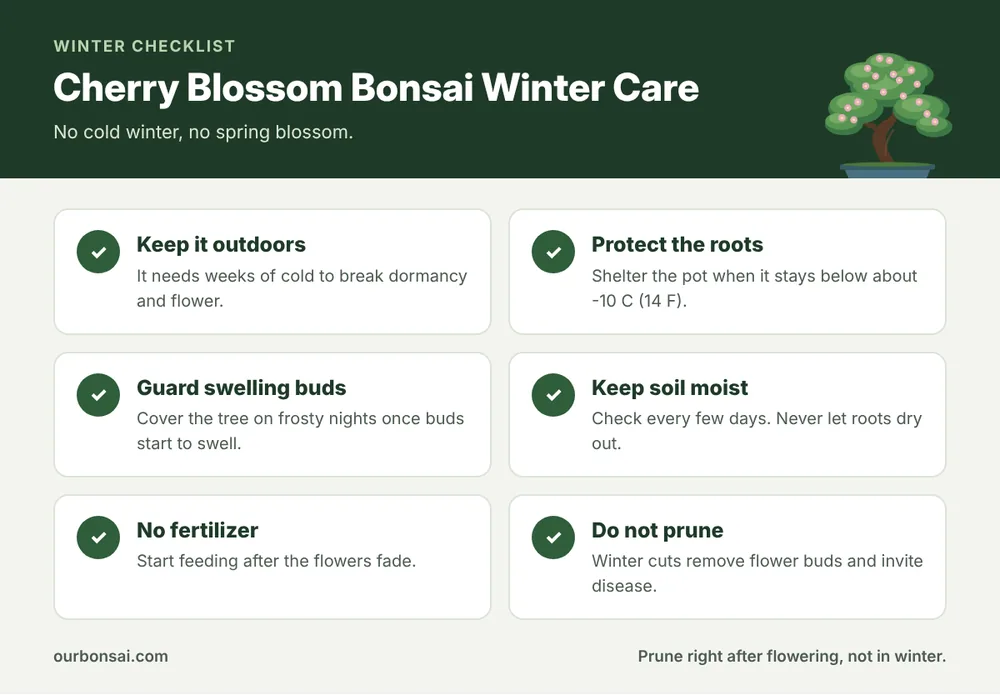
Cherry blossom bonsai winter care checklist
Where to keep a cherry blossom bonsai in winter
Outdoors, sheltered from wind. A spot on the ground near a wall or hedge works well. Avoid high, exposed benches during hard freezes, since cold air reaches the pot from all sides.
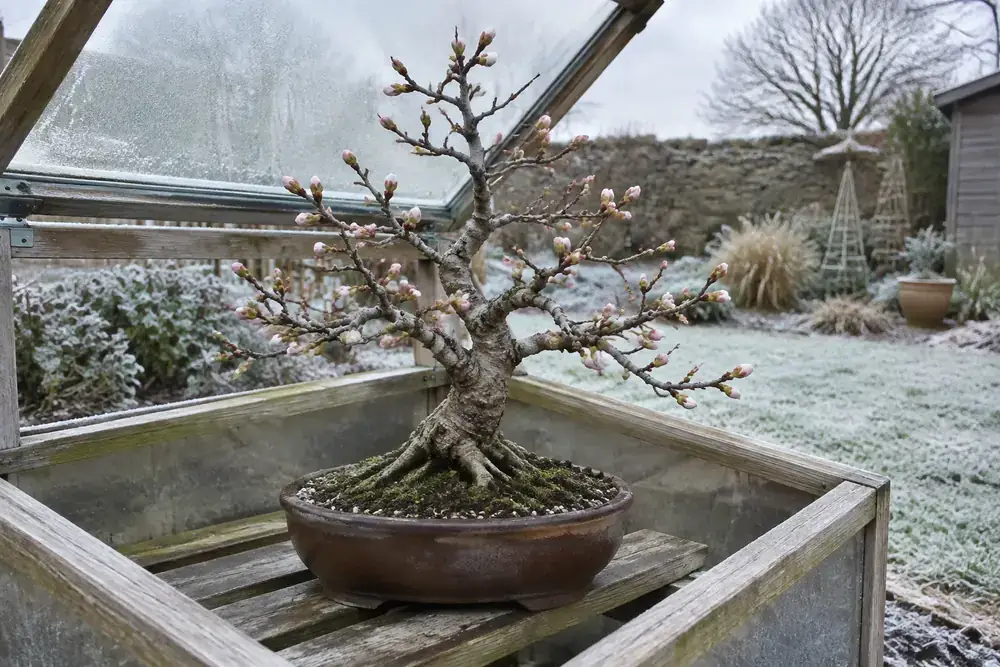
Cold frame or unheated greenhouse. In cold regions, this is ideal. It keeps the roots from freezing deeply while still giving the tree its chill. Ventilate on sunny days so it does not get too warm and wake the tree early.
Unheated shed or garage. A good option during long freezes. The tree has no leaves and needs little light while fully dormant, but bring it out as soon as the hardest cold passes.
For more ideas on outdoor setups, see our outdoor bonsai display ideas.
Watering in winter
A dormant cherry uses little water, but its roots are alive and must not dry out.
- Check the soil every few days.
- Water when the surface starts to dry, ideally in the morning on mild days.
- Do not water when the pot is frozen.
- Trees under cover do not get rain, so check them more often.
Overwatering is also a risk in cold, wet weather. Use a free-draining bonsai soil; our guide to bonsai soil mix ratios explains good blends for deciduous trees.
Why you should not prune a cherry in winter
Cherries form next year’s flower buds in summer. Any winter pruning removes flowers. There is also a disease risk: Prunus trees are prone to fungal and bacterial infections such as silver leaf and bacterial canker, which enter through pruning wounds in cool, damp weather.
The best time for pruning:
- Right after flowering: Shape the tree and shorten long shoots.
- Early summer: Light trimming of new growth.
- Large structural cuts: Late spring or summer in dry weather, then seal the wound with cut paste. Our guide to a bonsai cut paste alternative lists options.
Our guide on when to prune deciduous bonsai gives more detail on timing.
Protecting the flower buds from late frost
The most common way to lose a spring display is a late frost after the buds have swelled. Fat, colored buds and opening flowers are easily damaged by temperatures just below freezing.
- Watch the weather forecast in early spring.
- On frosty nights, move the tree into a shed or cover it with frost protection fleece.
- Remove the cover in the morning so the tree gets light and air.
Waking your cherry bonsai up in spring
- As buds swell, move the tree to its normal sunny spot.
- Increase watering as leaves and flowers open.
- Enjoy the flowers; keep the tree out of heavy rain and strong wind to make them last longer.
- After flowering, prune, then start feeding with a balanced fertilizer.
- Repot, if needed, just before or right after flowering, depending on the tree’s vigor.
Watch for pests and disease before winter
Aphids are common on cherries in spring and summer, and they can overwinter as eggs on the branches. A winter check of the bark and buds, and a clean-up of fallen leaves in autumn, reduces problems next year. Our guide to aphids on bonsai trees shows how to deal with them. For general disease prevention, see bonsai pests and diseases.
Indoor “cherry blossom bonsai”: a note
Many products sold as cherry blossom bonsai are artificial trees or LED lamps. These need no winter care at all. A real, living cherry bonsai is very different and must spend winter outdoors. If you want a flowering tree for indoors, see our list of flowering indoor bonsai trees instead.
Feeding before and after winter
What happens in late summer decides how many flowers you get next spring. Flowering cherries set their flower buds during summer, so a tree that was well fed and well watered in June and July carries more buds into winter. Use a balanced fertilizer from after flowering until late summer, then stop by early autumn so the new wood can harden before frost.
In spring, wait until flowering is over before you start feeding again. Feeding during bloom can push leaves at the expense of the flowers and shorten the display.
Common cherry blossom winter mistakes
- Keeping a live cherry indoors as a houseplant.
- Pruning in winter, removing next spring’s flowers.
- Letting the soil dry out in cold, windy weather.
- Moving the tree into a warm room in late winter to “speed up” flowering, then exposing it to frost.
- Leaving it on a high bench during a long deep freeze.
FAQ: cherry blossom bonsai winter care
Can I keep my cherry blossom bonsai inside in winter?
Not in a heated room. It needs cold dormancy. An unheated garage or porch during the worst cold is fine.
Why did my cherry bonsai not flower this spring?
The most common causes are not enough winter cold, pruning at the wrong time, late frost damage to buds, or a weak tree that was underfed in summer.
Do cherry blossom bonsai lose their leaves in winter?
Yes. They are deciduous. Bare branches with plump buds are exactly what you want to see.
When will my cherry bonsai flower?
Usually early to mid spring, depending on the variety and your climate.
Final thoughts
Cherry blossom bonsai winter care comes down to letting the tree get properly cold while keeping the roots from freezing solid and the buds safe from late frost. Keep it outdoors, protect the pot in hard freezes, water when needed, and wait until after flowering to prune and feed. Do that, and each spring your tree will put on the show it is famous for. For other species that need the same outdoor winter, see our guide to deciduous bonsai tree types.