How Often to Water Serissa Bonsai (Indoor & Outdoor Guide)

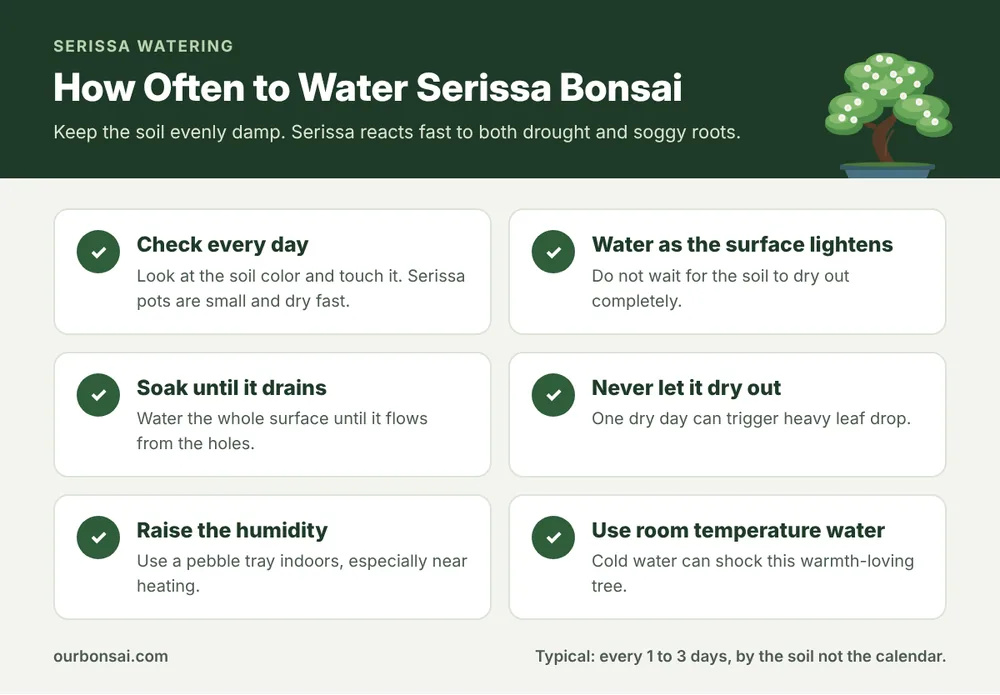
If you are asking how often to water serissa bonsai, the practical answer is every one to three days for most trees, whenever the surface of the soil just starts to dry. Serissa wants soil that stays evenly moist, never soggy and never dry. Indoors in winter that may be every three or four days. Outdoors in summer heat it can be daily. The calendar is only a guide, though: check the soil every day and let it, not the date, decide when you water.
In this guide
- Why serissa is so sensitive to watering
- How often to water serissa bonsai by season
- How to tell when serissa needs water
- How to water serissa properly
- Humidity: the other half of watering
- Signs you are watering serissa wrong
- Indoor vs outdoor serissa
- Watering serissa around flowering and repotting
- Common watering mistakes with serissa
- FAQ: how often to water serissa bonsai
- Final thoughts
Serissa (Serissa japonica), the snow rose or tree of a thousand stars, is famous for dropping its leaves when unhappy, and watering mistakes are the most common trigger. This guide gives you a routine that keeps it stable.
Why serissa is so sensitive to watering
Serissa has a dense mass of fine, fibrous roots in a small pot. Fine roots dry out fast and die quickly when the soil becomes dusty. They also rot quickly when deprived of air in soggy soil. Its natural home is warm and humid. The Wikipedia article on Serissa describes it as a plant of wet meadows and woodlands in Southeast Asia, which explains why it likes steady moisture.
The result is a tree with a narrow comfort zone. Get watering right, and much of its reputation for fussiness disappears.
How often to water serissa bonsai by season
| Season | Indoors | Outdoors (warm climates) | Notes |
|---|---|---|---|
| Spring | Every 2 to 3 days | Every 1 to 2 days | Growth and flowering increase water use |
| Summer | Every 1 to 2 days | Daily | Small pots can dry out by afternoon |
| Autumn | Every 2 to 3 days | Every 2 days | Growth slows |
| Winter | Every 3 to 4 days | Bring indoors below 10 °C (50 °F) | Heating dries the air and topsoil fast |
These are typical frequencies. Always check first. A tree in a cooler room or a deeper pot will dry more slowly.
How to tell when serissa needs water
Soil color
In an akadama-based mix, the surface turns a lighter, dusty brown as it dries. Water when it starts to lighten. Our guide to the bonsai soil mix ratio explains why an akadama-based mix makes this so much easier.
The finger test
Touch the soil about 1 cm deep. If it feels just barely damp, water now. If it feels wet, wait. If it feels dry, you are a little late, so water right away and check sooner next time.
Pot weight
Lift the pot after watering and again a day later. Serissa pots are usually small, so the difference is easy to feel with practice.
How to water serissa properly
- Use room temperature water. Serissa is a warmth-loving plant, and cold water straight from the tap in winter can shock the roots.
- Water gently over the whole surface with a fine spout until water runs out of the drainage holes.
- Wait a minute and water again so any dry pockets soak through.
- Let the pot drain completely. Do not leave water standing in a saucer.
- If the root ball has dried out badly, stand the pot in a basin of water for 10 minutes, then let it drain.
A small can with a fine rose, such as those in our guide to the best Japanese watering can for bonsai, makes this easy.
Tap water or rain water?
Serissa prefers slightly acidic conditions. Soft tap water is fine. If your water is very hard, alternate with rain water or filtered water to keep lime from building up in the soil.
Humidity: the other half of watering
Indoors, dry air from heating pulls moisture from serissa’s small leaves, and the tree reacts by dropping them. Watering the soil alone does not fix dry air.
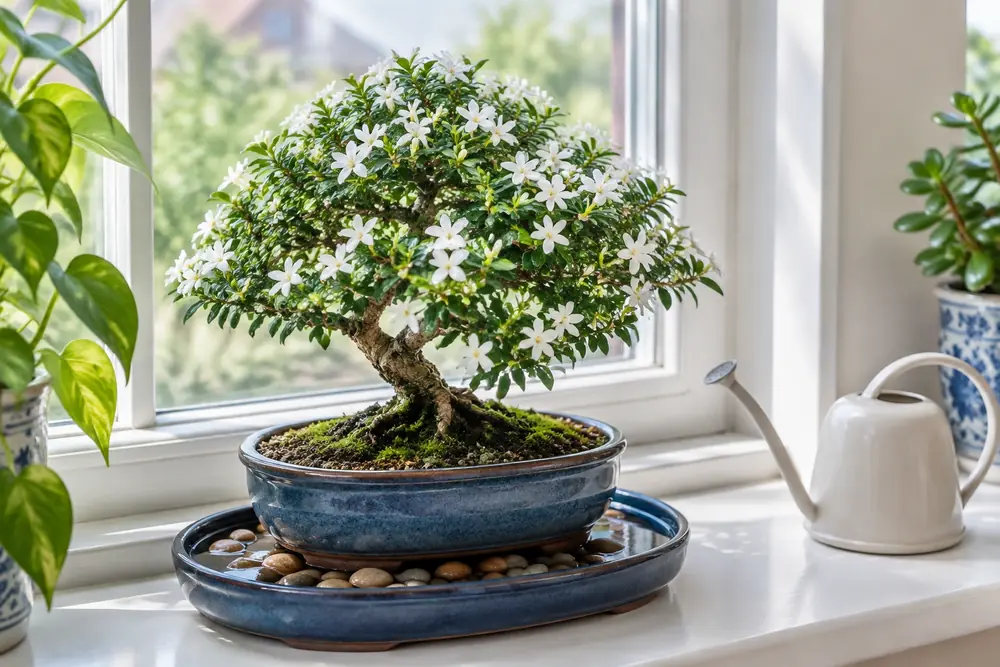
- Place the pot on a humidity tray filled with pebbles and water, with the pot above the water line.
- Group it with other plants.
- Keep it away from radiators, heaters and air vents.
- Light misting in the morning helps a little, but avoid misting open flowers.
Signs you are watering serissa wrong
| Sign | Likely cause | Fix |
|---|---|---|
| Sudden drop of green leaves | Soil dried out, or a cold draft | Water more consistently, check the spot |
| Yellow leaves, soil stays wet | Overwatering or poor drainage | Water less often, improve soil |
| Brown, crispy leaf edges | Low humidity or dry spells | Humidity tray, steady watering |
| Wilting with wet soil, bad smell | Root rot | Repot, trim dead roots |
Yellow leaves have several possible causes. Our guide to serissa bonsai yellow leaves covers them in detail, and if roots look dark and mushy, see root rot in bonsai.
Indoor vs outdoor serissa
Serissa can live outside in warm months, which it enjoys. Outdoors it dries faster and usually needs water daily in summer. Give it morning sun and afternoon shade, and bring it back in before nights fall below about 10 °C (50 °F). When you bring it in, expect it to need water less often, but watch for dry air. Our guide on how to take care of a bonsai tree inside covers the indoor season.
Serissa also dislikes being moved. Try to keep it in one place and change only one thing at a time.
Watering serissa around flowering and repotting
During flowering. Serissa can bloom on and off for much of the year, with the main flush in spring and early summer. Flowering uses extra water, so check twice a day in warm weather. Aim the spout at the soil rather than over the blooms, because wet flowers brown quickly.
After repotting. Fresh soil holds water differently and the root system is smaller for a few weeks. Water thoroughly once right after repotting, then check daily and water when the surface lightens. Keep the tree out of direct sun and drafts for two to three weeks.
After pruning. A tree with fewer leaves uses less water. Reduce watering slightly until new leaves appear, so the soil does not stay wet for too long.
Common watering mistakes with serissa
- Letting it dry out “to be safe”. Serissa punishes dry soil with leaf drop.
- Keeping it soggy. Constant wetness leads to yellowing and root rot.
- Watering with ice-cold water. Use room temperature water instead.
- Ignoring humidity. Dry indoor air is a big cause of leaf loss.
- Using dense potting soil. It holds too much water. Use a gritty bonsai mix.
FAQ: how often to water serissa bonsai
Should I water my serissa bonsai every day?
Check it every day, but only water when the surface starts to dry. In summer outdoors that may be daily. Indoors it is often every two to three days.
Why does my serissa drop leaves after watering?
Usually the soil dried out before you watered, and the leaf drop is a delayed reaction. It can also mean the soil is too wet. Check the roots if it continues.
Can I mist my serissa instead of watering?
No. Misting adds a little humidity to the leaves but does not water the roots. Always water the soil.
Does serissa need less water in winter?
Slightly less, since it grows more slowly. But indoor heating dries the soil fast, so keep checking regularly.
Final thoughts
So, how often to water serissa bonsai? Check every day, water when the surface begins to dry, and soak the soil completely each time. Expect every one to three days in most homes. Add a humidity tray, use room temperature water and keep the tree in one bright spot. Serissa is not as difficult as its reputation once its water needs are steady. For more on flowering indoor trees, see our list of the best flowering indoor bonsai trees.