Fukien Tea Bonsai Winter Care: Keep It Warm and Leafy


This post contains affiliate links. As an Amazon Associate, OurBonsai earns from qualifying purchases at no extra cost to you. Read our disclosure.
In this guide
- How cold can a Fukien tea bonsai handle?
- Fukien tea bonsai winter care checklist
- Light
- Watering a Fukien tea bonsai in winter
- Humidity
- Why is my Fukien tea dropping leaves in winter?
- Are the white spots on Fukien tea leaves a problem?
- Fertilizer and pruning in winter
- Pests to watch in winter
- Choosing a good winter spot
- Bringing a Fukien tea indoors in autumn
- Signs your Fukien tea is doing well in winter
- Common Fukien tea winter mistakes
- FAQ: Fukien tea bonsai winter care
- Final thoughts
Fukien tea bonsai winter care needs a little more attention than ficus or jade. Fukien tea (Ehretia microphylla, also sold as Carmona microphylla) is a tropical shrub from southern China and Southeast Asia with small, glossy dark green leaves and tiny white flowers. It is a beautiful indoor bonsai, but it is sensitive to change. Cold drafts, a dry root ball or a sudden move can make it drop leaves within days. Keep conditions warm, bright and stable, and it will sail through winter.
This guide covers the temperature, light, watering and humidity it needs, plus how to handle the leaf drop many owners see in winter.
How cold can a Fukien tea bonsai handle?
Fukien tea has no frost tolerance and does not like cool rooms.
| Temperature | Effect |
|---|---|
| 18 to 26°C (64 to 79°F) | Ideal, slow steady growth |
| 15 to 18°C (59 to 64°F) | Acceptable, growth slows |
| 12 to 15°C (54 to 59°F) | Stress, leaf drop likely |
| Below 12°C (54°F) | Serious stress, avoid |
If your tree spends summer outdoors, bring it inside before nights fall below about 15°C (59°F). Do it gradually if you can, and expect a small amount of leaf drop as it adjusts.
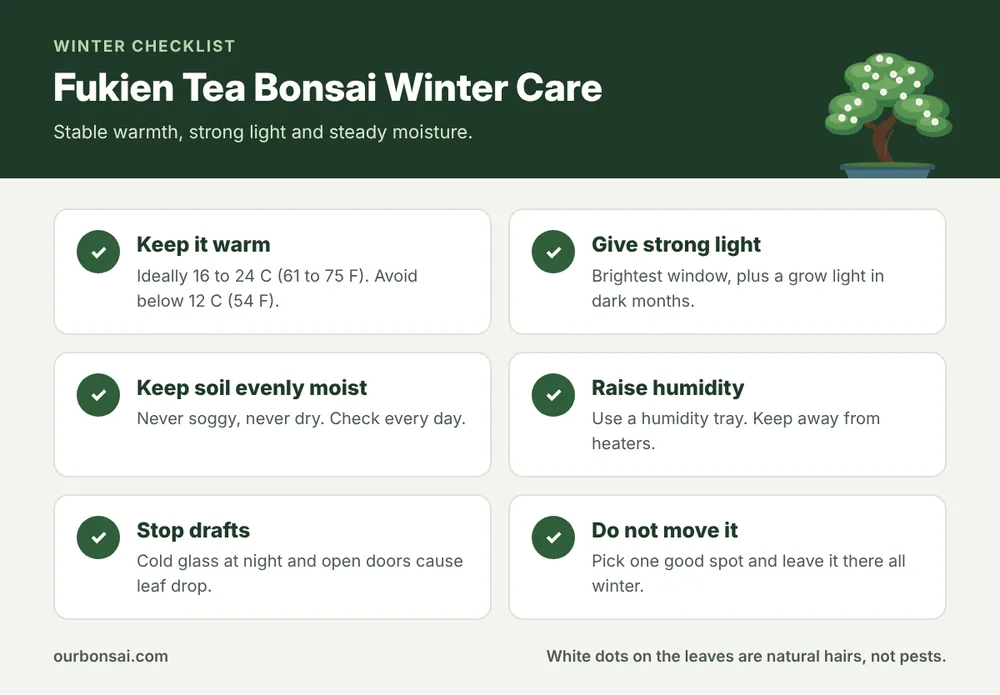
Fukien tea bonsai winter care checklist
Light
Fukien tea needs strong light to stay compact and hold its leaves. In winter:
- Place it right by your brightest window.
- If the window is not very bright, add a full-spectrum LED grow light for about 10 to 12 hours a day. Our guide to the best grow lights for bonsai covers good options.
- Keep the leaves from touching cold glass at night.
Watering a Fukien tea bonsai in winter
This is where most problems start. Fukien tea likes its soil evenly moist. It does not tolerate drying out, and it does not like sitting in wet soil either.
- Check the soil every day. In heated rooms, a small pot can dry quickly.
- Water thoroughly when the top layer is just starting to dry, until water runs from the drainage holes.
- Never let the root ball dry out completely. Fine roots die quickly, and leaves drop a few days later.
- Empty the drip tray after watering.
- Use room-temperature water.
A good soil makes this much easier. Our guide to the best soil for Fukien tea bonsai explains which mixes hold moisture without becoming soggy. Our tips for watering indoor bonsai in winter also apply.
Humidity
Fukien tea comes from humid regions and suffers in dry, heated rooms. A humidity tray under the pot is the easiest solution. Grouping it with other plants helps, and a small humidifier is ideal in very dry homes. Keep it well away from radiators and hot air vents.
Why is my Fukien tea dropping leaves in winter?
Common causes, in rough order of frequency:
- Drying out. Even once can trigger heavy drop.
- A cold draft from a window, door or air conditioner.
- Being moved to a new spot.
- Low light in short winter days.
- Overwatering in a cool room with dense soil.
- Pests such as spider mites, whiteflies or scale.
If the branches are still green under the bark, new leaves will usually follow once you fix the cause. Our guide to why bonsai lose leaves suddenly helps narrow it down.
Are the white spots on Fukien tea leaves a problem?
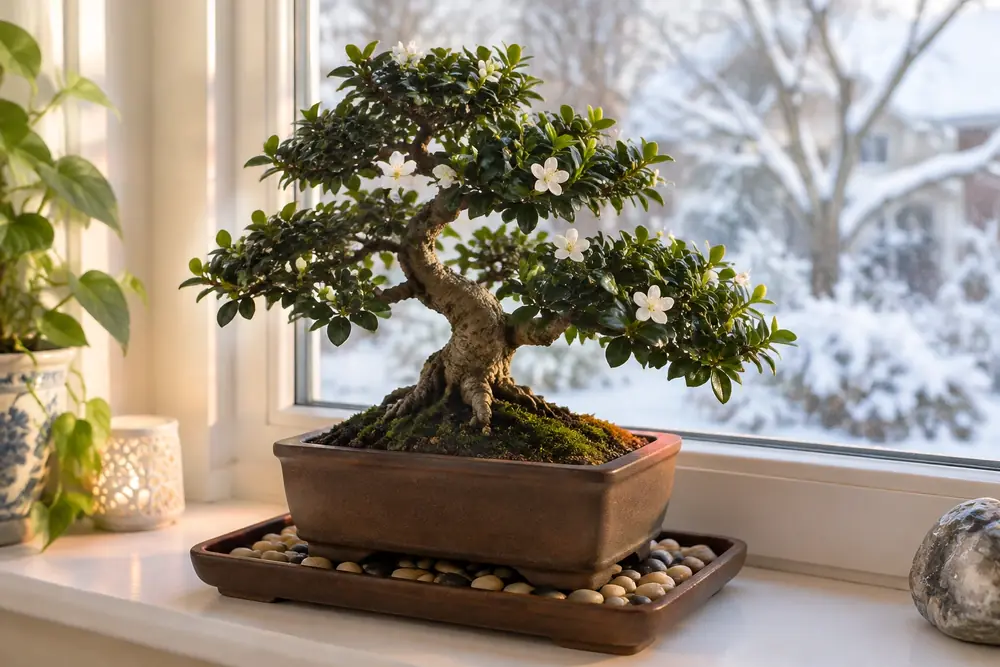
Usually not. Fukien tea leaves have tiny white dots on the upper surface. These are natural hairs (trichomes) and are completely normal. White fuzz under the leaves or along stems, on the other hand, can be mealybugs or whiteflies. Our guide to white spots on bonsai leaves shows how to tell them apart.
Fertilizer and pruning in winter
- Fertilizer: If the tree keeps growing under good light, feed at half strength once a month. If growth stops, pause until spring. See our picks for Fukien tea fertilizer.
- Pruning: Light trimming of long shoots is fine. Leave heavier pruning for late spring and summer.
- Repotting: Late spring, when the tree is growing strongly and the weather is warm.
For shaping ideas when spring comes, see our guide to Fukien tea bonsai styles.
Pests to watch in winter
Dry indoor air makes Fukien tea prone to spider mites and whiteflies. Check the undersides of the leaves every week. Wipe off small infestations and treat larger ones early, before they spread to other plants. Our guide to whiteflies on bonsai trees explains treatment.
Choosing a good winter spot
The best winter spot for a Fukien tea combines four things: bright light, steady warmth, decent humidity and no drafts. A wide windowsill in a room that stays warm day and night, with a humidity tray and a grow light, is ideal. A table in the middle of a dim room is not. If you are buying a new tree in winter, ask the seller to wrap it well for the trip home, since even a short walk in cold air can trigger leaf drop. You can also browse Fukien tea bonsai trees on Amazon.
Bringing a Fukien tea indoors in autumn
Many growers keep Fukien tea outdoors in summer, where the extra light makes it stronger and more compact. The move back inside is the riskiest moment of the year, so plan it:
- Move it early, while nights are still above about 15°C (59°F). Do not wait for the first cold snap.
- Inspect for pests before it comes in. Rinse the leaves, check under them and along the stems.
- Choose the final indoor spot in advance, with your grow light and humidity tray already set up.
- Keep the watering steady during the move. A tree that dries out and changes location in the same week almost always drops leaves.
- Accept some leaf drop in the first two weeks. New, smaller leaves adapted to indoor light usually follow.
Signs your Fukien tea is doing well in winter
- New shoots appear at the branch tips, even if slowly.
- Leaves stay dark green and glossy.
- The occasional tiny white flower opens.
- Leaf drop is limited to a few old inner leaves.
If you see these signs, your setup is working. Resist the urge to change anything.
Common Fukien tea winter mistakes
- Moving the tree from room to room.
- Letting the soil dry out completely.
- Placing it near a heater or an outside door.
- Keeping it in a cool room below about 15°C.
- Repotting or hard pruning in winter.
FAQ: Fukien tea bonsai winter care
Can Fukien tea stay outside in winter?
Only in warm, frost-free climates where nights stay above about 12 to 15°C (54 to 59°F). Elsewhere it must be indoors.
How often should I water Fukien tea in winter?
Check every day. Most indoor trees need water every two to four days, but it depends on the pot, soil and room.
Will my Fukien tea flower in winter?
It can flower on and off all year if it gets enough light, but winter flowering is usually lighter.
Why are my Fukien tea leaves turning yellow?
Usually overwatering, low light or a cold draft. Check the soil and the spot. The Wikipedia page on Ehretia microphylla describes its warm native habitat, which explains why it dislikes cold.
Final thoughts
Fukien tea bonsai winter care comes down to stability. Keep the tree warm, give it strong light, keep the soil evenly moist, raise the humidity and do not move it around. A Fukien tea that gets steady conditions holds its glossy leaves all winter and often rewards you with tiny white flowers. For more on indoor trees, see how to take care of a bonsai tree indoors.