Why Is My Ficus Bonsai Dropping Leaves? Causes and Fixes

This post contains affiliate links. As an Amazon Associate, OurBonsai earns from qualifying purchases at no extra cost to you. Read our disclosure.
In this guide
Ficus bonsai dropping leaves is something almost every ficus owner sees sooner or later. Ficus react to change by shedding leaves: a move to a new room, a cold draft, a missed watering, or the shorter days of autumn can all trigger it. Most of the time the tree is adjusting, not dying, and it will grow new leaves once conditions are stable again. The fastest way to find the cause is to look at the leaves that fell: are they green, yellow, crispy or sticky? Each points to a different problem.
This guide explains how to read the fallen leaves, the seven most common causes of leaf drop on Ficus retusa, microcarpa and benjamina, and what to do about each one.
Why ficus drop their leaves so easily
Ficus leaves are built for the exact light and temperature they grew in. When those change, the tree drops leaves that no longer suit the conditions and grows new ones that do. It is a survival strategy, and ficus are especially quick to use it. The weeping fig, Ficus benjamina, is the most sensitive of all and can drop a large part of its leaves after something as simple as being turned around on a windowsill.
Read the fallen leaves
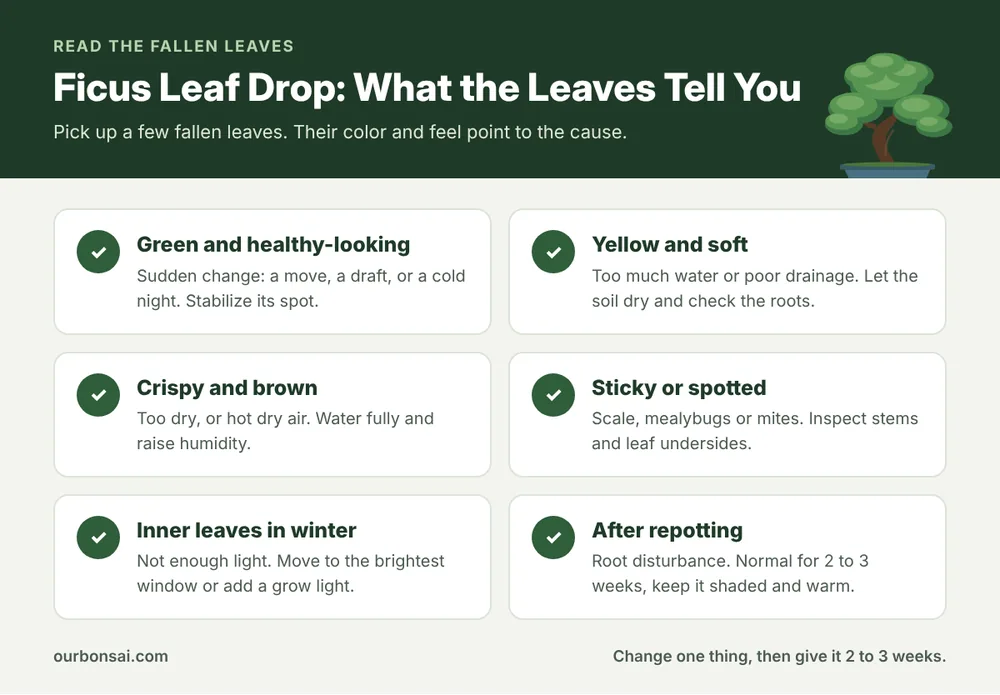
| Fallen leaves look | Most likely cause |
|---|---|
| Green and healthy | Sudden change in light or temperature |
| Yellow and soft | Overwatering or poor drainage |
| Crispy, brown edges | Underwatering or dry air |
| Sticky, speckled or spotted | Pests |
| Mostly inner and lower leaves | Low light |
7 causes of ficus bonsai dropping leaves
1. A move or a change of light
Bringing a ficus home from a store, moving it to another room, or carrying it outdoors for summer and back in for winter all change the light. The tree sheds leaves for two to four weeks and then pushes new ones.
Fix: choose the brightest spot you have and keep the tree there. Do not keep moving it.
2. Cold and drafts
Ficus are tropical figs. Temperatures below about 55°F (13°C), a cold window at night, an outside door, or an air conditioner vent can make green leaves rain down within days.
Fix: keep the tree at 60 to 75°F (15 to 24°C), away from doors and vents, and a little back from cold window glass in winter.
3. Overwatering
Soil that stays wet suffocates roots. Leaves turn yellow, go soft and drop. The soil may smell sour or grow white mold.
Fix: water only when the top 2 cm of soil is dry, and empty the drip tray. If the soil stays wet for days, repot into a gritty bonsai mix. Our guide to white mold on bonsai soil helps if you see fuzzy growth, and root rot in bonsai shows how to check the roots.
4. Underwatering and dry air
A ficus left to dry out completely drops crispy leaves. In winter, heating dries the air so much that leaves lose water faster than the roots can replace it.
Fix: water thoroughly when the top is dry, and use a humidity tray. See our pick of the best humidity trays for bonsai or browse bonsai humidity trays.
5. Not enough light
In autumn and winter, indoor light falls sharply. The tree drops the leaves it cannot feed, usually the inner and lower ones first. New shoots are long and pale.
Fix: move the tree right next to a bright window, or add a grow light for 10 to 12 hours a day. Our guide to how much light a bonsai tree needs explains how much is enough.
6. Pests
Scale, mealybugs, thrips and spider mites suck sap until leaves yellow and fall. Look for brown bumps on stems, white cotton, sticky honeydew, silvery streaks or fine webbing. Our guide to scale on bonsai trees covers the most common ficus pest, and spider mites on bonsai trees covers the second.
7. Repotting and root pruning
Some leaf drop for two to three weeks after repotting is normal, because the tree has lost roots. Keep it warm, out of direct sun, and do not feed for a month.
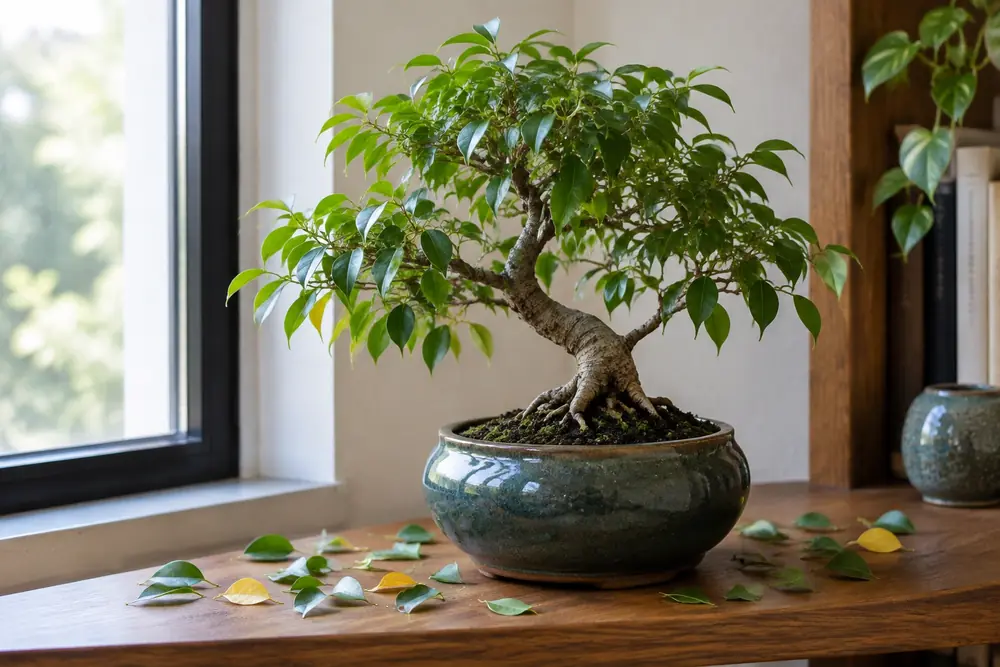
Ficus benjamina: extra sensitive to change
If you have a weeping fig bonsai, expect more leaf drop than with Ficus retusa or microcarpa. Benjamina can shed after being rotated, after a cloudy week, or when the heating comes on in autumn. The answer is the same, only more so: a bright, stable spot with steady watering and no drafts. The Wikipedia page on Ficus benjamina notes its well-known habit of dropping leaves when moved.
When in the year leaf drop is most likely
Leaf drop on a ficus bonsai often follows the calendar, which makes it easier to predict and prevent:
- Early autumn. Days shorten and the heating comes on. Expect some inner leaves to fall. Move the tree closer to the window before this happens.
- Bringing it indoors. A tree that spent summer outside will drop leaves for a few weeks inside, because indoor light is much weaker. Bring it in while nights are still mild, not after the first cold snap.
- Midwinter. Low light plus dry, heated air. Use a grow light and a humidity tray.
- Spring. Older leaves drop as the new flush opens. This is normal turnover and needs no action.
- Moving outdoors in late spring. Strong sun can scorch leaves grown indoors. Start in shade and add sun over two weeks.
Planning around these points stops most of the surprise leaf drop before it starts.
How to help a ficus recover from leaf drop
- Find what changed in the last two or three weeks.
- Fix it, then keep everything else the same.
- Water less while the tree has fewer leaves, checking the soil each time.
- Hold off on fertilizer until new buds appear.
- Do not prune or repot during the leaf drop unless the roots are rotting.
- Wait. New buds usually appear within three to six weeks.
If the leaf drop continues for more than a month and no new buds appear, check the roots and read our guide to bonsai losing leaves suddenly.
FAQ: ficus bonsai dropping leaves
Is it normal for a ficus bonsai to lose leaves in winter?
Some leaf drop in autumn and winter is normal indoors because light levels fall. Heavy drop means the tree needs more light or is too cold.
Will my ficus bonsai grow its leaves back?
Yes, as long as the branches are green under the bark and the roots are healthy. Ficus bud back readily.
Why is my ficus dropping green leaves?
Green leaf drop almost always follows a sudden change: a move, a draft or a cold night.
Should I cut off the bare branches?
Not yet. Wait until new buds appear, then cut back only twigs that are clearly dead.
Final thoughts
Ficus bonsai dropping leaves is a reaction to change. Read the fallen leaves, fix the cause, and give the tree a bright, warm, stable home. With patience, the new leaves will come, and the tree will usually be stronger for it.