Japanese Black Pine Bonsai Winter Care: Sun, Water and Frost

This post contains affiliate links. As an Amazon Associate, OurBonsai earns from qualifying purchases at no extra cost to you. Read our disclosure.
In this guide
- How cold can a Japanese black pine bonsai handle?
- Japanese black pine bonsai winter care checklist
- Light: keep it in the sun
- Watering in winter
- Needle thinning in late autumn and winter
- Wiring black pine in winter
- What not to do in winter
- Needle browning in winter: is it normal?
- Preparing for spring
- Preparing your black pine for winter in autumn
- A simple winter routine for black pine
- Black pine in mild coastal climates
- FAQ: Japanese black pine bonsai winter care
- Final thoughts
Japanese black pine bonsai winter care is straightforward because this is one of the toughest species in bonsai. Japanese black pine (Pinus thunbergii) comes from coastal Japan and Korea, where it grows on windswept cliffs and beaches. It handles cold, wind and salt well. In a bonsai pot, though, its roots are exposed, and its evergreen needles keep losing water through winter. Protect the roots, keep the soil from drying out and give it full sun, and it will come through any normal winter in good shape.
Winter is also an important working season for black pine. It is the time for needle thinning and wiring, which shape the tree for the coming year.
How cold can a Japanese black pine bonsai handle?
In the ground, Japanese black pine is hardy to about USDA zone 5 or 6. In a pot, the roots are the weak point.
| Conditions | What to do |
|---|---|
| Down to about -5°C (23°F) | No special protection, just shelter from strong wind |
| -5 to -10°C (23 to 14°F) | Pot on the ground, mulch around it |
| Long spells below -10°C (14°F) | Cold frame, unheated greenhouse or bury the pot |
| Very severe winters | Unheated shed or garage during the worst cold, then back outside |
Check your local winter lows on the USDA plant hardiness map.
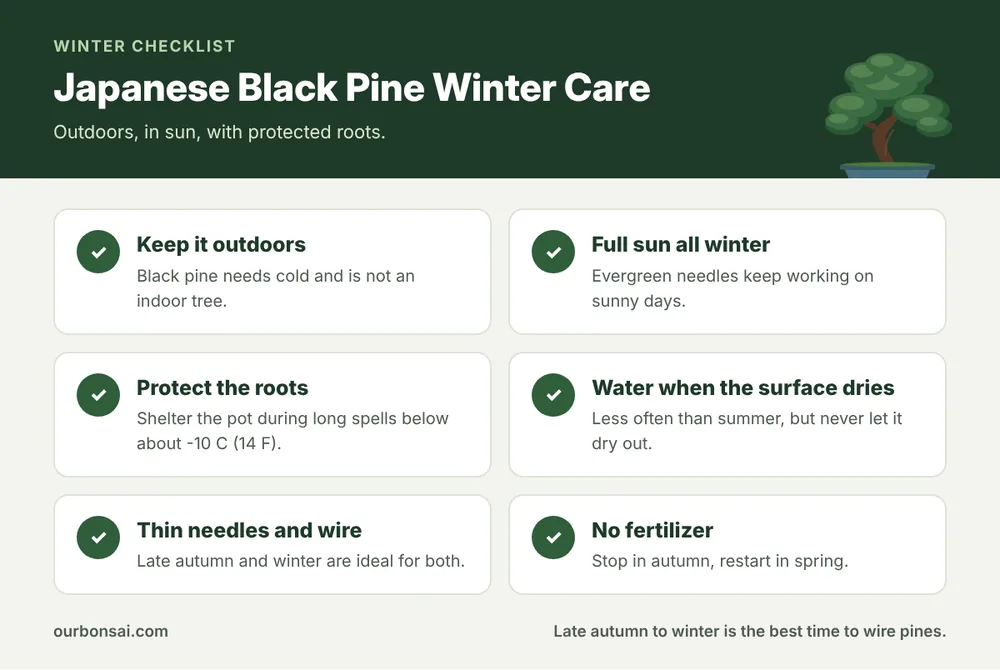
Japanese black pine bonsai winter care checklist
Light: keep it in the sun
Unlike deciduous trees, black pine keeps its needles all winter and continues to photosynthesize on mild, sunny days. That is why:
- Full sun is best all year round, including winter.
- Short periods in a dark shed during a hard freeze are fine, but bring it back into light as soon as possible.
- Indoors is never suitable. Warm, dim rooms weaken black pines quickly.
It is firmly an outdoor tree, along with many others in our guide to outdoor bonsai tree types.
Watering in winter
Black pine likes to dry slightly between waterings, but in winter, cold drying winds can still pull water from the needles. When the roots are frozen, the tree cannot replace it. This can cause needle browning in late winter.
- Check the soil every few days.
- Water when the surface has dried, ideally in the morning on mild days.
- Do not water a frozen pot.
- Trees under cover do not get rain; check them more often.
A free-draining pine soil makes this easy. Our guide to the best soil for Japanese black pine bonsai explains the mixes growers use.
Needle thinning in late autumn and winter
Japanese black pine produces many needles, and strong areas can become very dense. In late autumn and early winter, growers balance the tree by:
- Removing old needles (those from previous years) so light reaches inner buds.
- Thinning strong areas more than weak areas, leaving fewer pairs of needles on strong shoots.
- Reducing clusters of shoots to two per branch tip.
This evens out the tree’s strength and encourages back-budding. It is not urgent on a young tree but becomes important as the tree is refined.
Wiring black pine in winter
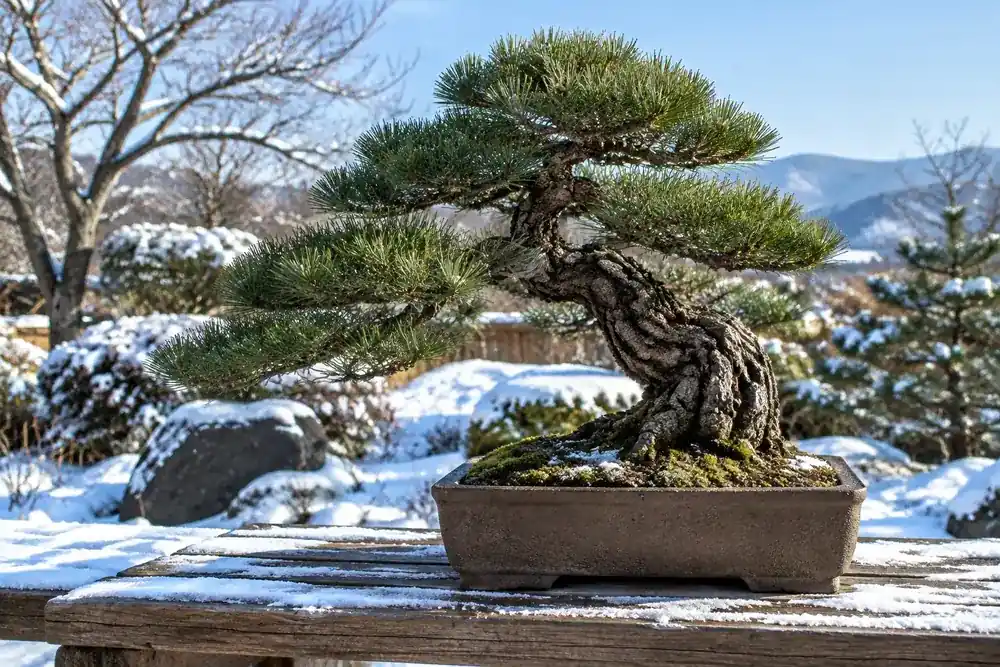
Late autumn to late winter is the classic wiring season for pines. The tree is not growing, so the wire does not bite in quickly, and with old needles removed, you can see the branches clearly.
- Use annealed copper or aluminum wire.
- Wrap at about 45 degrees, from trunk outward.
- Avoid trapping needles under the wire.
- Bend slowly; pine branches are flexible but can crack at junctions.
Our guide to bonsai wire sizes and uses helps you pick the right gauge. You can also find copper bonsai wire on Amazon.
What not to do in winter
- No decandling. Removing the new candles is a summer technique, not a winter one.
- No fertilizer. Stop in autumn and restart in spring.
- No heavy root work. Repot in early spring, just as buds start to extend.
- No indoor overwintering in heated rooms.
Needle browning in winter: is it normal?
Some yellowing and browning of the oldest needles in autumn is normal; pines shed old needles every year. Browning of new needles in late winter is usually winter burn from cold wind combined with frozen roots. To prevent it, shelter the tree from wind and keep the soil moist. If needles brown in other seasons, see our guide to bonsai leaves turning yellow or brown.
Preparing for spring
In late winter:
- Remove the tree from any winter shelter once the hardest frosts have passed.
- Check wire and remove any that is starting to bite.
- Plan repotting for early spring, as buds begin to swell and elongate.
- Restart feeding once the new candles begin to grow.
Preparing your black pine for winter in autumn
The work you do in late summer and autumn sets the tree up for winter:
- Feed well from late summer to mid-autumn. For black pine, this is a key feeding period that builds strength for next year’s buds.
- Let it harden off outdoors as the nights cool. The needles toughen up and the tree becomes more frost resistant.
- Check for pests such as pine aphids, scale and adelgids before winter, and treat any you find. Our guide to scale on bonsai trees covers one of the most common.
- Clean the soil surface of fallen needles and weeds to reduce fungal problems.
- Plan the winter spot so you can move the tree quickly when the first hard freeze is forecast.
A simple winter routine for black pine
- Every few days: Check the soil and water when the surface has dried.
- After storms: Make sure the tree has not blown over and the pot is not standing in water.
- During hard freezes: Move the pot to the ground or into its shelter.
- Once a month: Look over the needles and wire for problems.
Black pine in mild coastal climates
If you live by the sea or in an area with mild winters, your black pine can stay on its normal bench all year. In these conditions, the bigger risk is soil that stays wet for weeks during rainy spells. Make sure the pot drains well, use a coarse soil and tilt the pot slightly during very wet periods. Black pine is naturally adapted to salty coastal winds, so sea air is not a problem, but constant wet roots in cool weather can be.
FAQ: Japanese black pine bonsai winter care
Can Japanese black pine bonsai stay outside in winter?
Yes. It should. Protect the roots during long, hard freezes, but keep it outdoors in the sun.
How often should I water a black pine in winter?
When the soil surface has dried. Depending on weather, that might be every few days or once a week.
Is winter a good time to wire a black pine?
Yes. Late autumn through winter is the preferred time, since growth has stopped and branches are easy to see.
Why are my black pine’s needles turning brown in winter?
Old needles naturally yellow and drop in autumn. New needles browning usually means wind burn or dry roots. The Wikipedia page on Pinus thunbergii describes its tough coastal origins.
Final thoughts
Japanese black pine bonsai winter care comes down to keeping the tree outdoors in full sun, protecting the roots from deep freezes and keeping the soil from drying out. Use the quiet months for needle thinning and wiring, and save fertilizer and repotting for spring. For more on pines and other evergreens, see our guide to types of evergreen bonsai trees and our loblolly pine bonsai care guide.