Is My Japanese Black Pine Bonsai Dying? Signs and How to Save It

This post contains affiliate links. As an Amazon Associate, OurBonsai earns from qualifying purchases at no extra cost to you. Read our disclosure.
In this guide
A Japanese black pine bonsai dying is often hard to spot early, because pines do not wilt like broadleaf trees. Needles can stay green for weeks after the roots have failed, then turn yellow and brown all at once. On the other hand, a black pine (Pinus thunbergii) also sheds its oldest needles every autumn, which can look alarming but is completely normal. So the first job is to tell natural needle shed from real decline, and the second is to find the cause quickly.
This guide covers the warning signs, how to check what is still alive, the most common causes of decline, and a step-by-step rescue plan.
Normal needle shed or real trouble?
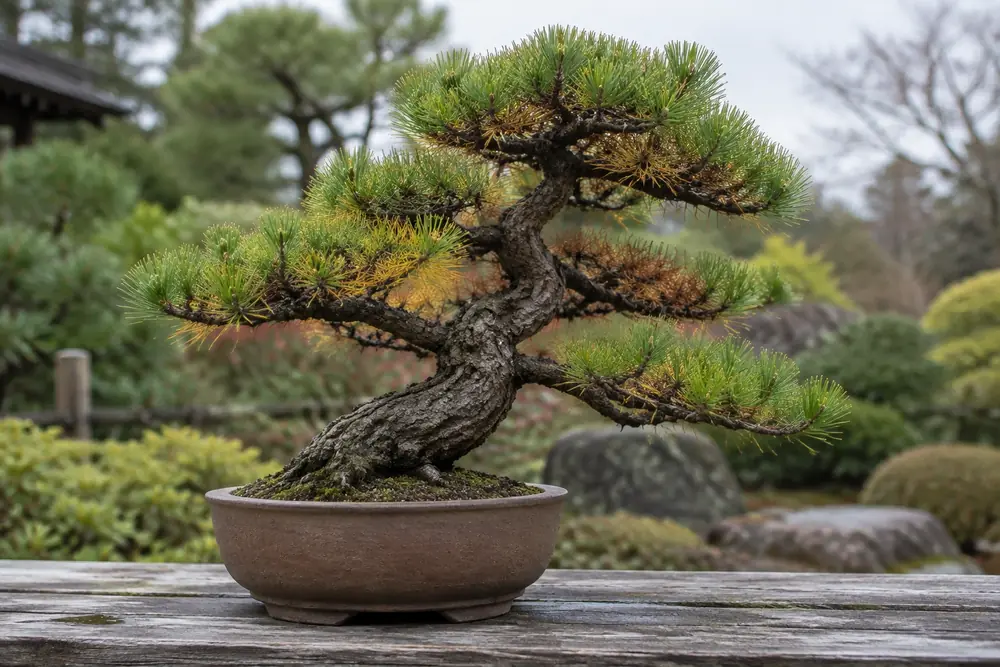
Black pine keeps its needles for about two to three years. Every autumn, the oldest needles, those furthest back from the branch tips, turn yellow and drop. If the yellowing is only on these older, inner needles and the current year’s needles at the tips are green and firm, the tree is healthy.
Real trouble looks different:
| Sign | What it suggests |
|---|---|
| Newest needles at branch tips yellowing or browning | Root problem or severe stress |
| Whole branches turning yellow, then brown | Branch dieback, root loss on that side |
| Needles brown from the tips down on many shoots | Drought, salt build-up or heat damage |
| Spring candles do not extend, or wilt | Weak or damaged roots |
| Needles loose and falling at a touch | The tree or branch has died |
| Soil always wet, green with algae | Overwatering or poor drainage |
| Sticky resin or small holes in the bark | Possible bark beetles or borers |
Is it still alive?
- Check the buds. Healthy buds at the branch tips are firm and plump. Dry, hollow or loose buds are dead.
- Scratch test. Scratch a tiny area of bark on a branch. Moist, green tissue underneath means alive; brown and dry means dead.
- Look at the roots. Ease the tree out of its pot. Healthy pine roots are firm and light-colored, often with white fungal threads (mycorrhiza) through the soil, a good sign. Black, mushy roots with a sour smell mean rot.
Common causes of a black pine bonsai dying
Kept indoors
This is the single biggest cause of dead black pines, especially those sold as “indoor bonsai”. Japanese black pine needs full sun and a cold winter rest. Indoors, it weakens steadily over a few months, then the needles yellow and drop. The Wikipedia page on Pinus thunbergii describes a tough, sun-loving coastal tree, which tells you everything about where it wants to live. Our guide to types of outdoor bonsai trees lists other species in the same group.
Wet roots and poor drainage
Pines hate wet feet. Dense soil, a pot without enough drainage, or watering on a fixed schedule all keep roots soggy, and they rot. Our guide to root rot in bonsai explains the symptoms.
Drought
A small pot in full summer sun can dry out in hours. One very dry day can kill fine roots. Needles then brown from the tips over the next few weeks.
Heavy work on a weak tree
Decandling, heavy pruning or repotting a pine that is already weak can push it over the edge. Black pine should be strong before any heavy work.
Pests and disease
Pine needle scale, aphids, adelgids and fungal needle blights can all weaken a pine. In some regions, the pine wood nematode causes pine wilt disease, which kills Japanese black pines quickly. Inspect needles and bark regularly. Our guide to aphids on bonsai trees covers one common pest.
How to save a dying Japanese black pine bonsai
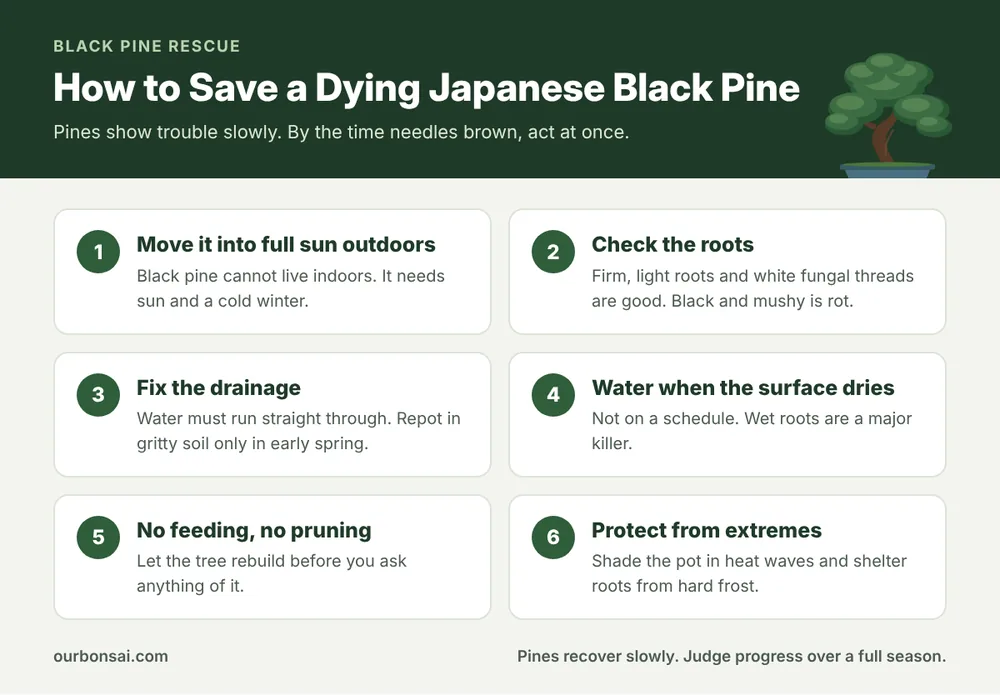
Step 1: Put it outdoors in full sun
If it has been indoors, move it outside to a sunny, sheltered spot. In summer, introduce strong afternoon sun gradually over a week or two. In winter, put it outside in a spot protected from hard frost and wind, not straight into deep freeze.
Step 2: Check and fix the roots
If the soil is soggy and roots are rotting, the safest emergency step outside spring is to improve drainage without disturbing the roots: tilt the pot to drain, remove any saucer, and keep the tree out of prolonged rain. A full repot into gritty soil is best done in early spring, just as the buds extend. Our guide to the best soil for Japanese black pine bonsai explains the mix.
Step 3: Water carefully
Water only when the top 1 to 2 cm of soil is dry, then soak the pot. Do not follow a fixed schedule.
Step 4: Stop all work
No decandling, no pruning, no wiring and no repotting (except emergency spring repotting for rot) until the tree shows strong new candles.
Step 5: Feed only once it grows
Once healthy new candles appear, feed lightly with an organic bonsai fertilizer. Our bonsai fertilizer pellets or liquid guide compares options, or browse organic bonsai fertilizer cakes.
Step 6: Protect from extremes
Shade the pot (not the needles) during heat waves, and in winter protect the roots from hard freezing by sinking the pot in mulch or putting it in an unheated shed or cold frame during the coldest spells.
How long does a black pine take to recover?
Pines recover slowly. A weakened black pine may take a full growing season, sometimes two, to rebuild. Judge progress by the strength of next spring’s candles. Strong, upright candles mean the roots are working again.
During that recovery year, let the tree grow freely. Allow the candles to extend fully without decandling, and leave all healthy needles on, even old ones, because every needle is making food for the roots. Keep it in full sun, water by checking the soil, and start light feeding once new growth appears. Only when the tree pushes vigorous candles across the whole canopy is it ready to go back to the normal pruning cycle. Rushing that step is the most common reason a recovering pine relapses.
FAQ: japanese black pine bonsai dying
Why is my black pine turning yellow in autumn?
If only the oldest, inner needles are yellowing, it is normal seasonal needle shed. If new needles at the tips yellow too, check the roots and watering.
Can a black pine bonsai live indoors?
No. It needs full sun and a cold winter outdoors. Indoors it slowly declines and dies.
Can a brown pine come back?
If the needles are brown and loose all over and the buds are dry, the tree is dead. If some needles and buds are still green, there is hope.
Should I cut off brown branches?
Wait until the tree shows new growth so you know what is dead. Then cut back dead branches in late autumn.
Final thoughts
A Japanese black pine bonsai dying is most often caused by being kept indoors, wet roots, drought or heavy work on a weak tree. Get it outside into full sun, fix the drainage, water carefully and stop all styling work until it is strong again. Pines are slow to recover, but a tree with healthy buds and some green needles can come back to full strength. Our loblolly pine bonsai care guide covers similar needs for another pine species.