Best Soil for Schefflera Bonsai: Mix Recipe and Ratios

This post contains affiliate links. As an Amazon Associate, OurBonsai earns from qualifying purchases at no extra cost to you. Read our disclosure.
In this guide
- What schefflera roots need
- Best soil mix for schefflera bonsai: recipes
- The ingredients
- Why regular potting soil is a problem
- Particle size
- Indoor vs outdoor schefflera
- Ready-made soil options
- How to repot a schefflera into new soil
- Signs your schefflera needs new soil
- Common mistakes
- FAQ: best soil for schefflera bonsai
- Final thoughts
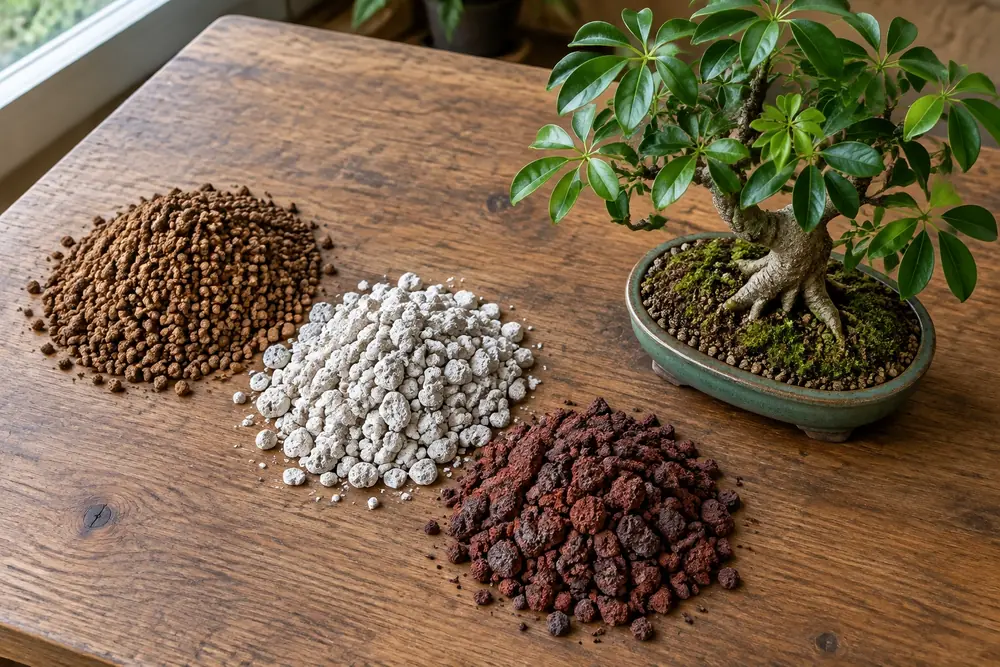
The best soil for schefflera bonsai is a fast-draining, gritty mix that still holds a little water, such as equal parts akadama, pumice and lava rock. Dwarf schefflera (Schefflera arboricola) likes steady moisture, but its thick roots rot quickly if they sit in wet, airless soil. A gritty mix lets you water thoroughly, drains in seconds and keeps air around the roots. Avoid plain potting compost or garden soil, which stay soggy and compact in a bonsai pot.
This guide gives you simple mix recipes, explains each ingredient and shows how to repot a schefflera into fresh soil.
What schefflera roots need
Dwarf schefflera is a tropical tree from Taiwan and Hainan. The Wikipedia article on Schefflera arboricola notes that it often grows as an epiphyte or on rocky ground in the wild, with roots exposed to air. In a bonsai pot, it needs three things from its soil:
- Drainage. Water should run straight through and out of the drainage holes.
- Air. Roots need oxygen. Gaps between particles provide it.
- Some water holding. Schefflera does not like to dry out completely, so the mix should hold moisture inside its particles.
A gritty bonsai mix gives all three. Our dwarf schefflera bonsai care guide covers the rest of its needs.
Best soil mix for schefflera bonsai: recipes
| Mix | Ratio | Best for |
|---|---|---|
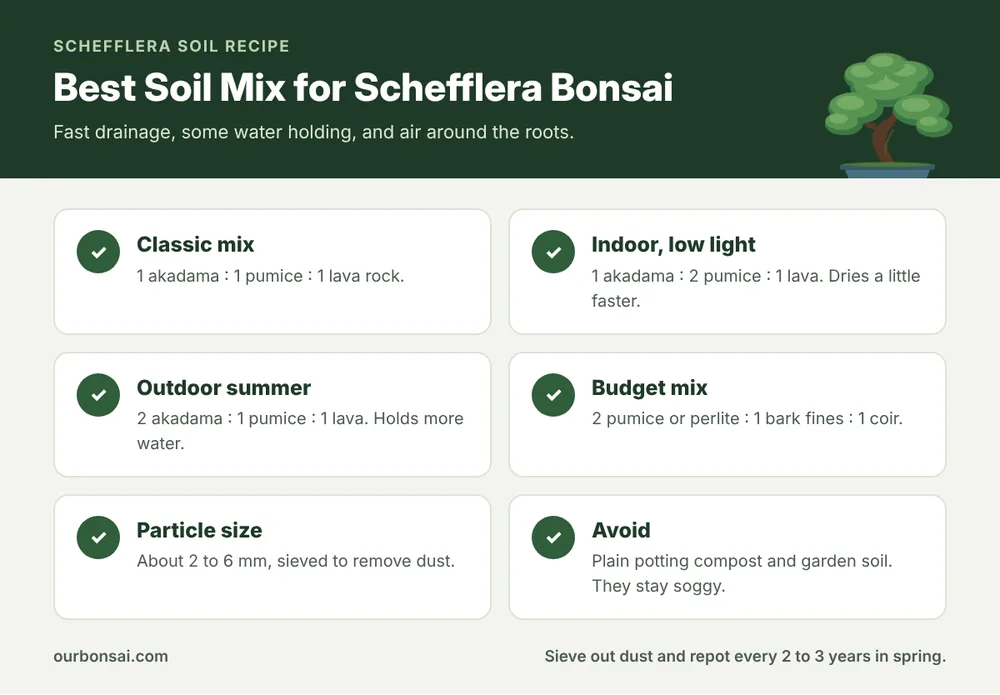
| Classic | 1 akadama : 1 pumice : 1 lava rock | Most schefflera, indoors or out |
| Indoor, low light | 1 akadama : 2 pumice : 1 lava rock | Trees in dim rooms that dry slowly |
| Outdoor summer | 2 akadama : 1 pumice : 1 lava rock | Trees in full sun, hot climates |
| Budget | 2 pumice or perlite : 1 fine bark : 1 coir | When akadama is not available |
| Inorganic only | 1 pumice : 1 lava rock : 1 calcined clay | Growers who overwater |
The classic mix is a safe starting point. Adjust it based on how fast your tree dries. If the soil is still wet four or five days after watering, add more pumice. If it dries out in a day, add more akadama. Our guide to the bonsai soil mix ratio explains how to tune any mix.
The ingredients
Akadama
A Japanese clay that holds water and nutrients inside each granule while leaving air gaps between them. It slowly breaks down over two to three years, which is one reason to repot regularly.
Pumice
A light volcanic rock full of tiny pores. It holds some water, drains very well and does not break down. It is the most useful ingredient for preventing soggy roots.
Lava rock
A heavier, rough volcanic rock. It adds structure, drainage and grip for fine roots. It holds less water than pumice.
Organic options
Fine pine bark and coir hold water well and are cheap. A small amount is fine for schefflera, but too much organic matter breaks down into mud in a few years. Keep it to a third of the mix or less.
Calcined clay
Products sold as soil conditioners or some cat litters are fired clay granules. They work like a cheaper akadama but do not break down. Our guide on the best cat litter for bonsai soil explains which ones are safe.
Why regular potting soil is a problem
Bagged potting compost is made for large pots where water can drain over a deep column of soil. In a shallow bonsai pot it:
- stays wet for days after watering,
- packs down and squeezes out air,
- breaks down quickly and blocks drainage holes.
The result is often yellow leaves, leaf drop and root rot in bonsai. Many mall-bought schefflera come in this kind of soil. Our guide to bonsai soil vs regular soil explains the difference in more detail.
Particle size
- Small trees and shallow pots: 2 to 4 mm particles.
- Medium and large trees: 3 to 6 mm particles.
- Bottom drainage layer (optional): a thin layer of 6 to 9 mm particles.
Always sieve out dust before using the mix. Dust fills the air gaps and makes even good ingredients behave like mud.
Indoor vs outdoor schefflera
Most schefflera bonsai live indoors. Indoors, light is lower and the soil dries more slowly, so a slightly more open mix with more pumice helps prevent overwatering. Outdoors in summer, a tree in full sun dries much faster, and a little more akadama or organic matter helps it get through hot afternoons.
If your tree spends summer outside and winter indoors, the classic mix works for both. Just water less often in winter. Our guide on watering indoor bonsai in winter explains the slower routine.
Ready-made soil options
If you do not want to mix your own, a pre-mixed bonsai soil labeled for tropical or indoor bonsai works well. Look for:
- mostly inorganic particles, such as akadama, pumice and lava,
- no fine peat or dust,
- particles of a similar size.
Our guide to good potting soil for bonsai compares ready blends. You can also search for bonsai soil for indoor trees on Amazon.
How to repot a schefflera into new soil
- Pick the right time. Late spring or early summer, when the tree is growing strongly. Our guide to the best time to repot tropical bonsai has more detail.
- Prepare the soil. Mix and sieve your ingredients. Lightly moisten them.
- Remove the tree. Ease it out of the pot and gently comb out the old soil with a chopstick.
- Trim the roots. Remove dark, mushy or circling roots. Schefflera tolerates fairly heavy root pruning when healthy, but remove no more than a third.
- Pot it up. Add a thin layer of coarse soil, set the tree, then fill around the roots, working soil into gaps with a chopstick.
- Water thoroughly until water runs clear from the drainage holes.
- Aftercare. Keep it in bright, indirect light for two weeks and hold off on fertilizer for about a month.
Repot young trees every two years and older trees every two to three years, or when water starts to drain slowly.
Signs your schefflera needs new soil
- Water sits on the surface or drains slowly.
- The soil stays wet for many days.
- Roots circle the pot or grow out of the drainage holes.
- Leaves yellow or drop even though watering seems right.
- The soil looks fine and muddy, with few visible granules.
Common mistakes
- Leaving a new tree in mall soil for years. Repot into a gritty mix the next spring or summer.
- Using garden soil. It compacts and stays wet.
- Skipping the sieve. Dust ruins drainage.
- Using too much bark or coir. It breaks down into mud.
- Repotting in winter. Roots regrow slowly in cool, dark months.
FAQ: best soil for schefflera bonsai
What is the best soil for schefflera bonsai?
A gritty mix of equal parts akadama, pumice and lava rock works well for most trees.
Can I use regular potting soil for a schefflera bonsai?
It is not ideal. It stays too wet in a shallow pot. If you must use it, mix it with at least an equal amount of pumice or perlite.
Does schefflera like acidic soil?
It prefers slightly acidic to neutral soil, but it is not fussy. A standard bonsai mix suits it.
How often should I change schefflera bonsai soil?
Every two to three years, or sooner if the soil breaks down and drains slowly.
Can schefflera grow in pure akadama?
Yes, but pure akadama holds a lot of water and breaks down over time. Mixing in pumice and lava gives better drainage and a longer-lasting mix.
Final thoughts
The best soil for schefflera bonsai is gritty and fast draining but still holds a little water. Start with equal parts akadama, pumice and lava rock, sieve out the dust and adjust the ratio to match how fast your tree dries. Repot into fresh mix every two to three years in late spring or early summer, and your schefflera will reward you with firm roots and glossy leaves.