Roots Out of Bonsai Pot Drainage Holes: What It Means

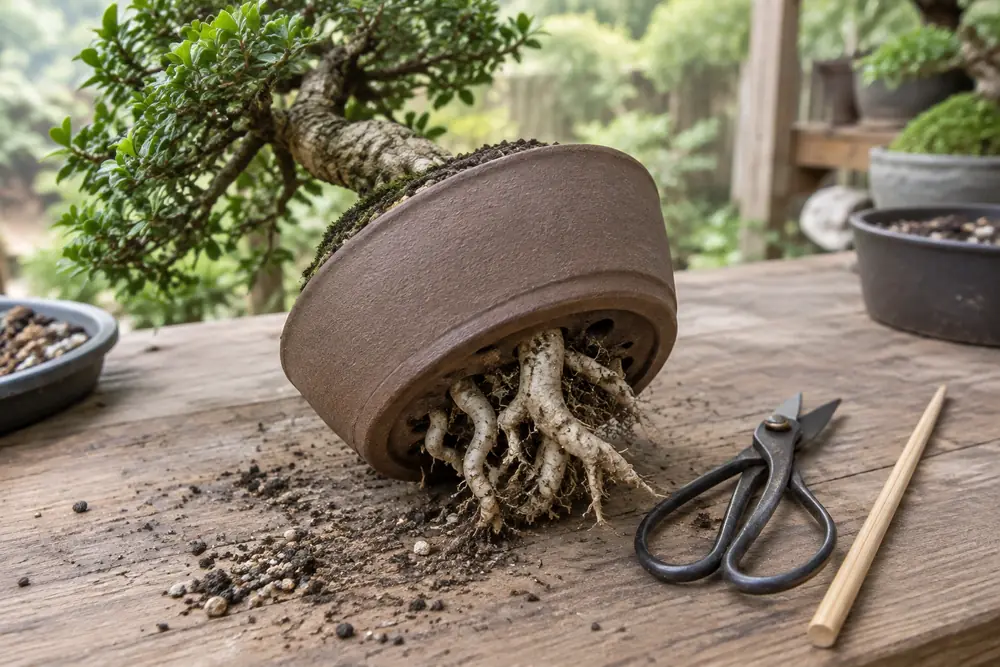
Seeing roots out of bonsai pot drainage holes is a clear message from your tree: either it has filled its pot and needs repotting, or it has found soil, gravel or a damp surface below the pot and grown into it. It is not an emergency. You can usually trim the escaped roots flush with the pot and plan a repot for the right season. The main risks are blocked drainage, which keeps the soil too wet, and roots that anchor into the ground and tear when you move the pot.
In this guide
This guide explains why roots escape, what to do now and how to repot safely.
Why roots grow out of a bonsai pot
| Cause | Signs | What it means |
|---|---|---|
| Root bound pot | Roots circle inside, water drains slowly or runs off the surface | Pot is full, repotting is due |
| Pot sitting on soil or gravel | Thick roots go down into the ground | Roots found a better source of water |
| Pot on a damp surface or tray | Fine roots spread under the pot | Roots chase moisture |
| Young, vigorous tree | Fast-growing species in a small pot | Normal growth, repot sooner |
| Missing or torn mesh | Roots pass easily through the holes | Replace mesh at the next repot |
Bonsai pots are small by design, and roots naturally grow toward the edges and bottom. As the Wikipedia article on bonsai cultivation and care explains, regular repotting and root pruning are what keep a tree healthy in such a small container. Once they reach the holes, the easiest path is straight out.
Is it harmful?
Not directly. Escaped roots are healthy roots. But they can cause problems:
- Blocked drainage. A mat of roots in the holes slows drainage, so the soil stays wet and roots can rot. See our guide to root rot in bonsai.
- Anchoring. Roots growing into the ground can become thick and woody. When you lift the pot, they tear and the tree loses a large part of its water supply.
- Uneven growth. Some trees grow strongly from roots in the ground, which thickens branches and coarsens the design.
- Root bound stress. If the pot is completely full, water and air cannot reach the roots well, and the tree may show yellow leaves or weak growth.
What to do right now
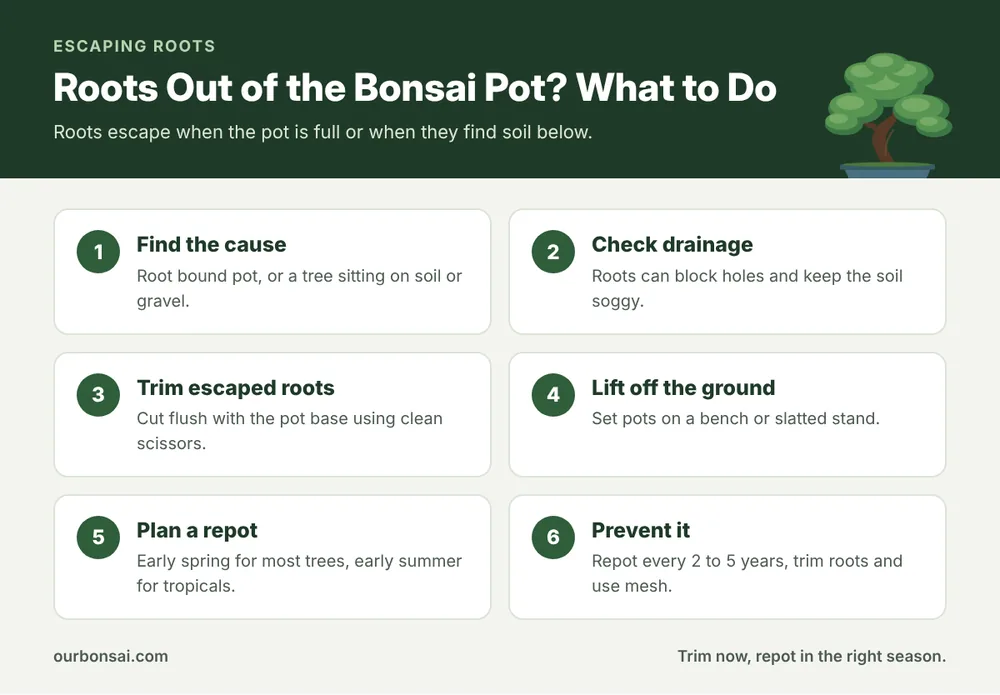
- Check the cause. Tilt the pot and look underneath. Is the pot on soil or gravel? Are there thick roots or just fine ones?
- Trim escaped roots. Cut them flush with the pot base using sharp, clean scissors. Our guide to the best bonsai repotting tools shows good root scissors.
- Free anchored roots carefully. If thick roots have grown into the ground, do not just yank the pot. Cut them below the pot first, then lift. If they are very thick, reduce them in stages over a few weeks.
- Check drainage. Water and watch how fast it drains. If it pools on the surface or drains slowly, repotting is a priority.
- Lift the pot. Set it on a bench, a stand or a slatted surface so roots do not find soil.
- Plan a repot for the right season.
When to repot
Trimming escaped roots is fine at any time of year. Full repotting is best done at the right season for the species:
| Tree type | Best time to repot |
|---|---|
| Deciduous (maples, elms) | Early spring, as buds swell |
| Conifers (pines, junipers) | Early to mid spring |
| Flowering trees (azalea) | After flowering |
| Tropical (ficus, schefflera, jade) | Late spring to early summer |
Our guides to the best time to repot tropical bonsai and repotting bonsai in autumn explain the timing in more detail.
If the tree is badly root bound and drainage is very poor in the growing season, you can do a gentle “slip pot”: move the whole root ball into a slightly larger pot with fresh soil around it, without disturbing the roots, and do a proper repot the next season.
How to repot a root bound bonsai
- Prepare. Have fresh bonsai soil, mesh, wire, a chopstick, root scissors and a root hook ready.
- Cut the tie wires and the escaped roots under the pot.
- Remove the tree. Run a knife or thin saw around the inside edge if the root ball is stuck.
- Comb out the roots. Work from the outside in with a root hook or chopstick, untangling circling roots and removing old soil.
- Trim the roots. Remove circling, thick and dead roots. Reduce the root mass by up to a third for healthy trees.
- Prepare the pot. Fix fresh mesh over the drainage holes and thread tie wires.
- Pot the tree. Add a thin layer of soil, set the tree, tie it in and fill with soil, working it in with a chopstick.
- Water thoroughly until water runs clear.
- Aftercare. Keep the tree out of strong sun and wind for two to three weeks and do not feed for about a month.
Use a gritty, free-draining mix. Our guide to the bonsai soil mix ratio explains good recipes, and bonsai repotting wire covers tying in.
Roots growing out of the top of the soil
Sometimes roots also rise above the soil surface. Thick surface roots spreading from the trunk are a desired feature called nebari. But a mat of fine roots on the surface, or roots lifting the tree out of the pot, usually means the pot is full. The fix is the same: repot at the right season.
How to prevent roots escaping
- Repot regularly. Young trees every two years, older trees every three to five years.
- Use mesh over the drainage holes and replace it when torn.
- Keep pots off the ground on benches, stands or slatted surfaces.
- Do not leave pots in saucers of water.
- Check underneath a few times a year by tilting the pot.
Using escaping roots on purpose
Some growers deliberately let a tree in a training pot or growing box root into the ground for a season. This speeds up trunk and branch thickening. It works only for trees in development, not for finished bonsai, and the roots must be cut back in stages before the tree is lifted.
Common mistakes
- Yanking a pot that has rooted into the ground. Cut the roots first.
- Repotting heavily in the wrong season because of escaped roots. Trim now, repot later.
- Ignoring slow drainage. It leads to root rot.
- Putting the tree in a much bigger, deeper pot. Bonsai pots should stay shallow. Prune the roots instead.
FAQ: roots out of bonsai pot
Should I cut roots growing out of my bonsai pot?
Yes. Cut them flush with the pot base with clean scissors. It does not harm a healthy tree.
Does roots coming out of the drainage holes mean I need to repot?
Usually, yes. It often means the pot is full. Plan a repot for the right season.
Can I repot a root bound bonsai in summer?
Tropical trees can be repotted in early summer. For most other trees, wait until spring, or do a gentle slip pot without root pruning.
How often should a bonsai be repotted?
Young, fast-growing trees every one to two years, older trees every three to five years.
Will cutting escaped roots hurt my bonsai?
No. They are a small part of the root system. Just avoid cutting very thick roots all at once.
Final thoughts
Roots out of bonsai pot drainage holes mean your tree is growing well but running out of room, or has found soil below. Trim the escaped roots, lift the pot off the ground and check that water drains freely. Then plan a proper repot at the right time of year with fresh, gritty soil. For general care, see our main bonsai care guide.