Bonsai Care January Checklist: Monthly Tasks Week by Week

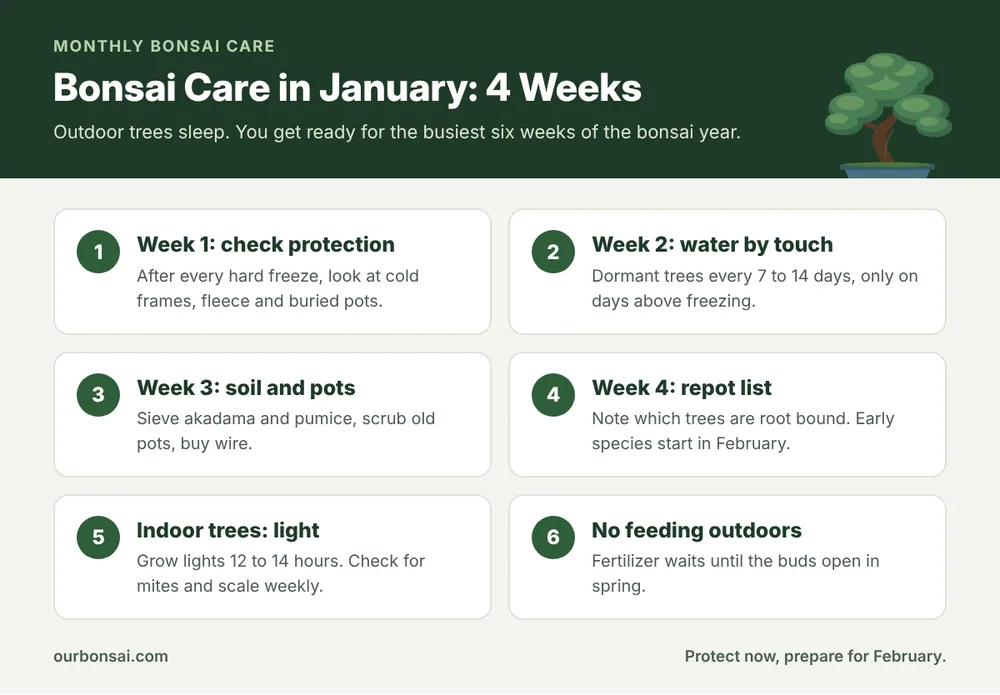
Bonsai care January jobs in the Northern Hemisphere are mostly about protection and preparation: check winter shelters after every hard freeze, water dormant outdoor trees only when the soil dries (usually every 7 to 14 days), give indoor tropical trees 12 to 14 hours of light, and use the quiet weeks to sieve soil, clean pots and write a repotting list. Fertilizer stays off outdoor trees. January is usually the coldest month, so most damage that shows up in spring actually happens now.
In this guide
- Week 1: inspect every tree after a hard freeze
- Week 2: water by touch, not by calendar
- Week 3: get soil, pots and tools ready
- Week 4: plan which trees to repot
- Bonsai care January tasks for indoor trees
- Late January in mild climates
- If you live in the Southern Hemisphere
- Frequently asked questions
- Final thoughts
Week 1: inspect every tree after a hard freeze
A clear, still night in January can drop well below the forecast. The morning after, walk round the collection:
- Cold frames: is the lid closed and intact? Is the min-max thermometer showing a low below about -5 C (23 F) inside? If so, add fleece or bubble wrap over the lid at night.
- Buried or mulched pots: has wind or a cat pulled mulch away from the edges?
- Pots on benches: anything left out in the open that should be sheltered? Small shohin pots freeze through first.
- Snow load: brush heavy wet snow off wired branches and junipers. Light dry snow can stay; it insulates.
- Rodent damage: look for gnawed bark near the soil line in sheds and garages.
If a pot did freeze solid, do not rush it into a warm room. Move it into an unheated garage so it thaws slowly over a day or two.
Week 2: water by touch, not by calendar
Cold soil dries very slowly. A pot that needed watering every day in July might stay damp for two weeks now, especially if it is sheltered from sun and wind. On the other hand, trees under eaves or inside a cold frame get no rain at all.
Test with a chopstick pushed 3 cm into the soil. Water when it comes out dry, on a morning above 0 C, so excess drains before night. Evergreens like juniper and pine keep losing a little water through their needles on bright days, so check them first.
Week 3: get soil, pots and tools ready
February and March are the main repotting months for deciduous trees, and buds can move fast in a mild spell. Everything you need should be ready before then.
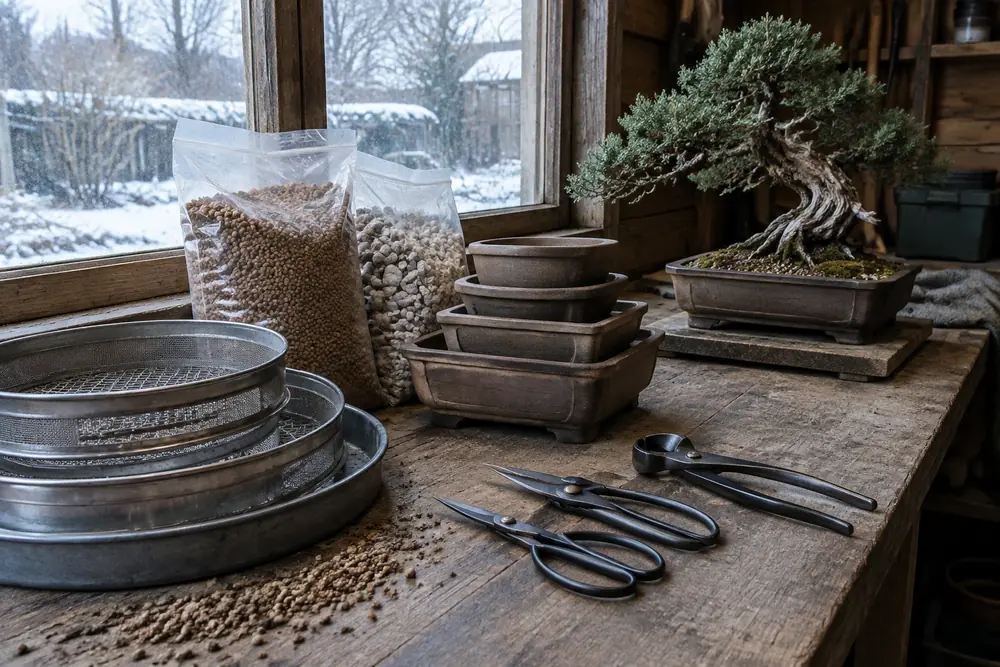
Soil. Sieve akadama, pumice and lava rock to remove dust, which clogs drainage. Keep the 2 to 6 mm particles for medium trees and 1 to 3 mm for small ones. Our guide to the bonsai soil mix ratio explains how much of each to use for deciduous, conifer and tropical trees.
Pots. Scrub old pots with a stiff brush and hot water, then let them dry. Cut drainage mesh squares and pre-cut tie-in wire.
Tools. Sharpen and oil scissors, concave cutters and root hooks. A clean, sharp blade makes cleaner root cuts that heal faster. If your kit needs updating, our list of the best bonsai repotting tools covers what you actually use.
Week 4: plan which trees to repot
Walk round with a notebook. For each tree, ask:
- Did water run through the soil slowly last summer? That points to compacted soil or a pot full of roots.
- When was it last repotted? Young deciduous trees usually need it every 2 to 3 years, older conifers every 3 to 5.
- Is it healthy enough? Weak trees should not be repotted the same year they are heavily pruned.
Then sort the list by species. Trident maple, Chinese elm and other early starters can go as soon as buds swell, which in mild areas is late February. Pines and junipers come later, usually March to April. Tropical species wait until late spring when nights stay above about 15 C.
| Tree group | What to do in January | Next big job |
|---|---|---|
| Deciduous outdoor | Protect roots, water rarely, structural pruning plan | Repot as buds swell, Feb to Mar |
| Conifers outdoor | Light, wind shelter, water a bit more often | Repot Mar to Apr |
| Tropical indoor | Light, humidity, pest checks, monthly feed if growing | Repot late spring |
| Subtropical in cool room | Bright and cool, dry side of moist | Repot spring |
Bonsai care January tasks for indoor trees
January days are short, and heated rooms are dry. If your ficus or schefflera has long pale shoots and big gaps between leaves, it needs more light. A full-spectrum LED 20 to 30 cm above the tree on a 12 to 14 hour timer is the simplest fix. Our article on how much light a bonsai tree needs gives the numbers.
Check for pests once a week. Spider mites leave fine webbing and speckled leaves. Scale looks like small brown bumps on stems. Catching them in January saves a full outbreak by March. Our step-by-step pest treatment guide starts with the mildest options.
Late January in mild climates
In USDA zone 8 and warmer, buds on early species can begin to swell by the end of the month. If you see trident maple or elm buds turning plump and showing color at the tips, the tree is waking. That is the signal to repot, not the calendar date. Keep fleece handy, because freshly repotted trees are more sensitive to frost for a few weeks.
If you live in the Southern Hemisphere
January is midsummer in Australia, New Zealand and South Africa. The jobs are almost the reverse: water daily or twice daily in heat, use 30 to 50 percent shade cloth in the afternoon, keep feeding growing trees, and pinch new shoots. Our guide to watering bonsai in summer covers that season.
Frequently asked questions
Can I repot bonsai in January?
Usually too early for most outdoor trees in temperate climates, because roots stay cold and wet for weeks after. In mild areas, late January can work for early starters like trident maple once the buds visibly swell.
How often should I water bonsai in January?
Outdoor dormant trees typically every 7 to 14 days, indoor tropical trees every 3 to 7 days. Always check the soil first.
Is January a good month for wiring?
Light wiring of deciduous trees is possible because you can see every branch, but wood is more brittle when cold. Work on mild days and bend gently.
Should I bring my outdoor bonsai inside during a January cold snap?
Only into an unheated space like a garage or shed. A warm house breaks dormancy and harms hardy species.
Final thoughts
January bonsai care is quiet but it sets up the whole year. Keep roots safe, water with care, and spend the cold evenings getting soil, pots and tools ready. For the year-round fundamentals see our bonsai care hub, and for background on how growers handle the seasons, the Wikipedia page on bonsai cultivation and care is well referenced.