Bonsai Pest vs Disease: What Is the Difference?
Your bonsai suddenly has yellow leaves, brown spots, weak growth, or dying branches. Is an insect feeding on it, is a disease spreading through the tree, or is the tree simply stressed by poor growing conditions?
Understanding bonsai pest vs disease: what is the difference? matters because the wrong diagnosis often leads to the wrong treatment. Spraying an insecticide will not fix a fungal infection, and applying fungicide will not solve spider mites or scale.
This guide explains how pests and diseases differ, the warning signs of each, how to inspect your bonsai, and when treatment or expert help is appropriate.
Quick Answer
A bonsai pest is usually an insect, mite, or other organism that physically feeds on or damages the tree. A bonsai disease is generally caused by a pathogen such as a fungus, bacterium, virus, or oomycete. However, watering problems, poor light, heat, and root stress can imitate both pests and diseases.
Bonsai Pest vs Disease: The Main Difference
For everyday bonsai care, the easiest distinction is this:
A pest is something attacking the tree. A disease is an infection or disease process occurring within or on the tree.
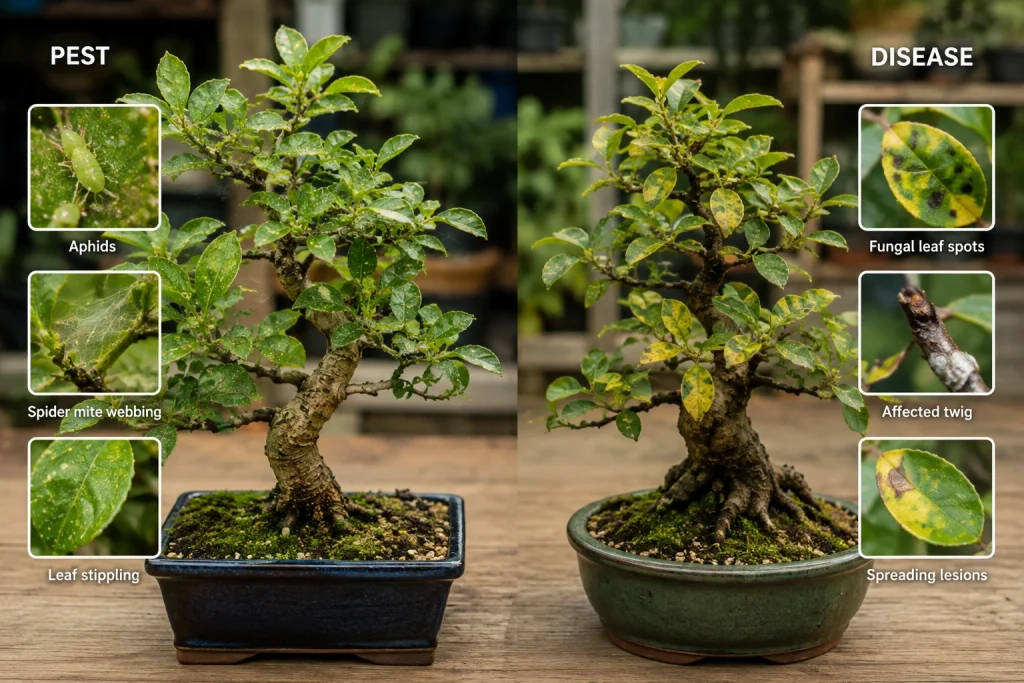
Common bonsai pests include:
- Aphids
- Spider mites
- Scale insects
- Mealybugs
- Whiteflies
- Caterpillars
- Fungus gnats
- Certain beetles and borers
Common bonsai diseases include:
- Powdery mildew
- Fungal leaf spots
- Rust
- Cankers
- Bacterial leaf spots
- Some forms of root rot
- Viral diseases
There is one important complication: horticulturists sometimes use the word pest broadly enough to include disease-causing organisms. In this article, however, “pest” refers mainly to insects, mites, and similar animals because that is how most bonsai owners use the term.
A third category is equally important: nonliving or abiotic stress. Too much water, too little water, fertilizer burn, heat, frost, poor light, root damage, and unsuitable soil can produce symptoms that resemble pests or diseases. UC Integrated Pest Management recommends considering both living and nonliving causes when diagnosing an unhealthy plant. (UC IPM)
| Problem | Typical Cause | Common Clues | First Response |
|---|---|---|---|
| Pest | Insect, mite, larva, or similar organism | Insects, webbing, sticky residue, chewing, stippling | Isolate and identify pest |
| Disease | Fungus, bacterium, virus, oomycete, or other pathogen | Spots, lesions, cankers, mold, rotting tissue | Identify disease and improve conditions |
| Abiotic stress | Water, light, temperature, fertilizer, roots, chemicals | General yellowing, scorching, wilt, weak growth | Correct the growing condition |
| Mixed problem | Stress plus pest or disease | Several symptoms occurring together | Treat the underlying stress and confirmed cause |
How to Recognize a Bonsai Pest Problem
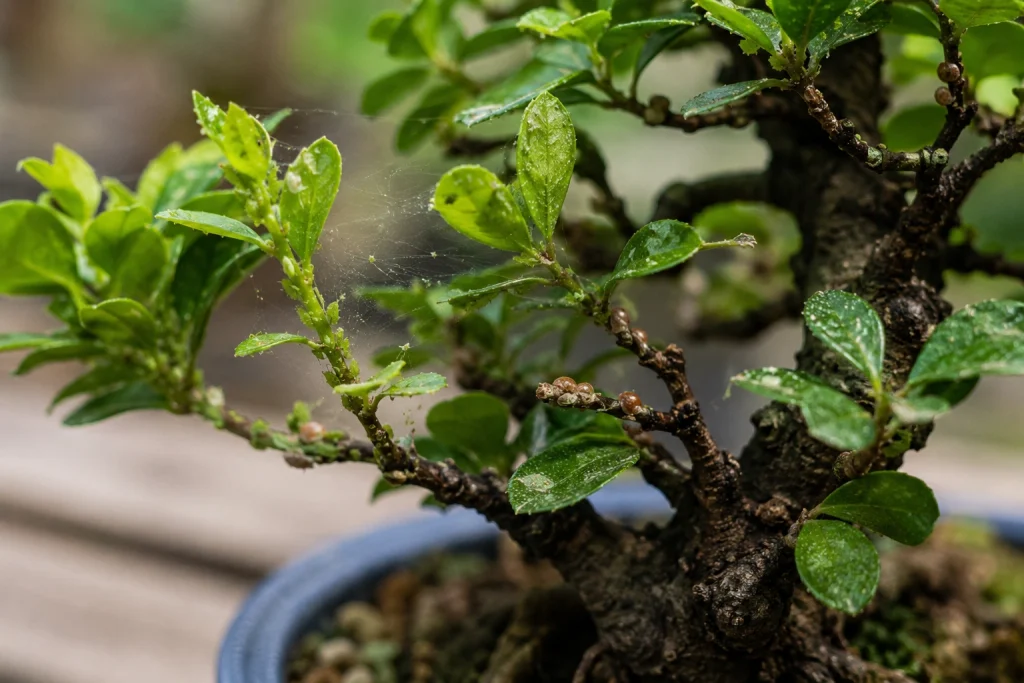
Pest damage often gives you physical evidence that something is feeding on the tree.
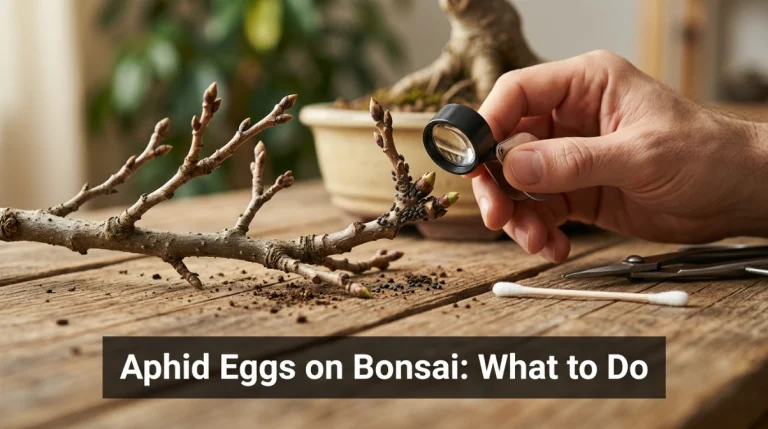
Look carefully at the leaves, stems, branch junctions, bark, and soil surface. A hand lens can be useful because mites and young scale insects can be difficult to see with the naked eye.
Visible Insects or Eggs
Finding insects is the strongest clue.
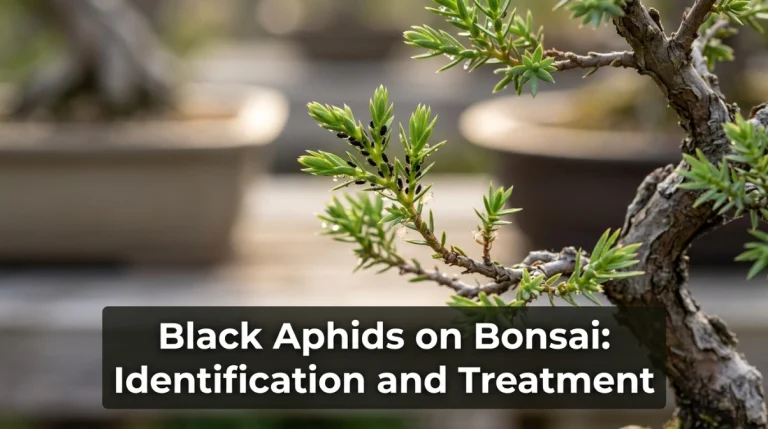
Aphids commonly gather on tender new shoots. Mealybugs may appear as white, cottony clusters. Scale can look more like tiny brown or pale bumps attached to stems than recognizable insects.
Do not assume every insect on your bonsai is harmful. Some insects are harmless visitors or beneficial predators, so identification is important before treatment.
Sticky Leaves or Surfaces
Aphids, scale, mealybugs, and some other sap-feeding insects can produce a sugary substance called honeydew.
You may notice:
- Sticky leaves
- Shiny residue
- Sticky shelves or benches beneath the bonsai
- Dark sooty growth developing on the residue
The dark coating may look like a primary disease, but it can develop because honeydew created favorable conditions for sooty mold.
Webbing and Fine Leaf Stippling
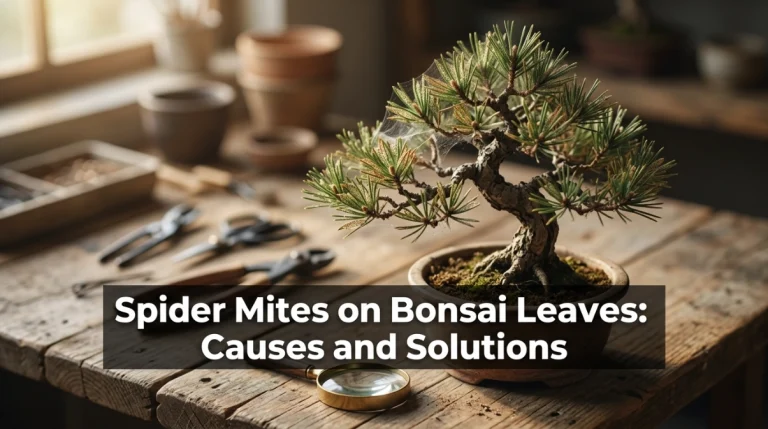
Very fine webbing between leaves or twigs can suggest spider mites.
Another clue is stippling—many tiny pale dots appearing across a leaf because mites have damaged individual plant cells.
Spider mites can multiply rapidly under favorable conditions, so inspect nearby plants as well.
Chewed or Skeletonized Leaves
Irregular holes, missing leaf edges, or leaves eaten down between the veins are more consistent with chewing pests than with most diseases.
Inspect the underside of foliage and nearby branches for caterpillars, beetles, larvae, or droppings.
How to Recognize a Bonsai Disease
Diseases can be harder to diagnose because the organism responsible may be microscopic.
Instead of finding an insect, you often find a pattern of damaged tissue.
According to the University of Minnesota Extension plant disease guidance, plant disease symptoms can include leaf spots, rot, wilting, and unusual growth or coloration. (University of Minnesota Extension)
Spots That Expand or Spread
Fungal and bacterial diseases can produce brown, black, yellow, or water-soaked spots.
Watch whether spots:
- Increase in size
- Develop defined margins
- Appear repeatedly on new leaves
- Spread through one section of the canopy
- Cause affected tissue to die
Fungal leaf spots can vary considerably in appearance, while bacterial lesions may initially appear water-soaked before becoming darker. (UC IPM)
Powdery or Fuzzy Growth
A white or gray coating that looks like powder can indicate powdery mildew or another fungal problem.
Fuzzy fungal growth around dying leaves, branches, or soil should also receive attention, although harmless fungi can occasionally grow on organic material without directly infecting the bonsai.
Do not diagnose a disease based on color alone. Look at the entire pattern and the condition of the tree.
Cankers and Dead Bark
A canker is a localized area of dead or damaged bark on a stem or branch.
It may appear sunken, cracked, discolored, or swollen around its edges. Some fungal and bacterial pathogens can cause cankers, but physical injury and other stressors may create similar-looking wounds.
Root and Crown Problems
Root diseases are particularly serious because bonsai trees have limited root volume.
Warning signs can include:
- Persistent wilting despite wet soil
- Rapid decline
- Dark or decaying roots
- Soft tissue around the root crown
- Unpleasant odor from badly decomposed roots
- Weak new growth
However, wet soil does not automatically mean infectious root rot. Overwatering can deprive roots of oxygen and kill them even without a primary pathogen. Damaged roots may then become more vulnerable to disease.
Pest, Disease, or Stress? How to Tell
This is where many beginners make mistakes.
Yellow leaves alone cannot tell you what is wrong. Neither can wilting or leaf drop.
Penn State Extension notes that plant symptoms are the plant’s response to damage, while diagnosis requires investigating the cause behind those symptoms. (Penn State Extension)
Use a simple process instead.
1. Check the Whole Tree
Do not focus only on the worst leaf.
Look at:
- New growth
- Older foliage
- Undersides of leaves
- Branch tips
- Trunk and bark
- Soil surface
- Drainage holes
Ask whether the damage is localized or affects almost the entire bonsai.
2. Look for Physical Evidence of Pests
Use bright light and, if possible, a magnifying lens.
Search for insects, eggs, webbing, sticky residue, shells, cottony material, feeding damage, or insect waste.
If you find a suspected organism, identify it before reaching for a pesticide. The UC IPM guide to diagnosing plant problems emphasizes matching plant symptoms with likely pest causes rather than relying on one symptom alone. (UC IPM)
3. Look for Disease Patterns
If you find no pests, examine damaged tissue.
Ask:
- Are spots expanding?
- Is there powdery growth?
- Is bark becoming sunken or discolored?
- Are shoots dying progressively?
- Is soft tissue beginning to rot?
- Are similar symptoms appearing on additional leaves?
Photographing the tree every few days can help you determine whether a suspicious patch is actively spreading.
4. Review Recent Bonsai Care
Think about what happened immediately before symptoms appeared.
Did you recently:
- Repot the bonsai?
- Prune heavily?
- Change its location?
- Move an indoor tree outdoors?
- Apply fertilizer?
- Spray a chemical?
- Allow the soil to remain waterlogged?
- Let the root ball become extremely dry?
- Expose it to unexpected frost or intense heat?
If most of the canopy changed quickly after one environmental event, an abiotic problem may be more likely than an infectious disease.
5. Consider the Species
Different bonsai species have different vulnerabilities.
A tropical ficus kept indoors may experience different pest pressures from an outdoor juniper. Deciduous bonsai such as maples can also show natural seasonal changes that inexperienced owners sometimes mistake for disease.
Knowing your species’ normal growth cycle, light requirements, watering needs, and winter behavior makes diagnosis much easier.
Expert Tip: Before treating a bonsai, photograph the damaged leaves, leaf undersides, trunk, soil, and entire tree. Comparing those photos over several days often tells you more than repeatedly changing treatments.
Why Correct Diagnosis Matters
The biggest danger is not simply identifying the problem incorrectly. It is treating the wrong problem while the real one gets worse.
For example, a bonsai with yellow leaves caused by waterlogged soil will not recover because you sprayed an insecticide. Continually adding treatments can increase stress.
Similarly, removing visibly damaged leaves may improve appearance without stopping the pest or pathogen responsible.
Correct diagnosis also saves money. A simple hand lens, clean scissors, good watering practices, and careful observation may be all you need for a small pest outbreak. Buying several insecticides and fungicides “just in case” is rarely a better approach.
Diagnosis quality matters more than product price.
What to Do if Your Bonsai Has Pests
For a minor infestation, start with the least disruptive treatment appropriate for the identified pest.
You may need to:
- Isolate the bonsai from nearby plants.
- Remove heavily infested leaves or small twigs where appropriate.
- Physically remove accessible pests when practical.
- Improve airflow and growing conditions.
- Use an appropriately labeled pest-control product only when necessary.
- Inspect the tree repeatedly for surviving pests or newly hatched young.
Avoid heavy pruning on a severely weakened tree unless removing affected material is essential.
Never assume that a natural or botanical pesticide is automatically harmless. Product concentration, plant species, temperature, exposure, and application method all matter.
When using any pesticide, follow the EPA guidance on reading pesticide labels. Labels explain where a product may be used, how it should be applied, storage requirements, and important precautions for people, pets, and the environment. (US EPA)
What to Do if Your Bonsai Has a Disease
Disease treatment depends heavily on the cause.
General supportive care may include:
- Removing infected fallen leaves
- Improving airflow
- Avoiding unnecessary wetting of foliage
- Cleaning pruning tools
- Reducing persistent soil saturation
- Separating affected plants
- Removing severely diseased tissue when appropriate
A fungicide is not a universal cure for plant disease. It will not correct a bacterial, viral, or purely environmental problem.
Some fungicides work mainly as preventatives, while certain advanced infections may be difficult or impossible to reverse.
Prevention Is Easier Than Treatment
Healthy growing conditions do not make a bonsai immune to pests or disease, but they reduce avoidable stress.
Good prevention includes:
- Inspecting foliage regularly
- Checking newly purchased trees before placing them with a collection
- Watering according to soil moisture rather than a rigid calendar
- Using free-draining soil appropriate for the species
- Providing enough light
- Maintaining airflow
- Cleaning tools between trees when disease is suspected
- Removing dead leaves and debris from pots and benches
- Avoiding excessive nitrogen fertilizer that produces unusually soft growth
- Keeping outdoor species outdoors unless temporary protection is genuinely needed
Frequent inspection is especially valuable because a small scale or aphid colony is much easier to manage than an infestation covering an entire bonsai.
Common Mistakes Bonsai Owners Should Avoid
- Treating yellow leaves automatically as disease. Watering, light, temperature, roots, and seasonal changes may be responsible.
- Spraying before identifying the problem. An insecticide does not cure most diseases, and a fungicide does not eliminate mites.
- Using several chemicals at once. This can make diagnosis harder and may injure already stressed foliage.
- Repotting a weak tree unnecessarily. Root work adds significant stress and should have a clear reason.
- Keeping diseased debris around the pot. Removing affected fallen material can reduce potential sources of reinfection for some diseases.
- Ignoring leaf undersides. Many small pests spend much of their time there.
- Assuming all root problems are fungal. Poor drainage and chronic overwatering can damage roots without a primary pathogen.
- Treating every indoor and outdoor species the same way. Species requirements matter.
- Increasing fertilizer when growth becomes weak. Fertilizer cannot correct dead roots, severe pest damage, or unsuitable light.
- Waiting until most of the canopy is damaged. Early inspection gives you more options.
When to Ask an Experienced Bonsai Grower or Arborist
Some problems are reasonable for beginners to manage. Others deserve a second opinion.
Seek experienced help when:
- A valuable or old bonsai is declining rapidly
- Large branches are dying unexpectedly
- The trunk develops spreading cankers
- Roots or the lower trunk are extensively decayed
- You suspect a serious vascular or systemic disease
- Symptoms continue despite correcting obvious care problems
- Several trees develop similar symptoms
- You cannot identify the pest before selecting a pesticide
- Major root pruning or repotting would be required on an already weak tree
A local plant diagnostic laboratory, university extension service, certified arborist, or experienced bonsai grower may be able to distinguish problems that look almost identical to an inexperienced eye.
This is particularly worthwhile for an expensive specimen. Losing a mature bonsai because of repeated trial-and-error treatments can cost far more than obtaining a reliable diagnosis.
FAQs
Can a bonsai have pests and disease at the same time?
Yes. A stressed bonsai can suffer from more than one problem. Pest feeding may weaken foliage, while poor growing conditions can make the tree less resilient. Diagnose each symptom rather than assuming there is only one cause.
Are yellow bonsai leaves a sign of pests or disease?
They can be, but yellow leaves are not specific enough for a diagnosis. Overwatering, underwatering, root stress, poor light, nutrient problems, seasonal changes, pests, and diseases can all contribute to yellowing.
How do I know if my bonsai has spider mites?
Look for very fine webbing and numerous tiny pale or yellow dots on foliage. Inspect leaf undersides closely with a hand lens because spider mites can be extremely small.
Is root rot a pest or a disease?
It depends on the cause. Certain root rots involve disease-causing organisms, but roots can also die because waterlogged soil lacks enough oxygen. That is why simply seeing dark roots does not prove a pathogen is responsible.
Should I use insecticide or fungicide first?
Neither should be the automatic first choice. Identify the problem first. Use insect-control products for confirmed susceptible pests and appropriate fungicides only for diseases they are specifically labeled to manage.
Should I repot a bonsai that looks sick?
Not automatically. Repotting and root pruning stress the tree. Repot when there is a clear root or soil-related reason and when the species, season, and condition of the tree make the procedure reasonably safe.
Can bonsai diseases spread to other trees?
Some can. Pathogens may spread through infected plant material, splashing water, contaminated tools, soil, or other routes depending on the organism. Isolating a suspicious tree and practicing good sanitation is a sensible precaution while you investigate.
Conclusion
The most useful way to understand bonsai pest vs disease: what is the difference? is to look for the cause rather than focusing on one symptom.
Pests usually leave evidence of feeding: insects, webbing, honeydew, chewing, scale-like bumps, or stippling. Diseases more often produce expanding lesions, abnormal growth, cankers, fungal coatings, or decaying tissue. But watering mistakes, root problems, fertilizer damage, temperature extremes, and other environmental stresses can imitate both.
Inspect first and treat second.
Check the entire tree, look under the leaves, review recent care, consider the species, and watch how symptoms change. Once you know what you are dealing with, choose the least disruptive treatment that actually matches the problem.
Make regular bonsai inspections part of your normal care routine. Catching a pest, disease, or growing-condition problem early gives your tree the best chance to recover while preserving the health and appearance you have worked hard to develop.